Southern Pacific Lines
Coast Line Division
“The Route of the Octopus”

Southern Pacific Lines
Coast Line Division
“The Route of the Octopus”
Company Employees
Obtain copies of Southern Pacific's Annual Reports for those years you're interested in. These typically list key executive positions held within the company including Presidents, VPs, CFOs (Chief Financial Officers), General Counsel etc. of not only the railroad, but often for the subsidiaries as well.
Employee Records
For 20th century employee records, the UP museum is your best bet. But you have to be a VERY close relative to obtain info, such as brother or father-son relations. I don't know if they do grandparents or not.
Tony Thompson
Central Pacific Executives
Timothy Guy Phelps, (Central Pacific) President, 1865-1868
Charles Crocker, (Central Pacific) President, 1868-1885
Southern Pacific Executives
Leland Stanford Southern Pacific President 1885-1890 2
Collis P. Huntington Southern Pacific President 1890-1900 2
Charles M. Hays Southern Pacific President 1900-1901 2
Charles H. Tweed Southern Pacific Chairman of the Board 1900-1903 2
Edward H. Harriman Southern Pacific President 1901-1909 2
Robert S. Lovett Southern Pacific President 1909-1911 2
William Sproule Southern Pacific President 1911-1918 2
Julius Kruttschnitt Southern Pacific President 1918-1920 2
William Sproule Southern Pacific President 1920-1928 2
Henry W. de Forest Southern Pacific Chairman of the Board 1929-1932 2
Paul Shoup Southern Pacific President 1929-1932 2
Hale Holden Southern Pacific Chairman 1932-1939 2
Angus D. McDonald Southern Pacific President 1932-1941 2
Armand T. Mercler Southern Pacific President 1941-1951 2
Donald J. Russell Southern Pacific President 1952-1964 2
Benjamin F. Biaggini Southern Pacific President 1964- 2
Denman McNear President 1976-1979
Alan Furth President 1979-1982
Robert D. Krebs President 1982-1984
M. Mohan, President 1984-
I have the beginnings of a list of SP executives.
Joe Strapac
Alan Furth was President of the holding company: Southern Pacific Company, not the railroad, Southern Pacific Transportation Company. Ed Moyers was hired when Anschutz and Morgan Stanley took the company public. Jerry Davis was President at the time of the UP take over.
Gary Laakso
Southern Pacific Chief Mechanical Officers
I have collected names and service dates for Chief Mechanical Officers (title varied) up through about 1985.
Tony Thompson
Number of Employees in 1880
The SP reported in the US census: 7 general officers, 22 general office clerks, 95 station men, 22 engineers, 15 conductors, 37 other train men, 17 machinists, 44 carpenters, 89 other shopmen, 130 track men, and 4 others, for a total of 482.
Jobs of the S.P.
1944 Circular 4
Executive Department
President Armand T. Mercler Southern Pacific President 1941-1951
Executive Vice-Presidents
Vice-Presidents - Passenger Traffic Felix McGinnis1929-1945
Financial Officer David Myrick 1944-
Executive Secretary Lester Glenn Arellanes
Manager of Public Relations
Gen. Advertising ManagerFred Treadway1930-1958
Division Supervisor
Asst. Division Supervisor
Accounting Department
Accountants
Head Cost Analyst - LA Division
Cost Analyst
Board of Pensions
Dining Car, Hotel, Restaurant and News Service Department
Dining Car Department
Dining Car Dept. - ManagerHarry A. Butler1932-1949
Train News Agents
To offer economical “Tray Service” to patrons on board trains consisting of refreshments, sandwiches (prepared fresh at the commissaries or in the dining car), snacks along with varied souvenirs, newspapers, etc.
Agents Helpers
assisted the TNA’s
Train Passenger Agents
Trains, 9 &10, 50 & 52, 53 & 54, 94 & 95, 96 & 97, and 98 & 99 all carried Train Passenger Agents from inception of 98 & 99 until 1958. These persons were mostly men who passed through the trains answering questions, handle arrangements for ticketing and settle problems that may arise. From time to time the TPA would make use of the train public address system to point out things of interest along the trip and to announce stops and meal calls. After the war, a few women did serve in this capacity.
S.P. Master Chef Otto Paul Reiss
Traveling Chef
Supervising Chef
Worked in the kitchen/bakery units at West Oak or LA Commissaries with a staff of cooks which prepared such items as soup stocks, bullions, pies, mayonnaise, dressings, sauces, bakery goods for use on dining cars and restaurant service. Also prepared meats for “cold service”, salads, special dishes on coffee shop cars, sandwiches used in buffet service and for news agents on departing trains. Also made “blends” used for muffins, biscuits, hot cakes. etc.
Dining Car Steward
He was nominally the foreman for the whole crew. He was the only white person on the whole crew.
Dining Car Chef
Chef
He was the boss of the kitchen. He worked the charcoal broiler.
Dining Car Cook
Cooks
Prepared meals on the trains, Commissaries, ferry boats and stations. All wore white jackets, checkered denim trousers, and white chefs hat
2nd Cook
Prepared the soups and cooked the roasts in the oven and handed out orders to the waiters.
3rd Cook
He was the fry cook and worked the range.
4th Cook
He primarily was the dishwasher, peeled potatoes, shelled peas, cleaned vegetables and helped the chef or 2nd cook.
Inspector
Traveling Waiter
Dining Car Pantryman
He was like the head waiter. Pantrymen worked in the pantry area of a dining car. They added the finishing touches to a plate before delivery to the waiter.
Stewards
Waiter
Liquor
Butcher
Prepared meats for meal services. Smoked, cured meats, worked on dressing beef, poultry, stuffing sausage links
Dishwasher
Maids
Originated 3/21/37 with inauguration of the streamlined Daylight. Maids wore gray satin dresses with a white apron. (Daylight, Wright, pg. 633)
Porters
Barber - Valet
Coach Cleaners
Commissary Department(*see Classic Trains Fall ‘02, pg. 38)
General Manager (Dining-Car Service) Allan Pollok
Commissary Superintendent
Assistant Manager of the Dining Car Dept.
Kitchen
Commissary Cook
Bakery
Butcher Shop
Lead Butcher
Clerical
Commissary Clerk
Purchasing Dept.
Buyer
Stores Dept.
Plating Dept.
Silversmiths
Laundry and Linen Rehabilitation Plant
Seamstresses
Cutters
Engineering, Maintenance of Way and Valuation Department
Engineering Department
Chief Engineer
Directs system design engineers, repair shops, major construction/rebuild crews.
Division Engineers
Responsible for signals, bridges & buildings.
Assistant Div. Engineer
Roadmasters (of the district)
Directs Section Foreman (union) and crews that maintain yards and trackage.
Yard Office
Gen. Yardmaster
Yardmasters are in charge of planning and directing shift-to-shift yard work by yard crews based on information from the yard clerks. He works the railroad yard assembly line of trains. He makes the selection and oversees the order of the cars in the consist of trains.
Yardmaster, Train Yard
Yardmasters were promoted switchmen. Only terminals/yards with switchmen instead of brakemen manning the switch engines had yardmasters. Locations that used to have switchmen include: San Luis Obispo, Santa Barbara, Mojave, old Colton, Indio and Yuma. Salinas never had switchmen. Gemco did not have swtichmen, the crews were supervised by a Trainmaster and Assistant Trainmaster working via the clerks. When a terminal grew in size, the switchmen's union (SUNA) would negotiate for their union to take the jobs from the trainmen (BRT & BRC). The opposite applies as things shrink. Obviously, after the UTU merger it was one union anyway. SP made these decisions after negotiating with the unions.
Outbound Clerk
Inbound Clerk
Chief Yard Clerk
1st. Asst. Chief Yard Clerk
2nd Asst. Chief Yard Clerk
Yard Clerk
Relief Yard Clerk
Switchmen / Herders
A Herder was a Switchman by craft but not assigned to a crew but to a fixed position in a yard. At some yard throats where there was a lot of movement a Herder might be utilized. Some herder jobs were replaced by the installation of interlocking.
Car Distributer
Car Record
Scale House Man
Maintenance of Way Department
They would have their own Burro cranes, they would not use the relief train equipment except very exceptional conditions. They would have their own string of work cars, 3 or 4 or more cars, a locomotive and caboose, and would go out and do the work on their own, the work they needed to do, pick up rail and ties, do repairs.
Crane Operator
His primary job is running the crane, and he spent all this time fiddling with it.
Yard Crews
These individuals block trains for movement. They group cars according to destination or switching conditions. They work only within the yard limits.
Section Gang Job
titles in the 1880s. 2) For a section gang, "coal passer"?
I'd bet it was a "middle" guy who handled coal, probably for section houses, depots, etc. The same title was used for the middle guy on an ice deck who moved the divided ice blocks to the car, called a "passer," and the for the guy who fished the hot rivets out of the furnace and passed them to the riveter.
Tony Thompson
Supervisor of Women
Hospital Department
Medical Department
Chief Surgeon DR. C. A. Walker
SP District Surgeon (Los Angeles) Dr. Francis K. Ainsworth
Stewardess - Nurse
Land Department
Land Commissioner Mr. Bunker 19__ - 1938
Law Department
Lease Department
Mail and Express Traffic
Motive Power Department
Motive Passenger Department
Gen. Superintendent of Motive Power George McCormick
Chief Mechanical Engineer - Locomotives Frank Russel, Sr.
Chief Mechanical Officer
Road Foreman of Engines
Supervises the operation and assignment of engines and are responsible for instructing and qualifying engine crews.
A Road Foreman is responsible for seeing that the railroad operates in a safe and efficient manner. They are responsible for training and monitoring performance. They also are responsible for testing both new personnel and those experienced as new techniques and technologies are developed. On the Southern Pacific, in addition to his own territory, the Road Foreman can travel anywhere
on the system that a locomotive goes to fulfill this mandate.
Roundhouse Foreman
Roundhouse Clerk
Storekeeper
Chief Mechanical Engineer - Cars E.B. Daily
Engineer of Car Design & Construction Norman Passur
Air Conditioning Eng. Norman Passur
Designer Norman Passur - 1935
Designer Charles Eggelston
Car Shop Foreman
Car Inspector
Operating Department
Chief Train Dispatcher
Dispatcher
From a CTC console, he controls movements of all trains over the entire railroad. He is to know all sections of the road at all times. He concentrates on mainline activity in his division. His job is to keep traffic moving safely over the line and knows the whereabouts of every train operating over the lines. He will assign the respective cabs and insure that train classification priorities are followed.
He is to be aware of conflicts or delays which might affect the movement of trains. He monitors the progress of every train by CTC mechanisms or OS Reports from tower or station agents. He records on Train Sheets each time a train passes a check point. He controls trains by Train Orders and signal indications. He controls track side signals and turnouts at junctions, passing sidings and crossovers. He authorizes extra trains, annulling scheduled ones, dispatches work/wreck trains or writes Train Orders to affected trains delayed. He takes action to change meeting points, hold trains, etc. He uses a manual board (magnets representing trains) or a CTC board to record train movement on a painted track diagram.
In addition to these responsibilities, the Dispatcher should be familiar with schedules and all the types of trains serving the Coast Line. These include:
Passenger Trains(trains stopping at passenger boarding points)
Time Freights(merchandise trains which run on tight schedules)
Peddler Freights(trains stopping at all receivers along the coast)
It is also the responsibility of the Dispatcher to set the fast clocks. Train dispatchers are union workers.
Road Crews
Each road crew consists of a conductor and an engineer (the roles may be combined). The conductor is in charge of the train, while the engineer runs the locomotive. They navigate trains over their system picking up and setting off cars along the way.
Conductor
The conductor directs the train so that it follows the appropriate schedule and route and conforms to any and all Train Orders. He commands all on-line switching operations. He directs the movement of the train by communicating with the engineer. He also serves as the switchman (to throw switches), the brakeman ( to couple and uncouple cars), and the flagman (to communicate with the engineer).
He holds on to the waybill when a car is part of the train, in the same order as the cars of the train. He receives a switchlist by the yardmaster as a guide to switching in route. While switching, wait a few moments for the brakeman to walk the length of the train to carry out a task of loading/unloading.
Engineer
He is the person who operates the train. One of their jobs is to change the train numbers on the loco.
Brakeman
Known also as the flagman is the pin-puller and flagman. He must keep freight car destinations indexed in his mind so as to minimize the total number of moves. "Trainman" was another term used for brakeman.
Head Brakeman
Worked in engine.
Rear Brakeman
Worked in caboose.
Call Boy
Crew callers (call boys, or sometimes girls), were responsible to call the train crews for work. Most SP terminals used them at least through the end of steam, especially at away-from-home terminals where crews did not have a permanent address.
Railroad Police
S.P. had a police force who had railroad police badges.
There were SP, CP, PE, NWP, and SSW police departments. SP 250, was a baggage-dorm converted to police use in the 1980's.
SP Chief Special Agent Dan O'Connell, headed the SP Police from 1919-1944 and was in charge of the 1939 City of San Francisco sabotage investigation.
Signal Department
Signal Supervisor
Signal Maintainers
"Lamp Room" - maintainers for oil-fired / kerosene lanterns mounted on top of the switchstands.
Purchasing Department
Stores Department
Tax Department
Traffic Department
Passenger Traffic Department
65 Market St.
Freight Office
Freight Agent
Asst. Freight Agent
Gen. Foreman
Asst. Gen. Foreman
Night Foreman
Cashier
Asst. Cashier
Chief Clerk
Freight Clerk
Freight Claim
General Clerk
Outbound Billing Clerk
Inbound Freight Clerk
Freight Rate Checkers
Delivery Orders Clerk
Demurrage Clerk
City Office
Dist. Passenger Agent
Dist. Freight Agent
City Ticket Agent
Chief Clerk
Secy. Passenger Agent
Secy. Freight Agent
Station
Ticket Agent
Ticket Clerk Cashier
Telegraph Operators
Baggage Agent
Station Master
Treasury Department
Train Service Bureau - 1949
Communications Department
signal maintainer
Loss and Damage prevention Department
Pacific Motor Trucking Company and Pacific Motor Transport Company
References
Trainline35
Trainline 36
1956 Circular 4
Executive Department
Vice President Executive Department (SF) Mr. D. J. McGanney,
Operating Department (Engineering, Maintenance of Way and Valuation and Motive Power Department)
Vice-President Operations
Has three functions of Transportation, Engineering and Mechanical.
Passenger Operations
Vice-Presidents - Passenger Traffic Claude Peterson1945-
Engineering Department
Chief Engineer
Directs system design engineers, repair shops, major construction/rebuild crews.
Division Engineers
Responsible for signals, bridges & buildings.
Assistant Div. Engineer
Director of Engineering Services
Engineer Design & Construction
Gen. Yardmaster
Yardmasters are in charge of planning and directing shift-to-shift yard work by yard crews based on information from the yard clerks. He works the railroad yard assembly line of trains. He makes the selection and oversees the order of the cars in the consist of trains.
Yardmaster, Train Yard
Yards like Roseville, Bayshore, Ogden, Taylor and others would have YM's. Some yards like Gemco have had YM's but then lost them and have gone to "footboard YM's". (Much of this is era specific.)
Mechanical Department
Chief Clerk
The Chief Clerk of the Mechanical Department was the official editor of the Classification book. That book went to press in 1943.
Transportation Department
General Supt. Transportation
Responsible for coordination of the divisions plus car control, rules, scheduling, clearances, freight claims, police, etc.
Division Supt. [Coast Line - Jimmy Jordan]
Responsible for transportation operations in their area.
Assistant Division Supy. [Coast Line - Mr. Robinson]
Terminal Superintendent. [Coast Div. - Mr. E.G. Davis]
Subdivision Trainmaster
Bottom level of management, determine traffic assignments to specific trains, scheduling and supervising all the union employees actually running the trains and yards and doing paperwork. As managers they are on call 24 hours a day. Transportation union crafts include on-train employees.
Terminal Trainmaster
Assistant Trainmaster
Chief Clerk
Clerks
Yard Clerk
Freight Agents
He works at key locations along the line. He is responsible for assigning cars to industries so products can be shipped and uses Switchlists and Waybills to tell the Train Crews which cars to pickup and deliver. It is his job to see that customers’ shipment requests are handled expeditiously.
Pilots
They are conductors and/or engineers, or management Trainmasters or Road Foreman, of the railroad being run over, who guide train crews of foreign trains who are not qualified on the specific territory. Regular trackage rights are generally exercised by qualified foreign crews without pilots.
Tower Operator / Station Agent
Tower operators
handle towers and interlockers and provide communications between dispatchers and crews.
Train Baggage Men (TBM)
At stations were the mail or Santa Claus trains did not set out cars it was necessary for railroad employees to load and unload the mail cars. The railroad established Train Baggage Men or TBM's to load and unload the mail. TBM's were brakemen assigned to the baggage cars. On the Coast mail trains two TBM's were assigned out of S.F. with one working through to San Luis Obispo and second working between S.F. and Salinas. At Salinas the TBM would go off duty until the westbound mail train arrived and then work back to S.F.
Janitor
Billing Clerk
Baggage Clerk
Ticket Clerk
Watch Repairman
Signal Department
Signal Supervisor
Signal Maintainer
Mechanical Department
Car Department
Chief Mechanical Officer
Supervises a Car Dept. and a Locomotive Dept.
Each would include major shops etc.
Chief Clerk
The Chief Clerk of the Mechanical Department was the official editor of the Classification book. That book went to press in 1943.
Division Master Mechanics
Directs local Car Foreman (union).
Car Shop Foreman
In charge of car inspectors, repairman, wreck trains, etc.
Master Car Repairer (Mr. Rogani, Bayshore)
Car Men
Electrician
Machinists
Boilermakers
Painters
Sheet Metal Workers
Upholsterers
Car Test Department
Design Engineers
Locomotive Department
Chief Mechanical Officer
Locomotive Test Department
Design Engineers
Enginehouse Foreman (union)
Directs hostlers, craft repairmen, laborers, etc.
Hostler
The Engine Hostler is responsible for servicing the engines, both the yard engines and the road engines, steam and diesel. Before use, each engine must be serviced.
He is the individual who runs units out of the enginehouse into the yard on time. For inbound trains, he dumps ashes, fills tenders with fuel, and adds water and sand to locos. He also makes sure engines are sent to the roundhouse for routine maintenance or to heavy repair facilities for major repairs. Lastly he makes sure the engine is center of gravity is correct on the turntable.
At the beginning of an operating session, the hostler should first service at least one engine for each of the yards so the road crews can begin their work.
Roundhouse Foreman
He is in charge of the roundhouse. He selects motive power for each train spelled out in the Engine Facility Call Sheet. Occasionally he may have to substitute other motive power not called for. If he does, it must be in line with tonnage and speed requirements of the train. He is lastly responsible for servicing of the engine facility itself (ash, sand, fuel).
* (Union Staff Men)
Roundhouse Clerk
Car Shop Foreman
Roadmaster
Storekeeper
Car Inspector
Scale House Man
Electrician
Machinists
Sheet Metal Workers
Boiler Makers
Blacksmiths
Pattern Makers
Painters
Laborers
Tender Truck Men
Platers & Polishers
Superintendent of Women
Mrs. Jane Warren (Sacramento Shops)
Flag Girls
Blue flag (maintenance in progress) were set out by women employees. Before removing, the flag girls would be required to walk the length of the train to assure all service crews had completed their work.
Executive Department
Accounting Department
Dining Car Department (Dining Car, Hotel, Restaurant and News Service Department)
Hospital Department
Land Department
Law Department
Motive Power Department
Purchasing Department
Real Estate Department (former Lease Department)
Tax Department
Telephone Sales Office - 1955
Treasury Department
Pacific Motor Trucking Company and Pacific Motor Transport Company
Freight Traffic Dept. [ Frank Kreibel }
Train Crews
Locomotive “Full Crew”
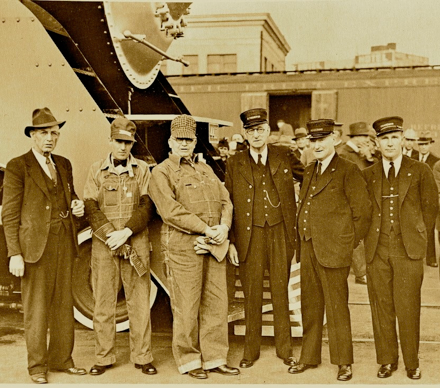
A "full crew" in the steam era was 6 men - Engineer, Fireman, Head Brakeman, Swing Brakeman, Rear Brakeman/flagman and Conductor.
George Simmons
Passenger Train Seating
The two brakemen and the conductor on passenger trains wore uniforms and rode in the passenger cars of the train.
Mike Tisdale
On Train Order and ABS trackage, lining up the switch at a passing siding for a meet with a superior train falls to the head brakeman. He needs to be at the head end and not at the back end riding in a coach seat.
The head brakeman did not ride the locomotive of passenger trains on the SP, at least not north of San Francisco and east of Roseville. There was no rule that said he must ride the engine.
Jack Bowden
Freight Train Seating
On any freight train, the head end brakeman always rode the cab (or doghouse if so equipped). He was the guy who would throw switches and other brakeman duties in the front of the train, while the rear end brakie did the same for the rear of the train.
Bill Daniels
To say that the head brakeman always rode on the engine is not necessarily true. It all depends on what time period one is talking about. Up until the July 1949 the head brakeman, as well as other brakemen, were required to be out on top of the train at certain locations on the line.
Jack Bowden
Jack Kerouac & Cuesta - Spring, 1953
JK was employed by the Southern Pacific as a brakeman out of SLO in the Spring of 1953, working up the hill to Santa Margarita. He became a famous novelist. Jack Kerouac seemed to be between the feverish writing spurts that would produce two novels that year, his pen was still moving and he wrote little notes to express what he was experiencing in SLO.
Brian Moore
Here is Kerouac reciting some of his own words, working the peninsula...
http://writing.upenn.edu/pennsound/x/Kerouac/october_in_the_railroad_earth.php
Behind big engine 3669
In the bright day of
San Luis Obispo the
mtns. of hope rise
up, treed, green, sweet
—a rippling palm
behind the pot Steams—the young firemen of
Calif. waiting to
make the hill up to
the bleakmouth panorama plateau of
Margarita where
stars of the night are holy—