Southern Pacific Lines
Coast Line Division
“The Route of the Octopus”

Southern Pacific Lines
Coast Line Division
“The Route of the Octopus”

Oil Industry (Oil / Petroleum Products)
Large oil fields mean pipelines, the volume of crude is far beyond the capacity of any railroad to carry it. The same goes for most refinery products which are voluminous, such as gasoline and diesel, they travel mostly in pipelines too. The common "wisdom" that SP tank cars were all used for company fuel service is indeed a myth, in fact, less than a quarter of SP's fleet was needed for that purpose.
Tony Thompson
Crude oil is hardly ever moved in any quantity in tank cars, as pipelines are so much more efficient. The exception is immediately after opening a new oil field, before pipelines have been built.
Tony Thompson
Tank cars in a train can be carrying many things other than POL (petroleum, oil, lubricants), ranging from vegetable oil to wine to simple chemicals, assuming they are "conventional" or ICC 103 tank cars. Any state with extensive industrial capacity, not just California, will see numerous tank cars in service, even if only a fraction of them carry POL.
Tony Thompson
Small refineries put out 150+ cars a week of finished oil products. Lubes, waxes, extracts or 'black oils', LP gases and fuels. Enough for nearly solid trains sometimes.
SP & the Oil Industry Timeline
Oil products of many kinds have always moved, and still move, by rail. Even in the early days, it was only the first flush of a boom area when crude would be moved by rail (basically until a pipeline could be built). Reading the history of any oil company or oil patch will verify this. The early days of WW II were to some extent an exception.
1940’s
Prewar oil from Texas to the Northeast moved by ship to a great degree. When these were sunk by submarines oil was shifted to the rails until the pipelines were completed (ca. 1943). The use of pipelines instead of rail, however, dates back to the early Pennsylvania fields and was one of the means that Standard Oil used to gain monopoly control of the oil business.
There were oil rigs in Summerland during the 40‘s. Also Sea Cliff. A typical buildings of oil during 40’s were wood frame with galvanized metal outside.
As late as WW II, SP did get oil fuel for steam locos in tank cars at Taylor.
Tony Thompson
WW2 Era
From of the San Francisco office of the Office of Defense Transportation (ODT) files for WWII.
Gallonage governed. The majority of cars referenced were 8,000 gallon cars, with a smaller number of 10,000 and 6,000 gallon cars. Tank cars were a critical resource for the war effort and were controlled centrally by the ODT. The 50 ton was standard for shipping products during WWII.
Some AAR of tank cars interchanged at Port Chicago, CA from the Santa Fe to the SP. The cars mostly came up from Texas/Louisiana with components for the Shell and Tidewater refineries on the SP.
John
1950’s
Bulk crude oil was moved by rail well into the fifties, but volume of traffic in this commodity was perhaps only 10% of what it was in, say, 1943. What you would see in photos are all the OTHER tank cars that delivered refined petroleum products.
Joe Strapac
Most of the oil moving by pipelines what was the PE handling on their El Segundo branch out of Standard Oil at El Segundo. Night after night that a tank train would come up the hill from El Segundo and they would push the cars into that siding for a time, maybe an hr. or so. Then you would hear the train coming back and soon hear the switching of the cars to make up this whole train to go down the hill into Watts.
Rusty Ron
A pipeline to the Long Beach area was built by 1955, when diesel came to Taylor by pipeline.
Tony Thompson
There is a picture of a T&NO switcher and tank cars at Lake Charles, La. in the Trainlines issue on "SP in the Bayous". This picture is also in SP Review 1979 in the section about the T&NO. The picture is from 1950, just before SP's pipelines made oil (almost) cease to move by rail.
1970’s
Chevron at Mariposa Reina was built in the 70’s.
In the '70s, the SP ran unit oil trains from Utah to Richmond, Calif. (two photos of one of the trains can be found on pg. 272 of Signor's Donner Pass book).
1980’s
Later, Espee ran solid tank car trains from the Kern oil fields. They ran a solid tank train from Bakersfield to LA. The train was for Shell Oil and the cars went to the Shell facility in Wilmington for refining. The train began in 1983 and was scheduled to arrive in Wilmington at 5 am each day. In addition to the Bakersfield -LA trains they also ran from Mojave to LA for a while and more recently from an oil field in the southern Salinas Valley near King City. Strings of tank cars were parked by Martinez.
They also ran from Mojave to LA for a while and more recently from an oil field in the southern Salinas Valley near King City. Strings of tank cars were parked by Martinez but destinations are not known.
1990’s
The pipeline was built between Bakersfield and Mojave in 1994 or '95 which ended the railroad operations. SP Oil Cans discontinued the crude oil Tank Train in the 90's when a pipeline was built to replace the need.
SP still moved the crude from Fleta, south of Mojave, to the refinery in Carson. That lasted a few years via the Soledad Canyon and was then discontinued altogether. View the oil train just north of Mojave.
http://www.pbase.com/paulv99k/ image/38645523
The last run of the cans over Tehachapi was October 31, 1996. The train then did a Mojave (Fleta) to Carson run for a while. Then in 1998, the Coast operation to Wunpost began.
Jason Eminian
Tank Train on the Coast Line
Around 1994/95 is when the Oil Cans started on the Coast. Originally it had whatever old six axle power SP could dig up,but eventually changed to three unit sets of AC4400's up till the merger. Never did see the billboard Cans on the Coast, but I remember seeing some sets with the small "Tank Train" logo when it first started running on the Coast.
Nils Gustavson
I did photograph one of the first Coast Oil Cans at SLO with SP SD40M-2s for power.
Peter Arnold
It always was a UP operation starting after the death of SP. The UP Oil Cans Wunpost-Dolores started running in June 1998 to replace the Estero Bay marine terminal. I checked my slides I took and they are labeled June 1998 as the first run. I do have slides of oil cars before that in SLO, but they were empty being moved back and forth (Including those with "tank train" lettering), but no unit trains.
Peter Arnold
The reason for the train was the closure of the marine terminal at Morro Bay / Cayucos so that closure confirms the 1998 period.
Bruce Morden
SP/SSW Oil Movements
Tank Trains
The cars were built by GATX and were interconnected with 10 flex tubing. They were made up as 12 car strings originally. Later made into 13 car strings.
They ran a solid tank train from Bakersfield to LA. The train was for Shell Oil and the cars went to the Shell facility in Wilmington for refining. The cars were built by GATX and were interconnected with 10 flex tubing. They were made up as 12 car strings originally. Later made into 13 car strings. The train began in 1983 and was scheduled to arrive in Wilmington at 5 am each day.
Oil Cans used Hacks
SP Oil Cans that ran over The Loop used hacks. Oil Cans left Bakersfield and used a hack and returned empty trip from LA. This train was inaugurated in 1983. You wouldn’t see a caboose on the cans. Oil train helpers were set up was mid-train, a normal train would have six SD-45s or tunnel motors on the front and six more about 2/3 back in the train. They usually returned at night going back empty, but if they had helpers they were probably mid-train also, rear end pushers were not as common on Tehachapi as mid train helpers.
For the first few months of the train's operation, the route was via Cajon Pass, in which case the helpers were cut out at the Tehachapi summit. Then the route was changed to go through Soledad Canyon and the helpers were cut out at Sylmar to return to Bakersfield.
While the train at times ran with 6 road units with 6 helper units, it also commonly ran with 4 or 5 road units with 5 or 6 helper units. The Railfan & Railroad article stated that sometimes the train had one helper unit behind the caboose in addition to the mid-train helpers.
Pictures of the "Oil Can" with cabooses in 1986 had for example:
SP#8325-83879390-8292-8307 + 55 cars:helpers
#8309-7442-7485-8505-7475-8386-9390 + 33 cars and caboose.
SP “Oil Cans” / GATX Tank Train
SP did run many unit trains of oil and gas over it's system. One of these was the famous "Oil Cans" that ran over Tehachapi pass.
You can pick out the SP tanks because they were pretty large (12,500 gallons vs. the far more common 8000 and 10,000 gallons). Most refinery companies either had their own cars or had a lease deal with GATX, SHPX, NATX, etc., and those would all be the smaller cars. The non-petroleum cars would likewise be almost all lease cars.
Tony Thompson
There were at least two different types of tank cars that were used on the SP "Oil Can" tank train. These are GATX cars owned by the customer so although an SP operated train, are not something you might find in an SP book (other than train pics). The tank cars used in the 2 tank trains changed over time. Both in construction and paint.
(*see MR 7/92, pg. 100)
Today (2008), a tank train using the same interlinked GATX cars traverses the ex-SP Coast Line between Wunpost (the Santa Maria area) and Carson. This move happens two times per week. This operation has been taking place for a good five to six years and has been well documented and discussed online. Check Railpictures. net or Trainorders. com for the pics.
Jason Eminian
SP used various oil Can/tank train car types. Though tank cars are billed and usually classified by volume, such as 8000 gallons. Nominal tonnage capacity often doesn't tell you much.
Tony Thompson
The tonnage is important in calculating the weight of a train and every railroad did this. But the weight of a tank car IS NOT on the waybill. I would assume there was a rule of thumb for tank cars of a given size and cargo type.
Tony Thompson
References
Contact SPHTS member Tom Zehnder, oil engineer & consultant.
Union oil Museum at Fillmore
Kern Co. Museum
There are pics of various tank train car types in the book "Classic Freight Cars Vol 2 A Rolling Pipeline" by John Henderson. This is a picture book on tank cars (with many errors) They include the earlier cars that look more like the MDC cars, BUT all photos are of cars other than SPs tank train equipment, and most are from the east coast. Though some are the right kind of cars.
There are photos of the cars on the web. There’s a selection of photos to the Group, titled "tank trains".
Richard Percy also has some on his website.
For a photo of a caboose on the Oil Cans, taken at Colton in 1984, see page 52 of the June 1992 issue of Railfan & Railroad (in article "They Call Them the "Oil Cans,"" pages 48-55). Another magazine article about the Oil Cans was in the August 1994 Trains.
Modeling Oil Industry
Model shipments of lube oil, kerosene, gasoline, and many other refinery products. They can add up to a LARGE traffic themselves.
Tank Cars on the Southern Pacific
SP had tank cars for company use. Statistics from several years show that only about one-fourth of the SP tank car fleet in steam days was used to haul company fuel at any one time. They hauled petroleum, oil and lubricants (the category often called "POL" from the initials of those commodities).
Crude oil is hardly ever moved in any quantity in tank cars, as pipelines are so much more efficient. The exception is immediately after opening a new oil field, before pipelines have been built. There are a number of possible tank car owners to consider, primarily UTLX and GATX, but do not think that SP must be excluded.
Tony Thompson
There’s no other reason for oil to be shipped in big blocks of cars. It seemed that during the Southern California "oil boom" that oilfields were being discovered faster than pipelines could be built, and that building the pipelines would also present problems in terms of land acquisition to build them.
In all cases pipelines were built within a few years of the field coming into production. The only other reason to ship crude by rail was for locomotive fuel, which both SP and Santa Fe used at first, but by 1910 they were already using lower fractions from the refinery.
Tony Thompson
These cars were being loaded with product for delivery to regional and local distributors, not bring crude oil to the refinery (crude came to Richmand mostly by tanker).
Bob Proctor
The "private name" cars were either leased from a company like GATX, SHPX and UTLX, or were owned by that private name. Either way, the cars were in assigned service and not available for general use. Something like a Texaco car would be carrying Texaco products, etc. Thus the "plain Jane" black cars with only the leasing company initials are the safest for general use.
Tony Thompson
At the Standard Oil (now Chevron) facility in Richmond, CA., there were a 80% to 90% of tank cars in the refinery that had UTLX reporting marks. This is no surprise as Standard Oil was a major owner of Union Tank Car.
There are two major pipelines serving the Chevron Richmond refinery, and I'd bet the supply by that route exceeds the tanker volume. In fact, if one watches consistently at the Chevron loading/unloading facility (and the same is true for the refineries farther up the waterway), the majority of ships DEPART loaded. Some arrive empty, a minority arrive loaded, but most depart loaded. The pipelines were built early in the 20th century and continue to carry California crude to the refinery, but I'm sure the refinery receives significant imported crude also.
Tony Thompson
In looking through Espee Freight Cars, vol 5 it was noted that Espee tank cars only had dome platforms on the left hand side. Tank car models have platforms on both sides. In the ACF tank car book there’s a few photos that showed the right hand side of the car they all had dome platforms on the right hand side. Official SP photographers only took pictures of the cars' left sides, so SP management decided it was unnecessary to model details on the unseen right sides.
The UTLX cars, though not exclusively leased to Standard Oil companies like Chevron (in those days it was Standard Oil of California), might well have been serving Chevron's El Segundo refinery, and certainly the Standard companies also leased from GATX. They were going to a pipeline terminal or more likely a distribution center.
Tony Thompson
GATX was by far the biggest owner (and private too), with SHPX around half their size, back into the 1920s. Until after WW II, UTLX was pretty much exclusively carried petroleum products, unlike GATX and SHPX, and was very heavily leased to the various Standard Oil segments around the country. In the 1950s that changed, and UTLX began to lease for other products and to a variety of companies, in order to compete. It's true that a number of smaller companies sold their fleets to GATX and SHPX in the 1930s due to the Depression, then leased the cars back. Texaco is one example.
Tony Thompson
References
There are pics of various tank train car types in the book "Classic Freight Cars Vol 2 A Rolling Pipeline" by John Henderson. This is a picture book on tank cars (with many errors) They include the earlier cars that look more like the MDC cars, BUT all photos are of cars other than SPs tank train equipment, and most are from the east coast. Though some are the right kind of cars.
There are photos of the cars on the web. There’s a selection of photos to the Group, titled "tank trains". Richard Percy also has some on his website.
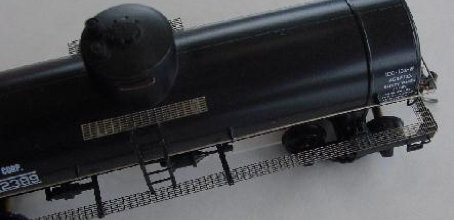
Modeling Tank Cars
There are a lot of "private road" tank cars on the market in all the scales. GATX and UTLX tank cars are an obvious choice.
In the pre-1960 era, predominantly UTL's own X3 design, available from Sunshine in resin.
Tony Thompson
Lettering & Numbering
These were all single dome, 8,000 gallon, 40 foot cars. All black with plain white or yellow reporting marks (usually covered in grime and barely readable, in fact the "yellow" marks may have been white originally).
UTLX used yellow lettering for decades. The cars are not "nominally 40 feet" long.
Decals
Champ
The Champ decal sets for UTLX tank cars are yellow. HT-52 UTLX yellow lettering black tank
HD-21 tank car data yellow order via Champ.
SP, Fuel Source and the OIl Companies
SP's primary fuel oil source was Standard of California (Chevron) after, say, 1930, but often would buy from others when they got a good price. This included, I was told, both Associated and Signal. Whether the other big players in California, Union 76 and Richfield, were also involved, I don't know, but I don't see why not.
Modeling Waybill Fuel Sources
You can waybill any of these oil companies without being WRONG, but probably Standard ought to dominate.
Tony Thompson