Southern Pacific Lines
Coast Line Division
“The Route of the Octopus”

Southern Pacific Lines
Coast Line Division
“The Route of the Octopus”
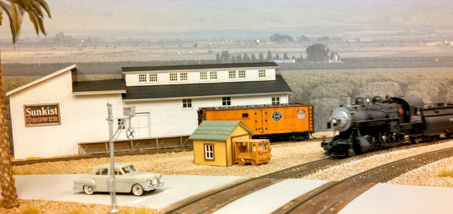
Packing Houses and the Railroads
Citrus Industry Timeline
In the early years citrus was packed at the freight depots owned by the railroads or wooden sheds built for the purpose. As the traffic grew, however, large, specialized packinghouses were built alongside the railroads, often by the co-operative shipping associations, which assumed an increasing responsibility for marketing of the crop.
1920’s
By the early 1920’s there were over 30 citrus packing houses located along the county’s rail lines.
La Habra (2) Santa Ana (3)
Fullerton (5) Villa Park (2)
Anaheim (4) Yorba Linda (2)
Orange (2) Olive (2)
Tustin (3) Placentia (3)
and Garden Grove, El Modena, McPherson, Brea, and Irvine.
Rail shipments of citrus in the West came from communities along the Santa Fe and Southern Pacific Railroads such as Riverside, Orange and Anaheim. By the mid 1920’s despite its small size, Orange County ranked as the leading producer of Valencia oranges in the state. While almost the entire crop was shipped by rail to the east in ensuing decades a growing proportion was reduced to juice by local processors (10% in 1930, 20% in 1940 and 30% in 1950) before being shipped to market.
Pre-War (pre-1942)
The Southern California packing houses strongly preferred having (depending on the railroad that served them) PFE and SFRD refrigerator cars rather than "foreign" cars for loading.
1942
In early 1942 the Office of Defense Transportation issued an order that in part called for the nation's refrigerator cars to be used where and as needed regardless of ownership. This resulted in non-PFE and non-SFRD produce reefers showing up at the doors of local packing houses. And not all of these foreign reefers were up to PFE and SFRD standards.
During WWII citrus production peaked and the Santa Fe reported the following packing houses and car loadings during the year on their Southern California rail system:
Los Angeles County: 21 packinghouses, 11 locations and 109 car loadings per week.
Orange County: 34 packinghouses, 9 locations and 255 car loadings per week.
Riverside County: 16 packinghouses, 6 locations and 53 car loadings per week.
San Bernardino Cty: 29 packinghouses, 9 locations and 130 car loadings per week.
San Diego County: 4 packinghouses, 3 locations and 45 car loadings per week.
By the 1940’s the number of packinghouses in Orange County had risen to 45. Orange County’s rail-bound citrus traffic peaked in 1945.
1947
In 1947 the order to control reefers was rescinded and operations returned to normal. While PFE and SFRD where busy trying to get their cars returned, FGE was working equally hard NOT to return them after World War II with the end of government control of refrigerator cars.
1948
By 1948 FGE's fleet in particular was in sad shape. Some cars were called "Weavers" because of what they looked like as they were moving and were said to "bow and tip their hats" when they came to a stop. Further financial stress came from trucks that even before the war were making inroads into FGE loadings in the southeast but after the was began making deeper impact on loadings. In 1948 FGE and WFE began to rebuild their wood sheathed cars with steel body frames and along with BRE began building steel cars to replace the many obsolete cars on their respective rosters. To help them get through their car shortage periods, FGE abused their goodwill with the western companies. This material illustrates why local packing houses did not prefer foreign refrigerator cars for loading.
Bill Welch
1950’s
The switch over from “shook” wood boxes to cardboard shipping boxes began in the mid 1950’s.
1960’s
By the early 1960’s Sunkist, the largest citrus exchange in the United States still had relationships with 112 packing houses in California including 50 in Southern California, 22 in Ventura and Santa Barbara County and 50 in the central California valley. The number of packinghouses in Orange County rail-bound citrus traffic remained strong into the 1960s before succumbing to spreading urbanization.
1970’s
Rail shipments of citrus and citrus products subsequently diminished as remaining growers and marketers shifted to motor truck carriers in the 1970’s. Many of the packinghouses are still standing a few even continue packing the citrus fruit and juice products that gave Orange County its name. In the 1970‘s logo stickers replaced the stamped Sunkist logo.
Citrus Related In-bound Railroad Traffic
In addition to the fruit itself, the railroads also carried a substantial inbound traffic in citrus-related items. Crating material or “shook” usually amounted to one boxcar load for every ten refrigerator carloads. This continues until the switch over to cardboard shipping boxes in the mid 1950’s. In addition, barrels or even tank car loads of smudge oil were an important item during the winter months and often received priority when cold weather threatened the harvest.
Citrus Journey
Getting fruit from the tree to the table is complicated. A citrus fruit is a living organism which must be protected from injury, decay and water loss on its journey across the country or across the ocean.
Harvesting
The Valencia harvest season was rather long and there was not the rush to harvest the crop that shorter harvest time crops had. Citrus begins its journey as they are picked by hand from orange and lemon trees, placed into large shoulder sacks and unloaded into sturdy wooden 'orchard boxes' [field boxes (4.5’ sq by 3’ high)] provided by the packing house. These were different from the retail 'crates.
The field boxes, filled with fruit, were picked up from the rows of the orchard by a 1.5 ton flatbed trucks and driven to the packing house (PH). At the packing house dock men with hand trucks (oak frame, steel wheels and parts) moved the full boxes from the trucks to the production line and reloaded the truck with empties.
Ken Parks
The area around Orange California, in the 1950’s, the procedure was to bring loads in from the groves being picked. 10 acres, which took a little more than a day to pick, two in a good year, it was pick absolutely every orange that wasn't all-green and teeny. No individual decisions by the picker. One shot per year for small parcels. Larger parcels could have been broken up into smaller.
Processing
The great majority of packing houses were located near the growing area so that harvested produce could be brought directly from the fields or orchards to be cleaned and packed at the packing house.
Tony Thompson
The truckloads from a given grove were unloaded along the outside of the house. The field boxes were carried into the packinghouse. A portable roller conveyor was used to move field boxes to a fixed conveyor line where the field boxes will be tipped over and dumped. Lots were kept together and processed together so that the VPOA grower could/was paid according to quantity and grading. No partial boxes/cartons of graded fruit- you got it filled with fruit from the next lot in line, or you lost it to that one, just like pickers paid by the full field box.
Large loading dock doors (appear to be vertically operated) and lines on the floor for lining-up the incoming field boxes.
http://digitallibrary.usc.edu/cdm/fullbrowser/collection/p15799coll65/id/9605/rv/singleitem/rec/13
Sorting Citrus
The oranges will begin their journey through the packing house starting at the fruit washer. The fruit go through this water bath for cleaning before the sorting and grading process. This is actually the first inspection for blemishes or defects before further sorting and grading. Oranges that had blemishes or scratches or damage from picking were “culled” out and loaded into trucks for transport to a central facility (Ontario, California for Sunkist) which processes such fruit into juice. Lemons were processed into juice in Corona, California.
Once the fruit was washed, it is stamped with the Sunkist logo and dropped into bins of similar size fruit through the spacing of rollers. The only change occurred in the 1970’s when logo stickers replaced the stamped Sunkist logo.
Packing
The crate is packed and secured with a lid nailed and strapped to secure the fruit during shipment. Wooden crates were used up to 1954-55 when they were replaced by fiberboard cartons one-half the wooden box capacity which are still in use 50 years later.
Packing Citrus Today
Most of this process is similar to what was done during the era of the ice bunker refrigerator car. For citrus that era ended about 1972 although ice bunker refrigerator cars continued to be used in ventilator service and with top-iced service (not used for citrus) for several more years.
Those 900 pound bins replaced the 90 pound field box and grading by electronic camera systems and packing by robotic machines certainly would have been science fiction in earlier days. The cardboard cartons came into general use in the mid-1950s.
Bob Chaparro
Fruit are carefully picked by hand and put into bins which hold about 900 pounds. The bins are hauled by truck to a packinghouse, where the fruit is pre-graded to eliminate the obvious culls (bad fruit) and washed to clean away field dirt and dust. The fruit's natural wax, removed during the washing phase, is replaced by a food grade, non-animal source wax to restrict moisture loss and extend shelf life.
The fruit is then graded, most often by electronic camera systems. After grading, the fruit is divided by size and the first grade fruit is stamped or labeled "Sunkist." An unmarked second, or choice, grade is also packed. The remaining fruit is sent to the juice plant.
Most oranges and grapefruit are packed with robotic carton packing machines in 40 pound cartons. Lemons and most tangerine cartons are volume-filled with a set number of fruit. The cartons are stacked on pallets and placed in a pre-cooler before being loaded on trucks or rail cars for transportation to markets.
Packing Houses Hours
A work day in the industry throughout Southern Calif. picking had to be done during the daylight and there was usually one packing shift, but it may have been longer than 8 hours and included at least a half day on Saturday. In the mid 1960s, the work week was 50 hours a week (9 hours M-F and 5 hours on Saturday). Unusual conditions might require packing at other times, but that was rare. There was no Sunday assignment, but the braceros would walk the area offering to work for cash.
Examples of one shift at the Villa Park Packing House:
Picker trucks depart around 6 am, done by 4 pm
Most of the house folks started around 7 or 8am
Loading of trucks, etc. went on after the rest of the house folks went home.
Shipping from a Siding
The railroad provided clean, empty refrigerator cars at the packing house loading dock based on shippers request. The cars were loaded by the shipper and iced at the packinghouse if it had such facilities.
Citrus products were loaded directly from trucks into reefers spotted on sidings (no packing house) such as team tracks. http://ljames1.home.netcom.com/scph_ventura_oxnard.html
From the 1920’s, hand trucks were often used for loading fruit into reefers. In the 50’s, roller trays were used to deliver crates to the loading spot as are commonly seen in photos.
There is much information on car loading arrangements in Chapter 14 of the book Pacific Fruit Express (2nd edition, Signature Press, 2000).
Oranges had to be shipped at temperatures around 40 deg. for the fruit to arrive at its destination in good condition. Many shippers elected to have the railroad pre-cool and ice their loads before loading the 40’ reefers with their 462 crates of oranges.
(See the Pacific Fruit Express - Operations Page for more information about reefer pre-cooling and icing.)
Citrus Shipping
Once the reefer had been loaded, on the Santa Fe, they were taken to the “B” Yard in San Bernardino to be assembled into trains such as the GFX (Green Fruit Express) for dispatch to east coast terminals. Icing platforms were placed en route to facilitate reeking to replace the 15% to 20% ice melt during a normal summer day. After a seven day trip the loaded reefers reached their destination and the empties were assembled for the return trip. Some backhaul traffic was generated by less than carload lots (LCL) which made use of empty clean reefers to carry this valuable traffic. Once reefers were returned they were placed in storage, repaired, cleaned and reentered for loading at the packinghouse.
Citrus Film
Here is a link to a short film from the mid-1950s titled "Citrus - The Golden Fruit". In addition to packing house scenes at about 10:45 into the film you will see railroad scenes showing loading, icing and a fruit block.
Bob Chaparro
Citrus Exchange Associations
The California Fruit Growers Exchange (Sunkist) seems to be the largest of the fruit exchanges. For most years between 1918 and 1960 about thirty percent of the Southern California growers marketed their citrus fruit through other cooperatives. Mutual Orange Distributors (MOD) marketed their fruit under the Pure Gold label. The American Fruit Growers company handled California citrus under their Blue Goose logo. Other fruit exchanges existed such as Cal Fame, and Mutual Citrus Exchange.
California Fruit Growers Exchange Shippers “Sunkist”
The California Fruit Growers Exchange adopted the "Sunkist" name in 1908 for its highest quality oranges. The Sunkist name became more prominent in advertising over the years and the California Fruit Growers Exchange renamed itself "Sunkist" in 1952.
Sunkist provided materials to the packinghouses, set standard for the fruit that was packed, sold the fruit and provided marketing and research. Since the Sunkist member packinghouse usually had a big SUNKIST painted on the building it was easy for people to think that the packing was being done directly by the Sunkist (CFGE) and not by a local organization.
The list below, is organized by the exchanges with the various associations listed under the exchanges. The city for each exchange and association is listed after the exchange and association name. Interestingly, not all associations were under the geographically nearest exchange.
This list is from the "Annual Report of the General Manager of the California Fruit Growers Exchange for the Year Ending August 31, 1913". It is a snapshot of just the shippers operating under this cooperative organization predominately in Southern California.
SHIPPERS OPERATING THROUGH THE CALIFORNIA FRUIT GROWERS EXCHANGE
A. C. G. FRUIT EXCHANGE Azusa
Azusa Citrus Association Azusa
Azusa Foothill Citrus Association Azusa
Glendora Citrus Association Glendora
Glendora Heights Orange and Lemon Assn Glendora
Alfred P. Griffith Association Azusa
Irwindale Citrus Association Irwindale
San Fernando Foothill Association San Fernando
Sierra Madre-Lamanda Citrus Association Lamanda Park
ARLINGTON HEIGHTS FRUIT EXCHANGE Riverside
Arlington Heights Fruit Company Riverside
Alta Cresta Groves Riverside
Sierra Vista Packing Company Riverside
Victoria Avenue Citrus Association Riverside
ASSOCIATED FRUIT EXCHANGE Highgrove
Bloomington Fruit Association Bloomington
Hemet Orange Growers Association Hemet
Highgrove Fruit Exchange Highgrove
CENTRAL CALIFORNIA CITRUS EXCHANGE Lindsay
Drake Citrus Association Lindsay
Exeter Orange Growers Association Exeter
Kaweah Lemon Company Lemon Cove
Lindsay Fruit Association Lindsay
Lindsay Producers Association Lindsay
Lemon Cove Association Lemon Cove
Mutual Orange Growers Company Lindsay
Ohio Lemon Company Lemon Cove
COVINA FRUIT EXCHANGE Covina
Covina Citrus Association Covina
Covina Orange Growers Association Covina
J. M. Riley Fruit CompanyCovina
DUARTE-MONROVIA FRUIT EXCHANGE Duarte
ONTARIO-CUCAMONGA FRUIT EXCHANGE Upland
Citrus Fruit Association Ontario
Cucamonga Lemon Association Cucamonga
Cucamonga Citrus Fruit Growers AssociationCucamonga
Etiwanda Citrus Fruit Association Etiwanda
Lemon Growers Exchange Upland
Mt. View Orange and Lemon Growers Association Upland
Stewart Citrus Association Upland
Upland Citrus Association Upland
Upland Heights Orange Association Upland
West Ontario Citrus Association Ontario
QUEEN COLONY FRUIT EXCHANGE Corona
A. F. Call Association Corona
Corona Citrus Association Corona
Corona Lemon CompanyCorona
Corona Packing Association Corona
J. H. Flagler Association Corona
W. H. Jameson Association Corona
Orange Heights Fruit Association Corona
REDLANDS-HIGHLANDS FRUIT EXCHANGE Redlands
California Orange Growing and Distributing Co. Redlands
Crafton Orange Growers Association Redlands
Crestline Association Redlands
Elephant Orchards Redlands
Gold Buckle Association East Highlands
Mission Citrus Association Bryn Mawr
Redlands Co-Operative Association Redlands
Redlands Fruit Association Redlands
RIVERSIDE FRUIT EXCHANGE Riverside
Co-Operative Fruit Growers Association Riverside
La Mesa Packing Company Riverside
Riverside Heights Orange Growers Association Riverside
Riverside Navel Orange Company Riverside
San Jacinto Packing House Company Arlington
SAN ANTONIO FRUIT EXCHANGE Pomona
Claremont Citrus Association Claremont
College Heights Orange Association Claremont
El Camino Citrus Association Claremont
Indian Hill Citrus Association North Pomona
La Verne Orange Growers Association Lordsburg
Pomona Fruit Growers Exchange Pomona
Richards Orange Grove Company North Pomona
Walnut Fruit Growers Association Walnut
SAN BERNARDINO CO. FRUIT EXCHANGE San Bernardino
Colton Fruit Exchange Colton
Highland Exchange Association Highland
Highland Orange Association Highland
Rialto Heights Association Rialto
Rialto Orange-Lemon Association Rialto
West Highland Citrus Association Highland
SAN DIMAS FRUIT EXCHANGE San Dimas
Charter Oak Citrus Association Charter Oak
San Dimas Lemon Association San Dimas
San Dimas Orange Growers Association San Dimas
SEMI-TROPIC FRUIT EXCHANGE Los Angeles
Alhambra Orange Growers Association Alhambra
Anaheim Fruit Association Anaheim
Cahuenga Valley Lemon Association Colegrove
County Farm Association County Farm
C. D. Hubbard Fruit Company Carpenteria
A. Duffill Association Pico
F. M. Ross Association Rossmoyne
El Ranchito Citrus Association Rivera
Fernando Fruit Growers Association San Fernando
La Habra Citrus Association La Habra
Leffingwell Rancho Whittier
Montebello Citrus Association Montebello
Ojai Orange Association Nordhoff
Pasadena Orange Growers Association Pasadena
Piru Oil and Land Company Piru
Placentia Orange Growers Association Fullerton
Rivera Fruit-Association Rivera
Sydmer Ross Association Fullerton
Whittier Citrus Association Whittier
Mrs. A. S. Wing Glendale
SUNSET FRUIT EXCHANGE Orange
David Hewes Association Orange
McPherson Heights Citrus Association Orange
Santiago Orange Growers Association Orange
Tustin Hills Citrus Association Santa Ana
Tustin Lemon Association Tustin
Villa Park Orchards Association Villa Park
Central Lemon Growers Association Villa Park
TULARE COUNTY CITRUS FRUIT EXCHANGE Porterville
Antelope Heights Orange Company Naranjo
Boydston Brothers Porterville
Fresno Citrus Association Fresno
Lindsay Citrus Association Lindsay
Lindsay Orange Growers Association Lindsay
J. J. Mclndoo Lindsay
Porterville Citrus Association Porterville
Strathmore Citrus Association Strathmore
Tule River Citrus Association Success
Zante Citrus Association Porterville
VENTURA COUNTY FRUIT EXCHANGE Santa Paula
Nathan W. Blanchard Santa Paula
Limoneira Company Santa Paula
Teague McKevett Company Santa Paula
SPECIAL CONTRACT SHIPPERS
Crocker-Sperry Company Santa Barbara
El Cajon Citrus Growers Association El Cajon
Escondido Citrus Union Escondido
Escondido Fruit Growers Association Escondido
Fillmore Citrus Fruit Association Fillmore
Johnston Fruit CompanySanta Barbara
Keen & Company San Diego
Lemon Grove Fruit Growers Assn Lemon Grove
Loveless Fruit Company Escondido
Mupu Citrus Association Santa Paula
San Diego Frum Company National City
Santa Paula Citrus Fruit Association Santa Paula
Sweetwater Fruit Company Bonita
Butte County Citrus Association Oroville
P. C. Drescher Association Oroville
Fairoaks Fruit Company Fairoaks
Whitney Estate Company Rocklin
Citrus Employees
Ethnic Workers
The available pre-war Sanborn map shows housing for "filipinos" behind the Central Lemon Assn. house. Earlier accounts of the industry refer to other Asian groups in some eras. Of course the Mexican Braceros worked most groves.
German POW’s Pickers
As a side note, during World War II German POWs were used as agriculture workers throughout the country. The Goleta area was no exception. Details are documented in the book, "The Soldiers of the Wehrmacht Pick the Goleta Lemon" by Justin M. Ruhge.
Modeling the Southern California Citrus Industry
Citrus Operation


Photo courtesy of Ryan Dora