Southern Pacific Lines
Coast Line Division
“The Route of the Octopus”

Southern Pacific Lines
Coast Line Division
“The Route of the Octopus”
Citrus Scenery
Citrus Tree Shape
Citrus trees in the 40's and 50's didn't have the tops of the trees cut flat, to make picking fruit easier, by limiting how tall the trees grow, but were allowed to grow naturally.
Citrus Grove Spacing
Older citrus texts call for 24 foot x 24 foot spacing for lemon trees for a grove.
Bob Chaparro
Modeling Citrus Scenery
Cockle Kitbash
All of my 130 or so orange trees were done by my wife Carol. Basically they are sponge pieces cut to shape and put on a stick, and then Woodland Scenics foam pieces were hot-glued over the sponge base. Several shapes, densities and colors were used, for variety. They were then sprayed with Scenic Cement adhesive and Woodland Scenics oranges sprinkled on, followed, when dry, by more spray adhesive. She found that you have to go easy on the spray or the oranges turn white.
Tom Cockle
I created a folder in the photo section named Tom’s test trees where you can see the result when the pictures are approved.
Corona Model Railroad Society Recipe
On the right side is two 2,3 inches white styrofoam balls, trimmed to shape, then two 2 inch balls and then various sponge trees made after the Corona Model Railroad Society recipe.
All are brush painted using acrylic craft paint.
Add Woodland Medium Green Coarse Turf as foliage.
Modeling of Citrus Grove Spacing
Mark out 3" by 3" (22' x 22' in HO scale) grids.
Drill holes and place the trunks allowing the trees to sit on ground.
References
Modeling Orange GrovesRMC July 1996
Modeling Palm Trees and Orange GrovesMR Sept 1999
Modeling Irrigation Ditches
I routed grooves for irrigation ditches and painted them earth color, then "flooded" with clear varnish.
I have added a few more photos to the modeling folder I created yesterday.
Tom Cockle
Modeling Citrus Grove Backdrop
BackDrop Warehouse
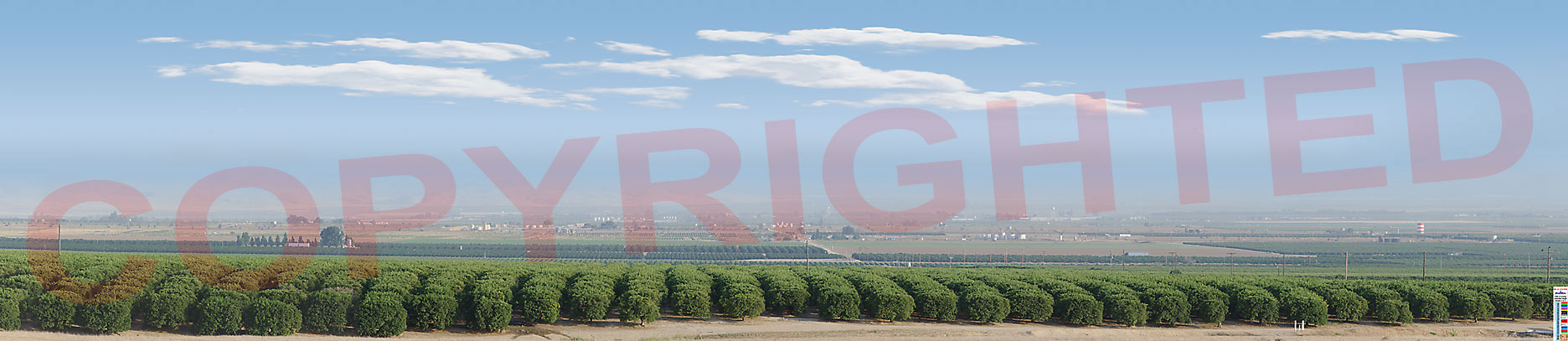
There are three citrus grove backdrops available. I have to advise you these backdrops are not inexpensive.
The BackDrop Warehouse site is: http://backdropwarehouse.com
Bob Chaparro
One set of citrus grove backdrops have the tops of the trees cut flat. This is a modern technique employed by todays citrus growers. Looking at the photo of the back drops, they would not be suitable for a steam era layouts.
Ryan Dora in San Bernardino is rebuilding his layout to accommodate some larger SP steam locomotives. As part of the rebuilding he has installed a citrus grove backdrop from the BackDrop Warehouse. It was quite realistic and impressive. You can view a photo in our Photos Section in an album titled "Citrus Features On Layouts". Look for the photo titled "Dora_Ryan 009".
Ryan's backdrop is this one: http://backdropwarehouse.com/images03/AG-SKL-237B.jpg
Windbreaks
Location
Santa Ana’s are from the north and east. Windbreaks were primarily for blocking hot Santa Ana winds from the east.
Robert
"The Santa Ana is a dry, sometimes hot and dusty, wind in southwestern California that blows westward through the canyons toward the coastal areas. Santa Anas are a seasonal phenomena, occurring mostly during fall, winter and spring, tending to peak in December. The wind usually has its origin when cold air spills southward into the Great Basin, trapped between the Rockies to the east and the Sierras and Southern California coastal range to the west. This cold air mass is characterized by unusually high pressure near the land surface. Winds are driven into Southern California when the pressure of this interior air mass exceeds the pressure along the California coast. Winds are often strongest in mountain passes which are ducts for the continental air flow. Because the air over the higher elevations of the Great Basin sinks as it flows into coastal California, it is heated adiabatically, and temperatures are often quite warm. This continental air mass is invariably dry, so humidities in Santa Anas are low, often less than 25% relative humidity. Santa Anas have occurred irregularly over the time period since about 1950 when we have collected detailed wind and humidity observations, with some months experiencing Santa Ana conditions 30% the time, and other months less than 5% of the time."
This often results in winds from the southeast blowing westerly. In fact, sailors participating in the Ensenada boat race count on southwestward winds to get them back to San Diego and L.A. Winds on the Oxnard plain are heavily influenced by the Santa Barbara Channel, which most days has a steady 15-knot wind out of the northwest. In the Fall, those winds can hit speeds of 60 mph, or more.
Eucalyptus Trees as Windbreaks
Types
There are 100's of varieties of eucalyptus. The "Green Gum" species grows very tall and skinny, so it can be planted closely. These gums were fast growing, tall, messy, hard to cut and split for firewood, slow burning, smell good, tough on pipelines, tough to kill, and dangerous in a wet windy spring. 300 year old eucalyptus make good poles and railroad ties.
The Tasmanian Blue Gum (Eucalyptus globulus) is a tall, straight evergreen tree growing to 230 feet in height and 6 feet in diameter. The rough, deeply furrowed, gray bark is continual at the base of the trunk but above this level it sheds in strips leaving the branches and the greater length of the trunk smooth-barked. The broad juvenile leaves are about 2.4 to 6 inches long and covered with a blue-grey, waxy bloom. This is the origin of the common name 'blue gum'. The mature leaves are narrow, sickle- shaped and dark shining green, 6 to 14 inches long.
All the trees are native to Australia and not indigenous to North America, the introduction of the trees to California dates back only about 130 years or so.
History
Eucalyptus trees were the usual choice for windbreaks. Windbreaks were required to dissipate some of the energy of the Santa Ana winds so were planted on the north and east sides of orange groves.
The "Green Gum" was the choice for windbreaks, as opposed to Blue or Red. The species grows very tall and skinny, so it can be planted closely.
Eucalyptus trees were used for railroad ties but only to the extent that eucalyptus wood was tried as an alternative. The Santa Fe Railroad planted thousands of these trees in what is now known as Rancho Santa Fe (north of San Diego), California, in the hope that the wood from these fast growing trees could be used for ties. But because the trees twist quite a bit as they grow, the wood grain was uneven and unstable. This made the wood unsuitable for use as railroad ties. But the wood was used for fence posts.
Reference
If anyone is interested all you've ever wanted to know about Eucalyptus is included in this website:
http://wwwlibrary.csustan.edu/bsantos/section1.htm#CALIFORNIA,%20HERE%20I
Good images are available at:
http://www.hear.org/starr/hiplants/images/600max/html/starr_031002_0025_eucalyptus_globulus.htm
http://pharm1.pharmazie.uni- greifswald.de/systematik/7_bilder/pis/kors-213.jpg
http://www.inta.gov.ar/balcarce/info/documentos/agric/forest/eucalypt us/foto4.htm
http://www.cuyamaca.net/oh170/Thumbnail_Pages/Eucalyptus_globulus.asp
Modeling Eucalyptus Trees
You need to model these trees as a windbreak if you are going to model a citrus grove. The tree to model is the Tasmanian Blue Gum (Eucalyptus globulus).
Make Eucalyptus Trees using the green floral wire to make the trunks. Twist up a bunch of it to from the trunk and branches, then several coats of brown latex flat paint. Dry brush some light gray latex on the trunk to give it the pealing bark look. Dark green foliage is used from Petite Pines Northern, #FM208..
Candy Tuft RE a dried craft flower-shrub. They are available at Michael's or JoAnn's, You will need olive drab paint, and two other dark greens for the foliage colors, just to get started, and then mix a gray color that comes close to the bark, like a bit of earth mixed with SP Lettering Gray, this will need tweaking for you own lighting.
Here is a link to view model tree’s tree's: http://www.santasusannadepot.org/images/DSCF2150a.jpg
Fruit
Fruit
Micro Beads
Here’s an item to use for fruit (oranges, lemons, grapefruit and apples) for my N scale trees. "Micro Beads No Hole DIY Nail Caviar Beads" are used as a covering for nails by females. It looks like course sand paper. They come in red, orange, yellow, green, purple, blue, black and brown.
Find them on EBay and by Googling "Micro Beads No Hole".
They also come in a size that would work for HO.
Michael Bishop
The colors are mostly metallics, and I can't find anything resembling citrus fruit for N scale. The closest "orange" beads i could find are 1mm diameter...6.4" . The .6 to .8 mm beads would be okay size wise, if one could find the right color....
Otto K.
Lemons
Modeling Lemons
JTT Scenery Products
We now have a source for lemons. JTT Scenery Products ( http://www.jttmicroscale.com/ ) now carries a product called "Orange, Apple, Lemon Fruit" ( http://www.jttmicroscale.com/viewproductdetail.asp?id=4 ). It comes in a 10 gram package with each fruit packaged separately. This thoughtful packaging saves one from having to sort a lot of fruit!
The product number is 92124. Cost is $8.95
Older citrus texts call for 24 foot x 24 foot spacing for lemon trees so use that as a guide for your groves.
Bob Chaparro
Oranges
Modeling Oranges
Woodland Scenics
Oranges have been available for years from Woodland Scenics.
Bob Chaparro
Modeling the Southern California Citrus Industry
Citrus Scenery
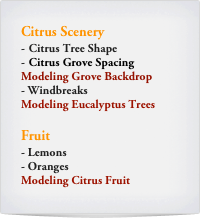


Photo courtesy of Ryan Dora