Southern Pacific Lines
Coast Line Division
“The Route of the Octopus”

Southern Pacific Lines
Coast Line Division
“The Route of the Octopus”
Train Communication
Bells
In the 1907 Rule Book Rule 31 states that the bell must be used for stations, public road crossings, tunnels and snow sheds.
Whistles
Air Horn
The usual practice seemed to be when train was moving forward at speed 40mph, the air horn was used.
The horn was activated with a "button" rather than a cord making it easier to activate while running at speed and performing the myriad other tasks required of a steam locomotive in passenger service.
Marc Montray
Mt's with skyline casings had horns. So did 4-6-2, GS’s, AC’s, ...
There is a 7x9-inch SP General Shops "builder's view" broadside shot (LA or Sacto?) showing the 4-4-2 No.3000 circa 1930 and a 4-horn interurban style cluster air horn is mounted atop its smokebox directly in front of the stack. The horns on the sides have that interurban-like bend to direct the sound outwards. This may be the earliest use of air horns on SP passenger steam power.
Kevin Bunker
4-6-2s came with an air horn mounted directly ahead of the stack, on top of the smoke box.
Air Signal Line
The air signal line is only on passenger trains. Never any on a freight train. Air signaling was done by increases in brake pipe pressure as read on the air gauges of the helpers.
On photos of SP steam power, air signal whistle were mounted in the cab on larger locomotives, especially those with enclosed cabs such as the GS's, ACs, etc. This is the air signal whistle that the conductor would "blow" according to the communication signal rules outlined in the Rules and Regulations. Examining the photos, sometimes there are two air lines to the whistle, and sometimes only one. You can see a second smaller line or wire running parallel to the air line.
This is not an air signal whistle, which was always installed in the cab so that it could be heard by the engine crew. The device that you see on the tender is a "conductor's valve" for making an emergency application of the brakes from the gangway. It had a rather high-pitched note.
Whistle versus Horn
There aren’t any special instructions regarding air horn versus steam whistle on the SP steam engines. Due to the properties of superior forward sound propagation, it was generally preferred to use the air horn in preference to the steam whistle for grade crossing warning [the Morse "Q" or --0-] reference Rule 14[l].
There was no hard and fast rule as to use of the horn vs. use of the whistle. But the horn was always used at grade crossings because it carried farther and also because, along the Daylight route, it meant that a fast train was approaching, so look out! The steam whistle was usually used when signaling trainmen instead of the horn.
Charles Givens
Steam Whistle
The steam whistle was always used to acknowledge signals passed to the locomotive cab via the signal line. Most signal line codes were acknowledged by two short toots of the whistle. This could be anything from "turn on the train heat" to "make station stop at the next timetabled stop," which could be an "f" flag stop or other conditional stop.
Consult Joe Strapac's Compendium to get the most accurate possible information!
Jim Warsher
The GS's had a steam whistle, a deep throated sound. The steam whistle was used primarily to signal crew.
John Vasconcelos
And the GS-4/5 "steamboat" whistle was a Hancock high pressure whistle in common with most (probably all) other U.S. locos with 300 lbs boiler pressure.
Charles Givens
Whistling Rules for Grade Crossings
The origin of locomotive whistling in general and the whistle for grade crossings in particular for the nation's was first published in rules giving the familiar - - o - for a grade crossing appeared on the Southern Pacific in 1930 (Rule 14l [that's 14 lower case L]).
The advantage of the final long note is it can be drawn out as necessary to carry the engine across the road, and perhaps the rule change merely codified what was already practiced.
A SP Rules and Regulations dated January 1, 1923. Page 19 is pasted over with a replacement page, which lists Rule 14l as "- o o - (Effective 4-1-28)". That is the date when a change took place, and the new whistle signal. Note that this is not the same as the - - o - signal you've cited (above).
Another SP Rules and Regulations book dated January 1, 1923. In this book the page is not pasted over with the updated whistle signal. This book shows the signal for Rule 14l as - - o o.
SP Rules and Regulations book dated February 15, 1943 shows the signal for Rule 14l as - - o -.
So, these books show at least part of the story:
Before 4-1-28 it was - - o o .
Effective 4-1-28 it was - o o - .
Sometime prior to 2-15-43 it became - - o - .
It is interesting to note that both the 1923 and 4-1-28 update say "Approaching public crossings at grade." However, the 1943 rule states "Approaching public crossings at grade, tunnels and obscure curves; to be commenced sufficiently in advance to afford ample warning, but not less than one-fourth mile before reaching a crossing, and prolonged or repeated until engine has passed over the crossing."
Grade crossing safety had obviously become a much greater concern.
SP Rules and Regulations Operating Department dated 6/15/03, 8/1/07, and 1/1/23 all have a Rule 14(l) which gives the designated signal as - - o o. The first issue of the 6/15/30 book gives the definition as do the preceding three; "Approaching public crossings at grade." The March 1940 revision to Rule 14(l) adds further descriptive material about continuing to sound the signal to the crossing, apparently the reason the signal was changed to - - o ----------.
The SP Rules of August 1, 1907 show two long and two short for approaching public crossings at grade. A series of short blasts warn of cattle or persons on the track.
The following website has a listing of what the engineer is saying with the horn. Many railfans will know two longs for "highball", three shorts for "backup" and --o- for a grade crossing, but there were more than that.
Below that is a list of the signals the conductor could give the engineer with the signal cord. Amtrak cars still have a button that can be used to signal the engineer in case of radio trouble.
Mike Tisdale
See Bob Church's Daylight Locomotives book, page 55. The air horn was used to signal to motorists at grade crossings, as it was supposedly heard better ahead of the train. For that same reason, the whistle was used to signal trainmen, as it was less directional.
Tony Thompson
Whistle Sign
A sign with a W to indicate the engineer that should use the whistle. Southern Pacific utilized the X & W. When there were two or more road crossings separated by a quarter mile or less the company could get by with using a single X sign for all. This was done by placing a numbered sign on the whistle post just beneath the X. Thus an X with the number 3 displayed beneath it would indicate that the train was approaching three road crossings, with only a single X sign for all three crossings.
Page 360 of Beebe's "The Central Pacific and the Southern Pacific Railroads" has a photo taken at Landers, Calif. in September 1892 that shows an SP whistle post with both an X and a W on it. This may have been the standard at the time. Note that the post is fairly sharp-pointed (another sharp-pointed post can be seen in a photo on pg. 605 of the book). The sharp-pointed posts began to be phased out with the adoption in 1904 of joint SP/UP common standards for signs, which called for less-sharp points and just Xs on the signs. It remains possible that the SP adopted the less-sharp design on its own before 1904).
No mention is in the 1907 rule book. In the 1907 Rule Book Rule 31 states that the whistle must be used at all whistling posts.
Some of the sharp-pointed whistle posts lasted a long time, as evidenced by the 1947 photo of the West Coast near Newhall found in the 1985 Whistle Stop Publications SP steam calendar.
Mention of these signs is in TT Bulletin No. 102, dated July 2, 1954, for Portland Division TT no. 146.
RULE 14. Following paragraph added to rule 14:
"Signs bearing the letter `X' located 1/4 mile in advance of certain public crossings at grade and signs bearing the letter `W' located one-forth mile in advance of certain tunnels and obscure curves, require engine whistle signal as prescribed by
RULE 14(1). Absence of these signs in advance of public crossings at grade, tunnels or obscure curves, does not relieve engineers from complying with Rule 14(1)".
In the Tehachapis up to sometime in the 1950s, there were metal whistle posts with Ws on them placed one-quarter mile from tunnels. The only photo of these signs is a print from Stan Kistler that was taken at the east end of Walong (the whistle post was for Tunnel 10). Other photos of the signs in the Tehachapi it only show the backs.
Examples: page 105 of "Santa Fe 1940-1971 In Color, Volume 3: Albuquerque - Los Angeles" and page 142 of Signor's "Tehachapi" (in the latter photo, look just below the front of the car that is right behind the helper). The signs had plates maybe three feet long mounted on a metal tube (in the era, there were similar metal signs for grade crossings that had Xs on them, but the plates were much shorter. See foreground of the bottom photo on pg. 217 of "Tehachapi").
Communication on Helper Service
SP used whistle communication between engines on helper service.
Whistles were not used as the line climbs up the Salt Creek canyon on both sides and then wraps around and goes above the lower line. With many sidings it would be possible to have 5 or 6 trains in various place of the canyon at once. (Is it your train's head end whistling or one above, below, or across from you?) The canyon also creates some echo effects even today.
Uphill trains would pull into a siding per orders and stop. At this time one or more of the helper crew would have an opportunity to get some rest. When it was time to continue out the siding and up the hill the lead engine would back the train into the helpers to gain slack (and it woke the helper crews up) and everyone would open the sanders and throttles and go. If they didn't work in unison it could easily result in a pulled draft gear which did happen often on the hill.
Air pressure was (also?) used to communicate. For water stops where the rear engines and cars cut off and backed to take water the air line would be used to tell the head end when the train was coupled back together and when it was time to go the head end would back into the helpers as described above. There is more detail on this in Austin and Dill's SP in Oregon book on page 291. The same system was used on the Donner line.
Tony Thompson
Modeling Whistle Posts
To model post-1904 wooden whistle posts, refer to plans on pg. 55 of "Union Pacific Common Standard Drawings, Vol. 2 - James Ehernberger Collection." The UP plans match exactly the measured dimensions of SP whistle posts.
Flagman Signals
Bill Box
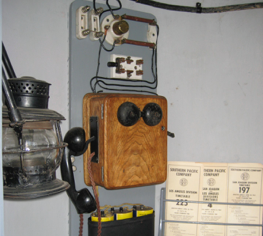
The bill box was used for the messages that were transmitted via that box, usually from a local agent to a train crew, sometimes in the opposite direction.
Station Communication
Telegraph
Calls
SP stopped using morse code to convey train orders and other messages to agents. The April 12, 1918 Bakersfield Californian reported that the SP was going to start using telephones for train orders before the went with DTC via radio to the crews.
One could also request photocopies of the SP "List of Officers, Agencies and Stations" documents in the collection of the California State Railroad Museum Library. Be sure to specify a year. Most stations had the same call letters while they existed, but for some locations, there were changes. For example, the first call letters for Saugus were SG; sometime between 1900 and 1903, Saugus was changed to JN.
The telegraph survived for many long years after the SP Company discontinued using it to transmit train orders. As early as 1926, train orders were already being transmitted over the telephone and had been doing so for a number of years. The telegraph was still in use at that time and continued in use until the early 1950s for sending messages and as a backup system.
In addition to trainorders, the telegraph was used for commercial business (Western Union telegrams). Even when the trainorders were transmitted by telephone, the telegraph was need for this other business and as a backup system if the phone line died.
Telegraph Call Signs
You can find a list of the two-alpha characters telegraph call-signs, that SP used to identify each of its stations in the Circular 4, List of Officers Agents and Stations
Here is a list of the two-alpha characters telegraph call-signs, that SP used to identify each of its stations.
Location 19311942 1952
Burbank Jct BU BU
Saugus JN JN
*Saugus were SG; sometime between 1900 and 1903, Saugus was changed to JN. Between 1900-1903.
Lang G None in 1942
Ravenna NA None in 1942 omit
Vincent VI None in 1942
Palmdale DA DA
Lancaster SR SR
Rosamond None in 1942
East Mojave Not listed 1942 MV
Mojave MCMC MJ
Tehachapi KI KI
Caliente W W omit
Bakersfield K and DS
Kern Jct. AG AG
Baker & Sumner DS & K
21st & R none in 1942
Owenyo OW
Glendale RO
San Fernando FO
Newhall FC omit
Monolith M
Woodford BC omit
Bealville B omit
Edison D
Searles SA
Inyokern Q
Cartago GO omit
Owenyo OW
add Sun Valley RY
add Lone Pine NE
LA Yard OD
SLO BI
Lucin UN Telegraph office closed in 1947
Lakeside SC Telegraph office closed in 1946
Note: the 1952 list does not show OD at LA Yard (Taylor Yard), but the train order office at the yard was called the OD until it was discontinued.
The SPH&TS "Southern Pacific Lines Stations" lists the telegraph call-signs for the stations covered in the three volumes.
Pronunciation
The railroad has its own pronunciations of locations, passed down for many years. Virtually none of the railroaders in SLO pronounced any of the Spanish station names correctly-deliberately.
This is not some railroad plot to demean Spanish, merely the culture of the railroad. The pronunciations used by rails are part of our culture and extend to other facets of "life on the railroad". Enjoy everything about the railroad and the vocabulary is part of the experience, almost every place name that can be contorted is!
Hank Winn
It would be a real service to try to memorialize these "mispronunciations." They are a part of the vanishing legacy of "real railroading" that came to and end in the mid-1990s. We need a repository of these pronunciations, with citations as to sources, if possible.
SP DTCTR
Examples:
Bakersfield -- BKF
Barstow -- Barfstow
Beaumont -- Blowmount
Buena Park -- Boona Park
Cadiz -- Kay deez
Cairo, IL -- KAY-ro)
Calais, ME -- CAL-us
Carpenteria -- Carp
City of Industry -- CofI
Cuesta -- Qwest uh, not "ah".
Fontana -- Funtuckey
Indio -- In di ooh
Landcaster -- Landscatter
Loma Linda -- LouieLouie
Los Gatos -- loss-gat-ohs and now loss-got-ohs
Los Nietos -- Looss Nuts
Mojave -- moo jovee
Palmdale -- Palmscatter
Piru -- Pee you
Pt Conception -- Concepion
Rivera -- Rye veera
San Luis Obispo -- San "Loo-iss" Obispo
Summerland -- nude beach
Tajiguas -- Tah he gus, or To Jesus
Tulare -- two-larry and now two-lair
Yermo -- Urnial
The San Luis Obispo locals all used the Anglicized pronunciation of Luis.
Hank Winn
Magazine ads of the D&RGW in the 1950s had this line at the bottom of the ad: "Say RYE-o Grand."
Tony Thompson
Internal Communication
Employees and managers communicated in different ways. There were three kinds of forms SP used internally for a number of years. These were called Telegram, Mailgram and Airgram, named for the way in which they were expected to be transmitted (“air” refers to air mail). But in fact pads of these forms were in many desks, and it’s clear from many surviving examples that messages were typed on whatever was handy. Especially as telegrams became uncommon as communication, all those pads of blank telegram forms became, in effect, memo pads. Pads of forms like this were in many employee’s desks, and were used for all kinds of handwritten and typed communication among employees, whether in the same building or far away across the system.
These SP forms came as plain paper forms, and as tissue versions for carbon copies. There seems to have been a color code. Sometimes the colors were dark, sometimes rather light. The forms came in 8 x 5.125 inches. The “full-page” forms are 8 x 10.25 inches, so that the smaller stock is half a full page.
Tony Thompson
Airgrams
Airgrams were on white stock.
Airgrams form is 8 x 5.125 inches.
Airgrams having green stripes along each vertical edge.
Mailgram
Mailgrams and Airgrams were on white stock.
Mailgram forms had blue stripes along each vertical edge.
Mailgram form is 8 x 5.125 inches.
Mailgram form dated 12-59 has a much paler and wider blue stripe than the Mailgram form of 1950.
Telegrams
You did not see a Telegram form with color stripes, but you would see the tissue Telegram forms in white, yellow and pink. The Telegram form is 8 x 5.125 inches.
Reference
http://modelingthesp.blogspot.com/2012/08/internal-sp-communications.html
Modeling Internal Communications
They are ideal for model layout operations for communications with train crews. Even if a layout does not use bill boxes, some kind of message to crews may have to be provided, and this kind of form is one way to do so. Make up a set of Telegram blank forms, drawn from the forms above, for use in bill-box messages from agent to crew.
Tony Thompson