Southern Pacific Lines
Coast Line Division
“The Route of the Octopus”

Southern Pacific Lines
Coast Line Division
“The Route of the Octopus”

General Engine Operations
SP Passenger Motive Power
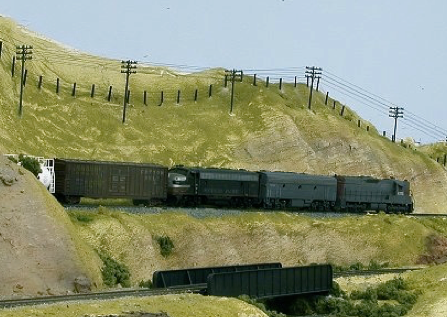
As a general statement, the E units stayed on the Coast, Golden State and Sunset Routes. The PA units stayed on the Overland and Cascade Routes. The PA's did get on the San Joaquin and Coast trains, however. All passenger power was eventually painted dark gray and Scarlet. Only two E units received black widow paint. The F's were on secondary trains on all routs and they came in black widow; they too were repainted in dark gray and Scarlet.
PAs, FP7s and Es ran on different trains on different routes. The last PAs were retired in 1967 as the SDP45s arrived, and after that, SDP45s, sometimes mixed with FP7s or F7Bs could be found leading any SP passenger train. The last PAs finished out on the City of SF.
The E7s were retired about 1968, and the E9s about 1970. By the time Amtrak took over, SP was generally using SDP-45s, FP7s, F7Bs on long distance trains.
Cascade
Yellow cars might show up on the Cascade or other SP trains from time to time.
City of SF
Until the end, SP had a fair number of cars painted in UP yellow for the City of SF, as UP preferred to have its trains all yellow east of Ogden. This didn't always happen, as there are pictures of the City of LA/SF with a silver SP car in it, but SP generally abided by UP's wishes, so the City of SF would run with economy baggage cars, through UP yellow head end cars, maybe a silver Oakland-Ogden dorm and coach, through yellow coaches from SP, UP or Milwaukee, silver automat, diner or diner-lounge, and dome, depending on season and year, yellow through sleepers, and maybe a silver SP sleeper.
Coast Daylight
Pictures of the Coast Daylight in the ‘50s and early to mid ‘60s show a mix of PAs and E units. It seemed to vary day by day.
Golden State
The Golden State had a mix of Rock Island and SP cars and locomotives, generally E-units It finished in early 1968. It and the Sunset were combined west of El Paso about 1966. The SP and Rock Island power started running through Tucumcari, but it wasn't always the case.
Sacramento Daylight
The Sacramento Daylight usually had a passenger GP9, but it also ran with a passenger SD9 on occasion. The commutes were in the hands of H-24-66s, and passenger GP9s, as well as the odd FP7. Passenger GP9s might sometimes find their way onto the point of a long haul train, but this was uncommon.
San Joaquin Daylight
The San Joaquin Daylight generally had Daylight coaches.
Sunset Limited
The Sunset stainless steel equipment showed up on the Cascade in later years, with some pictures showing the Cascade as having all or nearly all Sunset equipment on a given day, economy baggage car excepted. The Sunset's consist started running through to San Francisco as the Coast Daylight at some point, with extra cars added, so the Daylight might have a mix of long haul cars and Daylight coaches.
The Sunset Limited is the train that ran with the Budd Stainless Steel corregated cars with the single red stripe. This train was pulled by E-units in Daylight paint from it's inception (in the SS Cars) along with various other pieces of equipment including steam and PB units. In the late 50s and early 60s, you would find the same locomotives on the train now in the bloody nose paint job. At times you might even find some of the experimental paint jobs such as the "halloween" paint on F&s and FP7s. The same on the E-units and even the E7 B units and the PB units that would run on the train (these were painted from Daylight to Black).
Only two E-units were painted in the Black widow paint jobs (both A units) and they only remained in this paint job for approximately six weeks.
Modeling the Sunset Limited
If you want to model the Sunset Limited in Budd Stainless, pick your time frame and glance through some of the books that get recommended on this list to see what paint was on the locomotives at the time you model and go for it.
Modeling the middle to late fifties and my Sunset is powered sometimes by and an E9 in "Daylight" colors with two E7 B-units both in "Daylight" Colors. Sometimes throw in a "Daylight" ALCO B-Unit or maybe even pull it with three ALCO units, an A-B-B combination. E9 in Bloody nose with a B-Unit in "Daylight."
MUing Non-adjacent Locomotives
Early diesels couldn’t run in multiple-unit consists (i.e. - Alco RS-1 couldn’t run with EMD F-3). But EMD F-3 could run with EMD GP-7. In the 60’s builders worked out standardized arrangements so EMD F-3 could run with Alco RS-11.
On page 109 of Tom Dill's Shasta Route, a photo shows 2 Baldwin units (a DRS-6-6-15 and AS-616B) working at the Eugene hump yard separated by a flat car. This was to lessen the weight on the scale located at the crest of the hump.
Alco, Baldwin/B-L-H went its own way on multiple unit control. Instead of a multi-pin electrical connector, Baldwin used a multi-hose pneumatic mu control provided by Westinghouse Air Brake Co. Not all of them. There’s some photos of Baldwins MUed with other builder.
This may have enhanced the operational range of their fleets but it completely wiped out the Baldwins' best advantage over the major builders -- that of infinite throttle control [the air throttle] rather than limited to only eight throttle positions. In running a yard engine [and presumably a hump engine, as well], it was a huge advantage to be able to minutely vary the throttle setting for switching, and humping, purposes.
The traction motors were traditional series/parallel wound 600vDC but the ability to minutely vary the excitation of the main generator was a great advantage. It spelled longevity for many BLW and BLH products which would otherwise have been washed away years previously in the tide of new production from the major builders.
In the early 1960s, it was a treat to watch the Baldwins flat switch a yard, the yard engineers could peel the throttle right back and kick cars like nobody's business. If you did that to an Alco or an EMD, all you would hear would be an idling diesel engine and lots of alarm bells. The Fairbanks were also a good switching engine and would load right up but they had a conventional electric throttle.
The RSD5s did great yard work also. The Baldwin Co went belly up because the prime mover was junk. Had more oil leaks than Carter had little pills. The Baldwins on the Santa Fe were fair but nothing to write home about. I did not contradict your Eugene statement but you said all Baldwins had air MUs. Some did not.
Those railroads that early-on saw the need for universal MU did indeed specify electrical, rather than pneumatic connections. However, the SP owned no electric-MU Baldwin units; even the two latter-day batches of MU-equipped S-12s carried those pesky manifolds and hoses.
Joe Strapac
There are few photos of SP PAs operating in multiple with F-units, simply because SP did not need to do it that often--and photographers of that era were not interested in odd diesel lashups. On the other hand, SP had a surplus of EMD E7B units and sent them out regularly in multiple with PAs. Photos of these combinations are easy to obtain.
Joe Strapac
Espee/T&NO Alcos compatibility with other non-Alco locos depends on era. Initially they did not MU, but SP evidently made appropriate conversions. After around 1955 you certainly DID see Alco and EMD units together. On the Coast Line, PA and E7 or E9 units are widely photographed in the same consist.
Tony Thompson
SW1500 Diesel MU
In the mid to late 1970s SP did run up to 4 SW1500s MUed on freights running down the Peninsula and on the East Pleasanton Turn.
In Los Angeles on weekends they would do the same thing couple four SW1500's together and use them as haulers for the weekend. They did have to place hard rubber snubbers in the draft gear to keep the coupler side swing to a minimum. A switcher coupler has much greater side to side swing than road units and this caused problems with derailment with out the snubbers.
Paul C. Koehler
Dave Maffei, photographed 4 of them with a GP9 on a train leaving Bayshore yard. The GP9 was the last unit in the consist.
As far as their being found on a "hot train", SW1500s, as do most switch engines, lack the ability to make transition, and therefore lack the ability to provide any significant tractive effort at anything faster than, say, 20 MPH. The SW1500s were capable of MU with road units, however due to the lack of transition would just be "along for the ride" at higher speeds, providing tractive effort only at low speeds and when starting a stopped train.
The thing that made the SW1500 capable of mainline speeds was their flexicoil trucks, not their horsepower or lack thereof. Switch engine trucks such as the Commonwealth/ "AAR type A" switch engine truck had excessive lateral movement at higher speeds. Most railroads, restricted the maximum speed of locomotives with these trucks to 30 MPH.
Consists of four (or five) Espee SW1500s going up and down the Peninsula in the early 1980s did exist. (See Extra 2200 South and CTC Board Magazines) at the time. The purpose was to retire some of the GP9s and SD9s from performing this service. Most of the multi-unit SW1500 consist movements took place after the peak commute period, therefore mostly at night, at least on the SF Peninsula line. The practice didn't last too
long, maybe a couple months. The sound was something else when the units were at full throttle! Espee rapidly brought back its GP9s and SD9s for this role, returning the end-cab switchers to their typical yard assignments.
View this Bob Dengler photo showing SP 9110 leading SSW 9056 (two SD45s), two
MP15DCs and an SW1500 heading east (southbound) out of Newhall Yard.
There are plenty of other published photos depicting Espee SW1500s, MP15DCs,
and MP15ACs coupled in consists with road power. SP typically worked their switchers when going to larger terminals for their regularly scheduled inspections, the units didn't just tag along for the ride.
Rob Sarberenyi
Various Diesel MU
SD40s and SD45s were run with F-units from 1966 until the last freights Fs were retired in 1972. There are some Steinheimer shots in print of #6432 and a T-2 together at Antelope.
There’s a photo of #6432 with a SD45 on either end on the Guadalupe beets in 1972. The diesel deliveries of the time had an extra connector on top of the MU-recepticle that connected the older F's and GP's field loop so that they could operate together.
There were all sorts of unusual mixes on Colton or West Colton-City of Industry-Taylor Yard haulers '72-'75. One photo shows a six unit mix & match C-415 + SW1500 set in Pomona circa '74. A C-628/U50/DD35/ SD35/SD45/ U25B set would not have been out of the question. Anything that would run could be seen on their trains, especially as units needing servicing were moved to & from Taylor (switcher C-628s for instance). Since the LA area was home to many locomotive classes as well as Colton & Taylor, nothing was out of the question.
Rob Simpson
Images of Espee F-units mu'ed with six axle EMD and Alco power is also found
on Richard Percy's site:
This image of F7A 6193 (apparently smoking, electrical fire?) with an Alco
C-628 at an unknown location.
http://espee. railfan.net/ nonindex/ f-unit_photos/ fire_sp-f7a- byron_bostwick. jpg
Bob Dengler photo of F7A 6430 mu'ed with an identified six axle unit at Roseville
http://espee. railfan.net/ nonindex/ f-unit_photos/ 6430_sp-f7a- bob dengler. jpg
Bob Dengler photo of F7A 6440 at Roseville with SD40 8443
http://espee. railfan.net/ nonindex/ f-unit_photos/ 6440a_sp-f7a- bob dengler. jpg
Dave Potter photo of F7A 6470 with an Alco C-628
http://espee. railfan.net/ nonindex/ f-unit_photos/ 6470_sp-f7a- dave_potter. jpg
Among the SD40, SD45, and SD45T-2 images on Richard's site are a few additional photos of F-units coupled with these second generation EMDs:
In the four photos Rob provided links to, the F-unit is leading the consist. One photo of a mixed consist that appeared in one of Mr.Strapac's annuals was taken somewhere out near Winnemucca, and the consist is a black widow F7-A leading two SD45s that are coupled nose to nose.
Locomotive Direction
The lead unit on most (if not all) consists was short hood forward Diesels on the SP were turned when needed. Two F units (A and a B) could be turned on a turntable and longer lash ups were turned on the wye. Generally, the SP would have a cab facing outward at each end of the lash up so turning would not be required for the return trip. The units in between could be facing in either direction.
Charlie Morrill
Transition-era engine servicing
SP in the early '50s transition-era locos used the fueling facility in the yard.
Steam and diesel locos however did not use the same fuel oil. Diesel locos used diesel fuel dispensed through a hose and nozzle much like an oversized auto gas pump hose. Steam locos burned a very heavy oil loaded into the top of the tender bunker from a large swivel pipe assembly. Depending on the particular engine servicing yard design, the two loco types may have been fueled on the same inbound track. That fuel was pumped from ground level, not overhead!
Charlie Morrill
Note: Some models (GP9s and F7s), were also equiped to burn bunker C and diesels.
Joe Strapac
Both steam & loco types could use the same sanding facility. Additional sand delivery hoses were added to accommodate the sand box locations on diesel locos.
Charlie Morrill
Modeling Engine Speed
Scale MPH Operating Speeds
To better place scale speeds into perspective, the following HO scale speed table equates the scale speed (in SMPH) with real time (in everyday, 1:1 scale SECONDS) over actual distance traveled (in everyday, 1:1 scale INCHES):
5 smph = 1"/sec 35 smph = 7"/sec
10 smph = 2"/sec 40 smph = 8"/sec
15 smph = 3"/sec 45 smph = 9.1"/sec
20 smph = 4"/sec 50 smph = 10.1"/sec
25 smph = 5"/sec 55 smph = 11.1"/sec
30 smph = 6"/sec 60 smph = 12.1"/sec
There’s an on-line multi-scale smph calculator at: http://www.nhsouth.com/crafts/workbench/ssc.htm
During monthly TT&TO/CC&WB Ops sessions, they normally run trains at somewhere between 2"- 5"/sec - that equates to approx. 10-25 smph. The layout in question is rather large. Even when running at 10-25 smph, the actual running times between widely-spaced stations are not very great. Granted, they could easily 'sprint' 1st Class passenger and manifest freight over certain stretches of main track at 50-60 smph but that would translate into whizzing down the main track at an average rate of 10.1"-12.1"/sec - that would be extremely fast and would drastically 'shrink' the perceived temporal distances between stations thereby rendering the Ops sessions less realistic and less enjoyable.
The Glendale Model RR Club. GMRRC has a very nice, very large layout modeling the SP from LA to Bakersfield with a considerable long main line. GMRRC strictly enforced 'slow' running as being more realistic (and hence more fun) than simply high- balling down the main. Besides, it's always nice to watch the drivers roll with the side-rods and valve-gear moving in synchronicity, all while running at slow speeds.
Most layouts are far smaller than the GMRRC's large layouts, our(my) running distances are far less. Unless someone is modeling the Acela and has a VERY large layout (e.g., aircraft hanger-sized), it's difficult to relate to running trains at speeds much greater than around 25-30 smph.
Calibrate the Digitrax DT400 throttles to read in scale MPH using known distance test loops as time traps. Have scale speed tables covering 4' and 6' module boundaries that can be used on the fly while operating as a double check.
Speed wise we typically try to keep the mainline up at 60 MPH and the local at 35 MPH.
Train Indicators & Sections
The use of train indicators (and class lights?) did not cease until 7/1/1967. On the other hand, switchers did not carry indicators or class lights, at least up to the end of the steam era. After the 1967 date, what had been indicators became simply number boards, and most if not all engines displayed them. Class lights were used until they were no longer required by the FRA which was 1985.
SP DTCTR
Class lights continued to be used after train indicators were discontinued.
John Sweetser
The SP units in 1971 were all equipped with class lights, but we were not required to use them. If we didn't shut them off, we ran with white lights as most trains in my district were extra. All the new or rebuilt units had fixed number boards. The old units had number boards you could change if you had the numbers. The extra numbers had been removed from the unites, except the passenger units used in commute service. If you had a freight train that was a scheduled in the ETT , then every one would get a train order that read something like "Train 374 has engine 8808". Provisions for mutable sections was in the rule book, but I never saw a second section in my time.
Mike
Engine Servicing
SP in the early '50s transition-era locos used the fueling facility in the yard.
Fuel Oil
One shift, typically the graveyard, or midnight to 8 shift, took the engine to the roundhouse for refueling. Steam and diesel locos however did not use the same fuel oil. Diesel locos used diesel fuel dispensed through a hose and nozzle much like an oversized auto gas pump hose. Depending on the particular engine servicing yard design, the two loco types may have been fueled on the same inbound track. That fuel was pumped from ground level, not overhead!
Charlie Morrill
Diesels at some remote locations diesels were fueled by trucks.
Barry Anderson
Specific Engine Operations
E7s Operations
Freight Service
SP did not use its E-units in freight service.
Joe Strapac
As the Es were used on the Coast, Sunset, and Golden State Routes, you could use them for the Lark, Sunset and Golden State in addition to the Daylight and Starlight. That would give you 3 other paint schemes to have behind your Es. Generally the E-units were used on the premier trains and the secondary, mainly heavyweight, trains got other power, but probably somewhere, somebody has a shot of Daylight painted E-7s on the Coast Mail or Argonaut.
Every possible combination of motive power was used at one time or another on trains 90-91, but be careful when lumping "E-units" all together. SP E7s did not have dynamic brakes (nor did they have much tractive power) and thus were not routinely assigned to slow, heavy trains. The E8 and the E9's did have dynamic brakes.
There is nothing but one E9-PA-E9 shot in Shine/Ryan's NIGHT TRAINS OF THE COAST.
Headlights
One of the features that "evolved" was the oscillating headlight, because the railroad couldn't keep them working. So there was a constant replacement over the years with different products using different technology. You have to adopt a specific date or span of years before you can learn what would be "correct" for that period.
Lower Light
On E7s, and E8s the lower light was the headlight. These started out as a single bulb with reflector and ended up (for the most part) with dual sealed-beam lights, much like 1958-and-later US autos.
Upper Light
On E7s, and E8s the upper light contained an oscillating (Mars) light.
F7 Operations
Typically the steam generator would be 'butted' up against the passenger car, so an ABA would be <A-B-<A and not <A-B-A> otherwise the generator/boiler would be at the center, away from the passenger car. The steam went through a pipe and it did not matter where the unit was A-B-B-A OR A-B-B-B OR A-B-A
Don't forget that in the early years of operating F-units they didn't have nose MU's until they had the panels cut into the noses. So no <A,<A,B,B,A>,A> or the like until the early-mid 50's. More often than not, SP ran an AB combination for shorter passenger trains.
It's not unusual for SP to use one A unit and two B units on their passenger trains. It’s seen this lashup using and FP7 with two B units, F7 with two B units both with Boilers, and even an ALCO PA and two PB units pulling SP passenger trains. or, after the PAs, an SDP45 with a couple of B units.
Headlights
All Pacific Lines and T&NO F-units had dual headlights. All of the Cotton Belt FT's and F7's had single headlights.
SP had E and F units in service from 1947 until the early 1970s. One of the features that "evolved" was the oscillating headlight, because the railroad couldn't keep them working. So there was a constant replacement over the years with different products using different technology. You have to adopt a specific date or span of years before you can learn what would be "correct" for that period.
Lower Headlight
On F3s and F7s the lower light was the headlight. These started out as a single bulb with reflector and ended up (for the most part) with dual sealed-beam lights, much like 1958-and-later US autos. At the engineer's option, it would be activated day or night, but it did not HAVE TO RUN ALL THE TIME. In later years, especially in areas where there were many highway grade crossings, the oscillating feature ran all the time. The stationary light was in the nose door.
Upper Headlight “Oscillating Light”
On F3s and F7s the upper light contained an oscillating light. The top light oscillated white when the train was moving, or that was the general plan. In more urban areas like southern California, that meant the light was always oscillating. But that meant they wore out.
Joe Strapac
The term should be "oscillating signal light," (lower case), not "Mars Light," because SP used this feature as supplied by companies other than Mars, most notably Pyle-National.
The motor on the oscillating light had a separate switch that allowed the light assembly to be stopped at any position (aimed). The engineer could "lock" the white oscillating light into one position if for instance the lower "real" headlight burned out and there were no spare bulbs aboard.
See SOUTHERN PACIFIC HISTORIC DIESELS, Volume 10. On page 42, of the publication, below a front on view of F7, A unit # 6299, it says in part, "That's a Pyle "butterfly" oscillating signal light" (above) "and a two-element Mars stationary headlight empaled in the nose door."
Look at Southern Pacific Historic Diesels, Volume 10, which addresses the freight F-units in considerable detail. There is a specific section dealing with varieties of oscillating signal lights and plenty of pictures to demonstrate. SP tried almost everything in order to get this feature to operate reliably with a minimum of maintenance.
Red head light on F7's
The red mars light on an SP F-unit used as a rear marker for reverse moves on all SP locomotives until the FRA outlawed this practice in the early 1970s. The only time you'd see red oscillating or steady was as a result of an emergency application of the air brakes.
Jim Evans
SP used the red signal light on light engines and helpers entrained behind caboose. These red oscillating lights were also on many of the SP business cars and Daylight and Lark tail cars until 1970.
The rule book is pretty clear as to when and where it was to have been used. It would seem that the class lights (which had a red disk available) would have served as the operationally correct markers. Other "marker" arrangements might have been, shall we say, ad hoc.
Espee's red warning light was activated when a train dumped its air and went into emergency. Sometimes these lights could be seen gyrating when units were being serviced at diesel facilities. They were not used for backup moves or light movements.
There is a good photo on top of page 117 of Tom Dills "Historic Overland Route" of an eastbound leaving Wells, NV. Photo shows red light illuminated on rear F7 helper. SP used to run a lot of southbound lite moves from Bayshore to Oakland to balance power and the oscillating red light on the rear unit was always on. It really showed up in a distance after the train passed.
This practice was common on Donner and Shasta/Oregon Divisions when Fs and other units were tacked on behind the caboose as helpers. it was just used for emergency stops. The class lights had a red lens that could be moved into position if the unit was running light or as a helper.
In the late 70s, it was seen on helpers running back light on Beaumont Hill and the trailing unit had the red gryalight on.
Rule Book
From the rule book:
In "SOUTHERN PACIFIC LINES, RULES AND REGULATIONS OF THE TRANSPORTATION DEPARTMENT, effective Jan. 1, 1969, under the rule regarding "Oscillating Red Light on Power."
RULE 19-B
“Oscillating red light on rear of trains so equipped must be operated continuously day and night while train is on main track, except may be extinguished when a train is between siding or yard track switches to permit passing of signals.”
Light helpers would be trains under this rule. So that puts us effective Jan. 1, 1969. Between the late '40s/early '50s when equipment so equipped first went into service and Jan. '69 we've yet to come up with any firm information saying it was a proscribed procedure.
The red oscillating lights were used as rear markers on the F's and other units.
RULE 17-D [2nd paragraph]
"Oscillating red light [Mars] on engines so equipped shall be operated by day or night only when train has stopped, or is stopping under circumstances that may cause an adjacent track to be fouled, and will not in any way relieve trainmen or enginemen from compliance with Rules 99, 102 and other rules. A train or engine on the same or adjacent track must stop at once, and may proceed only after ascertaining that track is safe for passage of trains".
The Mars light should never be used as a marker light on the rear of any trains being used as helpers. Not saying that some hoggers (fireboys) didn't do it, but as the rule is stated, any and all trains could / would be stopped upon seeing same. Work was done without radios and when they did have radios, they were not very dependable back then, so this rule was pretty straight forward. A helper behind the caboose (monkey cage) would put up "red marker" lights (class lights) and have the rear headlight on dim.
Note: Marker Lights and Mars Lights are two completely different things.
Class Lights
The class lights were equipped with green and RED lenses which could be positioned between the white lens and bulb for 'following section' or 'rear of train'.
Reference
This website contains additional information about Gyralights and Mars lights, and yes, there are differences between the two. http://www.trainweb.org/gyra/
A good source of info on oscillating lights is: http://www.trainweb.org/gyra/
GE B Series
Just about every one of SP's lines in the West had tunnels. The GE's weren't banned as a whole. Some B23-7's and B30-7's were banned in Southern California in the mid '80's due to exhaust emissions exceeding the EPA standard. The later B39's and B40's were seen all over the system, including Tehachapi, the Coast Route, and just about everywhere else. And the last of the GE's, the AC4400's, were operating in Colorado on coal train trains and on the Cans through Soledad and Tehachapi. Plenty of tunnels there.
GE U-50
Were not used on the Coast Route, with the exception of a few select locations such as Tehachapi and Mojave. It seems the U-50's were used almost exclusively between LA and points in Texas. This raises a couple of questions:
1.) SP U-50's a few times were used on the Coast route, or up the valley, or east of LA to the Mojave desert and Tehachapi. Perhaps they were so large that they couldn't negotiate the tunnels, but then, the original 4-8-8-4 cab forwards did, so maybe size wasn't the issue.
In the early years the units ventured to various parts of the Espee system -- a safe bet would probably include Roseville. When delivered they were commonly seen along the Sunset Route, and made it to San Antonio as well (see U50 images here
Perhaps they even traveled along the Coast Route at one time. In the late 1960s/early 1970s they pretty much settled into shuttling heavy drags between Taylor Yard (Los Angeles) and West Colton, remaining in that service until being set aside in 1977.
Keep in mind they were 16 feet high and the cab would bob and weave at speed. Enginemen didn't care for the hypnotic view of ties disappearing underneath them from that vantage point (being so close to the nose) either. The equipment blower, dynamic brake and radiator were located immediately behind the small cab (and opposite end) and created a great deal of noise.
2.) SP U-50's did make it into East St. Louis and other points on the SSW system such as Pine Bluff AR.
3.) U-50's commonly seen lashed up with other SP power in 1972, like tunnel motors, U-33's/36s, SD-9E's. SD35's, -40s and -45s, assorted late GE B-truck units, GP30's, 35s and -40-2s, and SP's full set of GP40 X's.
They ran with lots of different units including the other U-50's, DD35's, U25B's, U28B's, GP35's, GP9's, GP20's etc. A good background on the U-50's along with images can be found in Joe Strapac's softcover book "Historic Southern Pacific Diesels, Volume 5, General Electric U-Series Locomotives". In Joe's book there's a great photo of a U50-DD35-U50 lashup ready for the next transfer call to West Colton in 1970.
The U-50's last ran in 1977, and went to scrap at Pacific Terminals Inc. (Long Beach) in January 1979.
They also had frame cracking problems.
SDP45/FP7 Operations
Consists
For SDP45/FP7 consists, FP7s were leading SDP45s it was probably discouraged because the SDPs were geared 62:15 (70 MPH max) until 1974 and the FPs were geared 60:17 (79 MPH Max). It was probably due to the SDP45's larger steam generator doing most of the heating and therefore running in the lead.
Alco PAs Operations
Freight Service
Alco PA/Bs, in Daylight livery, were never used in freight service. Daylight Alco Ps or Alco Ps on SP in any other paint scheme would likely not pull freight ever. There’s the story of a Bloody nosed ABA set of Alco Ps pulling a freight in the late 60's, so it is possible and not likely at all in Daylight!
It was impractical because the gearing for passenger locos is inappropriate for freight use. Using a loco designed for hauling relatively light tonnage (a passenger train) at relatively high speeds (80 mph) to haul heavy tonnage (a freight train) at low speed (50 mph) killed many a fine racehorse.
What kills high speed engines in freight service is the lowest speed at which the unit can be continuously run. When an electric motor turns, it generates back electro motive force or back EMF. This reduces the current flowing through the motor. If a motor turns too slowly, it won't generate enough back EMF and will allow enough current to pass through it to eventually burn it up. WP's F-units burned up their traction motors on Altamont in 1977 because they were given more train than they could pull. That's the big advantage of AC traction motors for slow speed freight service, they don't burn up. The computer gives them enough current to keep them turning even if they are only going at a walking pace. It is FAR more complex than that and has to do with the way the frequency of the AC power is applied to the motor, but suffice it to say that if you put passenger geared E-units in freight service, you're going to need more horsepower of them to keep a train going faster uphill than you'd in freight units to pull the same train or you're going to fry the motors.
While SP did not use their PA's in freight service; see page 43 of Steve Goen's "Cotton Belt Pictorial" for two color photos of Daylight painted SSW #300 in freight service teamed up with a Black Widow FTB and an F7A.
Alco PA on Daylight Train
The Daylight (from the Bay Area to LA) one time, were being pulled by a pair of PA's (<PA-PA>). Helper engines over the mountains into LA were a PA-PB combination.
In retrospect, it seems kinda backwards as a PA-PB could be easily turned in LA. It’s presumed the PA-PB were easily turned on the LA side of the mountains for the return.
Fairbanks-Morse H24-66 Train Master
When new, the first Train Masters were assigned to the EP&SW because of bad water and the division's early (1952?) complete conversion to diesel only. They all originally worked the Golden State Route from El Paso to Tucumcari, on the Rio Grande Division, hauling both freight and passenger trains, There the desert dust caused problems for them.
In 1957 the SP brought them to San Francisco to replace steam on the commute run. SP brought all their Fairbanks-Morse switchers to the bay area too so all the opposed piston engines could be maintained at one location. SP Train Masters are best remembered in the 1960s and '70s for being the frontline commute locomotives on the peninsula.
On weekends they would haul freight only as far as Watsonville Junction, Oakland, or occasionally Roseville, and south on the Coast Division. There are photos of them reaching San Luis Obispo. The TMs could leave their Peninsula assignment when the commute rush ended on Friday night, but had to be in back in place in San Jose for commute assignment by late Sunday night. They never ever went north. The short allowable absence from San Jose precluded them from operating over Donner or to Dunsmuir.
Train Masters Assignment
TM's were assigned to freight service on the weekends a few times. Train Masters ran on almost every train except the Lark and the Daylight, and that was because in those days SP required a streamlined locomotive on these two streamlined trains. Pg. 95 of "Southern Pacific's Coast Line Pictorial" has a 1958 photo showing a Train Master and GP9s pulling a westbound freight at Chorro, just north of San Luis Obispo.
They routinely came to L. A. in the 1960s for wheel truing as needed. In the Los Angeles Taylor Diesel Shop, the Train Master would have its “wheeled peeled” (wheel truing), then sent back to San Francisco for its normal commute service. The practice was discontinued in the mid-60’s when Sacramento or Roseville shops installed a “wheel-peeler”. They worked down on the "Coast Mail" and returned the same way.
Pentrex's "Southern Pacific Film Archives Combo DVD" has photographic proof of Train Masters on sugar beet trains. In "Daylights, Cab Forwards & Early Diesels". (2 Black Widow Train Masters and a Black Widow GP9 descending Cuesta grade with a loaded beet train.) Another photo at Chorro apparently taken on that same day in 1958 by the company photographer can be found on pg. 99 of "Southern Pacific Official Color Photography, Vol. 1" and shows an eastbound sugar beet train pulled by GP9s.
They were put on trains #90/91 and coupled in the engine consist as the trailing unit which normally had an FP-7 and F7B. See the 1955 photo on pg. 146 of "Southern Pacific's Coast Line Pictorial" also of a single Train Master on the Coast Mail.
All TM’s were off the roster by mid-1975 when all of the GP40P-2 were delivered and all of the SDP45's were released from Amtrak duties.
If anyone wants to model the Coast Division from 1955 to 1965, they can safely power almost any train that operated there with Train Masters alone or in multiple with other units.
Joe Strapac
GP9's Operations
Southern Pacific operated their GP9's short or long hood forward, but they were set up for short hood forward operation and were more commonly run that way. There are always exceptions to every rule. The Sacramento Daylight and Del Monte would be exceptions to this rule as their units generally weren't turned and half their runs would have been long hood forward. Some of the passenger GP-9s had wings on the long hood to reflect this dual end ability.
"Commute GPs" had GP pointing in both directions. These units had dual control stands, for operation with either end being the "Front". They are easily identified by having the orange and silver wings painted on both ends of the body. And, later, the bloody nose on both ends.
GP9's
by Joseph A. Strapac
Shade Tree Books, 2000
Wraps cover, 96 pages, 182 b&w photos, color cover photos
ISBN # 0-9309742-21-4
All SP GP-9s had the short hood designated as the front of the locomotive, despite having full signal light packages on the rear of the unit, as well as the front, or dual controls. (Pictures have the 'F' on the short hood end.) This is in contrast to, say, the RSD-5 or RS-11 fleets, which had some locomotives with the long hood designated front, and others with the short hood designated front.
In the book Southern Pacific Historic Diesels, Volume 7, Electro-Motive GP9 Locomotives, there are a total of three photos of GP-9s running long hood first. These include two photos of a dual control GP-9 running long hood forward on a passenger train (#5622 on train 77, the "Del Monte" taken at Burlingame on page 31, and #5893 on train 223, the "Senator" taken at Berkeley on page 11), one photo on a local (#3851 on the "Terra Bella Turn" on the Porterville Branch on page 81), and on the rear cover, #5623 running by itself on Oakland Terminal Company trackage.
But the hottest power on the Coast was the GP9 as soon as steam was gone, and there are a number of photos of the Advance Overnight and Overnight with GP9s (Black Widow).
Tony Thompson