Southern Pacific Lines
Coast Line Division
“The Route of the Octopus”
Southern Pacific Lines
Coast Line Division
“The Route of the Octopus”
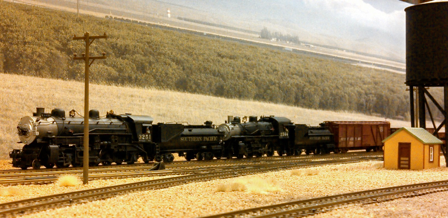
Locomotive Helpers
Helper Definition
1. A helper engine consist of not more than 8 axles, operating or isolated may be placed behind a caboose.
EXCEPTION: Within the State of California, not more than one locomotive operating or isolated may be placed behind a caboose.
2. A helper engine not qualifying under Item 1, which weighs less than 840,000 pounds, may be placed anywhere in a train, but must not exceed maximum trailing tonnage on ascending grade as shown in Timetable, or be placed behind a caboose.
3. A helper engine which weighs more than 840,000 pounds must be entrained to pull not less than 60% of the tonnage being handled by that helper.
4. Helper engine must be entrained ahead of empty two-axle intermodal cars. Helpers are not allowed to push against an empty car.
(When necessary to relocate helper due to restrictive cars, helper may be moved forward the minimum distance necessary, but must not exceed the maximum trailing tonnage on ascending grades as shown in the Timetable).
Procedure
They used to run mark up and run these beginning in 1944. Practice was, once train got run into some siding, then wait for whistle of lead locomotive, repeat whistle for loco at end of train. Wait about 30 seconds, then begin shoving. The loco on the rear was expected to push immediately after receiving whistle signal. Then the mid-train (him) would begin pushing, then the one out in front released brakes and added steam. The whole locomotive used to shake as the driver slowly turned over, without going anyplace, then in a few seconds, it eased off and they began moving uphill.
Backing of Helpers
Special Instructions for the San Joaquin Division, ETT 163 (Effective: 3/8/1942), states:
"Miscellaneous:
4(d) ... The use of SP type engines backing in helper service, should be avoided if possible. When necessary to use them other helper power must not be used to shove on this class of engine..."
Eric Berman
The issue with "backing" and/or "shoving" a SP class engine was most likely the trailing truck tended to derail.
Bill Driscoll
Helper Engine Placement (1989)
Helper configuration and placement was and still is determined by formula, train-by-train. Some of the considerations include total train tonnage, percent of train to be pushed versus pulled, drawbar limitations for the grade, and total horsepower needed to make the summit. Speed of helper removal is never supposed to be a factor. Everyone prefers rear end helpers, of course, provided they meet all the other requirements. Photos of SP trains operating show both head end helpers and the much more common mid train helpers.
SP Class (2-10-2) Locos as Helpers
The GS-4’s were double-headed with F-5 class 2-10-2 on the head end of the1955 Coast Daylight train as it traversed the pass over Cuesta, north of San Luis Obispo, CA.
SP 5000 Class (4-10-2) Locos as Helpers
An interesting Special Instruction (Miscellaneous, #4(e) - Coast Division ETT #149, Effective 3/8/1942), which reads as follows:
"Helper engines must not be placed on rear of 5000 class engines in the direction of cabooses when latter engines are being
operated back-wards."
This needs further insight as regards Special Instructions against both/either operating a 5000 (SP) class loco in reverse and/or shoving on same with a helper.
Eric Berman
They didn't want to put a 4-10-2 followed by a helper followed by a caboose (where the caboose is the end of the train) UNLESS this combination did not operate backwards -- but it sounds like it was ok to put the 4-10-2 and helper BEHIND the caboose (so that when they backed up, the caboose was to the rear of the direction of movement).
Tim O'Connor
4-10-2’s were expressly forbidden to operate on Cuesta, heading West out of SLO, but of course in an "emergency" power shortage, it DID happen. It was rare even to see the 5000s come in from Santa Barbara.
In 1951 or ‘52, they put a 5000 (4-10-2) on the front of #99 to go up the hill, as a helper. That was very rare. They were never supposed to go beyond the west switch of the yard. They were okay south of San Luis, but weren’t supposed to be used on the hill. The SP classes were prohibited from Cuesta because of track effects, while of course the F's were standard helpers. Roadmaster Pearson was really annoyed afterwards at the work they had to do on the track. If it was absolutely necessary to move west (when there was a power shortage), they were supposed to have special lubrication put on and they were supposed only to be run light.
Mac Gaddis
What tears up the track is the vertical forces created by the side rods and any imbalance in the drivers.
Lou Adler
Cab-Forwards Locos as Helpers
It was quite common to see two or more articulateds spread out within a freight.
In the late '40s and early '50s, most westbound trains between Los Angeles and Bakersfield that had cab-ahead road power probably had one cab-ahead helper cut in just ahead of the caboose, with the helper running through from LA to Bakersfield.
John Sweetser
AC-11 as mid-train helper were used on the Sunset Route about 1953.
Double-Heading Cab-Forwards
SP did doublehead cab-forward although it was not common. SP had a general rule against double-heading 4-8-8-2s on freights because that much power would tempt yardmasters to add more tonnage, thus increasing the probability of pulled drawbars. However, SP did doublehead 4-8-8-2s on passenger trains, such as the Lark and West Coast (at least) over Tehachapi, especially on days when there was a lot of head-end traffic.
Joe Strapac
It's not the locomotives exceeding the drawbar strength, it's as Joe Strapac said, it's the resisting force (weight) of the train which the locomotives exert tractive force to pull. A smaller train, like a passenger train, okay. A really big freight, like the two ACs could pull, and that can spell trouble.
Tony Thompson
An example of SP using two of the early cab forwards on the point of freight trains is shown on page 86 of, The Modoc, Southern Pacific's Back Door to Oregon where you will find a picture of two 4000s on the head end of a heavy train at Likely, Calif. This was by no means an uncommon occurrence. It was in fact a regular practice. Heavy trains out of Alturas required 4 of these engines from Likely to Sage Hen. One immediately ahead of the caboose, one cut in about 15 cars ahead of the cab and two on the point. It is interesting to note that these helpers were usually cut out one at a time, at Sage Hen, Crest and the point helper at either Viewland or Wendel.
Jack Bowden
The SP did double-head AM-2 Cab Forwards (4-6-6-2s) on freights; these were not as powerful as the more well-known 4-8-8-2 cab forwards. See photo on p.183 of Signor's "Southern Pacific's Western Division".
Jack Herris
It was fairly common for Trains such as the Owl and West Coast (Bak-LA) to get doubleheaded cab aheads, based on photos. But it was a rarity in the flats of the LA Basin.
Joe Strapac
That westward grade out of Glendale was hardly "flat," and was around 1 percent. Helping heavy trains westward wasn't rare, though two ACs had to be uncommon.
Tony Thompson
Special Instructions
A 1952 Special Instructions for the Shasta Division specifically forbids double heading of locomotives over a certain weight, which just happens to include all of the 4100 and 4200 series locomotives, on freight trains. The exact same language is in the Coast Division Special Instructions for 1953 and Southern Pacific Western Division Special Instructions No. 5, September 27, 1953:
Pat LaTorres
(All subdivisions, page 3)
"...one helper may be placed on head-end, except that not more than one AC class engine, nor more than two engines of other classes may be placed on head-end of any freight train."
The above-cited rule was pretty religiously respected out there on the main line, especially after 1940.
There were certainly exceptions out there to almost any rule, but that doesn't mean the rule was violated at all often.
Tony Thompson
Here's a link to a Trainorders discussion, which shows a picture of two AC locomotives at the head of a freight train:
http://www.trainorders.com/discussion/read.php?3,2177288,2177478#msg-2177478
Brian Moore
The Owl
The Owl's standard power is 4 F units or 2 mallets from LA to Bakersfield and back. I don't think we've ever run it in the "light season" when it had a Mallet and a MT/GS point engine.
The Mail
The Mail if above 8 cars needs a MT/GS helper, and above 12-13 cars needs a 2nd AC. By 1955 the Mail was almost dead and regularly ran with a Mk-class engine as it was usually down to only 4-5 cars.
The West Coast
West Coast usually is light enough to only need a MT/GS and a mallet, but when the train's moving extra cars (special groups) it too can fill out and require 2ACs or 4 F-units.
The San Joaquin Daylight
The San Joaquin Daylight would get 2 MT/GSs and max out at 17 cars, normal 11-12 standard consist of 'lightweight' cars. During the 'off season' the Espee was seriously looking at using one AC from LA to Bakersfield to save on the crew costs.
Train Indicators on Helper Units
On "Point" helper, the train number (ie. 99) would be in the indicator. However, on Mid or Rear helpers, the indicators were left either all black or with only two spaces "blank". Most of the photos I've seen show the mid/rear units with two spaces left blank and the rest black. Most of these helper unit photos were taken on Cuesta.
Mike Madonna
In Santa Margarita and SLO they didn't know if the helper would be on the point with a passenger train or in mid-train on a freight. It would be easier to have just two open spaces to slip in passenger numbers than to have to put all back in. It would make no difference on a mid-train.
Jim Elliot
Whistle Communication on Helper Service
SP used whistle communication between engines on helper service. Air pressure was (also?) used to communicate. There was another form of communication between the lead locomotive and the helpers. Whistles were not used as the line climbs up the Salt Creek canyon on both sides and then wraps around and goes above the lower line. With many sidings it would be possible to have 5 or 6 trains in various place of the canyon at once. (Is it your train's head end whistling or one above, below, or across from you?) The canyon also creates some echo effects even today.
Uphill trains would pull into a siding per orders and stop. At this time one or more of the helper crew would have an opportunity to get some rest. When it was time to continue out the siding and up the hill the lead engine would back the train into the helpers to gain slack (and it woke the helper crews up) and everyone would open the sanders and throttles and go. If they didn't work in unison it could easily result in a pulled draft gear which did happen often on the hill.
For water stops where the rear engines and cars cut off and backed to take water the air line would be used to tell the head end when the train was coupled back together and when it was time to go the head end would back into the helpers as described above. There is more detail on this in Austin and Dill's SP in Oregon book on page 291. Approximately the same system was used on the Donner line.
Tony Thompson
Specific Location Helpers
Chatsworth Grade Helpers
Helpers ran during the steam era to assist trains from Chatsworth "over the hill to Santa Barbara" on the Coast. They turned on the wye near the junction with the Van Nuys Belt Line. The industrial line that left the main in the Burbank area, proceeded West just South of Victory Ave to the Canoga Park area where it turned North and rejoined the main at Chatsworth Even during the 40's it was not a busy line. When the Sepulveda dam was built and the flood control area was created that portion of the line was relocated a bit closer to Victory. One time the Coast Daylight was rerouted over the line on its way to LA. in the early 40s.
This line always been called the "Burbank Branch" describing a "Van Nuys" local which ran to Chatsworth, a required Burbank local and the Gemco jobs but not which line they ran on, the Gemco is obvious of course.
Cuesta Grade Helpers
1930’s
GS locomotives were used as helpers early in the life of the Daylights, in order to preserve the colors of the train. This was the practice in the late 1930s, when the Daylight train had gotten more popular, thus longer, and a single GS could no longer take it up Cuesta. But this would have been rare any time after the start of WW II.
Tony Thompson
After 1930, the most common helper power between SLO and Santa Margarita was a 2-10-2, but other engines were used as well. #4191 was assigned to Coast Div. helper service. It would cutoff at Santa Margarita and y’ed and sent back down Cuesta to SLO.
1940’s
SLO helper operations
In the late 1940's, in San Luis Obispo, rear end steam helpers were added to westbound freight trains.
The helpers drifted (it is downhill in that direction) to the east end of the yard and coupled on there.
From my interview with Mac Gaddis, who worked there in the early 1950s, I understood that they were put on from the east end while the train was still in the yard.
Tony Thompson
Photos of the SLO roundhouse in the 1940s and 1950s rarely show a Mt.
1953
The S.P. had a pair of SD7’s (5288 & 5289) that were used as helpers on the Cuesta. They had extra ballast added.
Rob Sarberenyi
1955
Photos show Train Master #4811 on Cuesta with a helper. The top picture on page 153 of Ryan and Shine's "Night Trains of The Coast Route" (4811 on Train 71 at Salinas on March 18, 1955), perhaps the trip over Cuesta would have looked a bit weird. See the Art Laidlaw photo of 4811 at San Luis Obispo on p. 146 of "Coast Line Pictorial"
Brian Moore
1956
#4808 ran lite on X4808E WJ to SLO on August 30. 4809 as a helper on 91 on September 1, 1956.
1976
The new SLO depot was right next to the yards and roundhouse. Freights would pass the yard leads on the west end when a helper came up and coupled on, on the fly. The engine was one of the Bi-Centennial SD 45 painted units.
1995
No set duty times for the crew working the helper set in the fall of ‘95
Contrary to popular opinion, the unit that a consist is called by is not necessarily the lead unit. This makes it easier to designate helpers since they will be working back and forth in the course of the day, and it would be confusing to have to change the designation for each directional change.
Chart on wall in SP office in SLO
LOCOMOTIVE TONNAGE RATINGS IN EFFECT BETWEEN SLO AND SANTA MARGARITA TONNAGE
GP30 / GP35 / GP38 / B23-7 / B36-7540
GP40 810
GP40M 950
SD40 / SD45 / GP60 / B39 / B40` 1210
MX (MAXI-TRAX) 1420
SD70 / C44-9 1990
AC’S 2510
This is in keeping with Southern Pacific's latest method of figuring how much power is needed to get a specific number of tonnage over a specific grade and helps determine whether helper units need to be added. The ratings displayed here are for the Cuesta Grade which trains traveling the Coast Route must cross over between San Luis Obispo and Santa Margarita.
SLO Helper Units Available
SP #6823SD45T-2R
SP #8262SD40T-2
DRGW #5410SD40T-2 (with Posi-Trak) adds additional tonnage rating
San Luis Obispo is the spot where dispatch WS60 to the south hands over control to WS58 for those continuing north.
Santa Fe Helpers on the SP with SP crews
Santa Fe helpers were on the SP during the early 1940s, operated by SP crews. In an engineman's timebook for the late 30s and early 40s, he was based in Bakersfield, but would often work on the L.A. extra board, on both the San Joaquin and L.A. divisions, as far north as Santa Barbara. The specifics that we're interested in are the following entries:
DATE ENGINE NO. CLASS TIME ON DUTY
4 /20 '42 1907 / 3449 Local 12 h 25 m
4 /21 '42 1907 Local 11 h 44 m
DATE Dep. City Dep. Time Arrv. City Arrv. Time
4 /20 L.A. 8:30AM Mojave 8:55PM
4 /21 Mojave 12:01PM L.A. 11:45PM
He ran as fireman on either 1907 or on 3449 from L.A. to Mojave on the 20th. One was the road engine, and the other the helper. He then returned light to L.A. with 1907 on the 21st.
SP had no engine 1907 in service in '42, which we take to mean engine 1907 was from another road. This could possibly be AT&SF 1907, a "1900 class" consolidation.
CNW, CRIP, DMIR, GN, and NP among others also contributed power during this period. CBQ #1907 (2-6-2) which was leased by Southern Pacific from 12/22/41 until 9/26/42 to tide them over the power shortage occasioned by the start of hostilities in the Pacific. SP leased a total of three 2-6-2 and two 4-6-2 types during this time. In addition two Mikes were on the property from 4/5/42 until 8/17/42.
(*See Arnold S. Menke's Compendium Companion dated September 2001.)




Photo courtesy of Ryan Dora