Southern Pacific Lines
Coast Line Division
“The Route of the Octopus”

Southern Pacific Lines
Coast Line Division
“The Route of the Octopus”
General Information
S.P. Rule Books
S.P. issued Rule books the following years: 1907, 1930, 1943, 1951, 1960, 1969, 1976
Maintenance of Way Dept.-Rules and Instructions
Issued: 1902, January 1, 1923 (with drawings), January 1, 1943 (with drawings), 1976
Operating Dept. Rules and Regulations
Issued: July 1, 1892, January 1, 1896, January 1, 1898, June 15, 1903, 1905, January 1, 1923,
January 1, 1944, January 1, 1947, January 1, 1953, July 1, 1968
Transportation Dept.-Rules and Regulations
Aug. 1, 1907, Aug. 31, 1913, Aug 1, 1916, 1919, Jan. 1, 1923, June 15, 1930,
Feb. 15, 1943, Mar. 1, 1947, Dec. 1, 1951, July 1, 1960, Jan. 1, 1969, Oct 31, 1976,
Jun. 1, 1978, Oct. 26, 1980, Oct. 30, 1983
Updates to 1957 version, 1978 version
Here are 4 pages of the 1943 book that are online:
General Code of Operating Rules
Issued: Oct. 25, 1985, Oct. 29, 1989
Rules & Regulations (effective Feb. 15, 1943
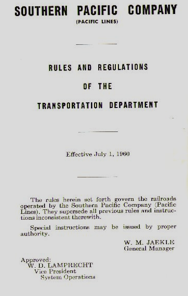
S.P. Cover Page
The rules herein set forth govern the railroads operated by the Southern Pacific Company (Pacific Lines). They supersede all previous rules and instructions inconsistent therewith.
Special instructions may be issued by proper authority.
C. F. DONNATIN,
General Manager.
Approved:
L. B. McDONALD,
Vice-President in Charge of Operations.
S.P. Inside Page
*see drawing
General Rules
A.Employees whose duties are in any way affected by the timetable must have a copy of the current timetable, and supplements if any, with them while on duty.
B.Employees must be conversant with and obey the rules, special instructions, and timetable bulletins. If in doubt as to their meaning, they must apply to proper authority for an explanation.
C.Employees must pass the required examinations.
D.Persons employed in any service on trains are subject to the rules and special instructions.
F.Accidents of any nature, also failure in the supply of water or fuel, defects in track, bridges, signals, or any unusual condition which may affect the movement of trains, must be promptly reported to chief train dispatcher from first available point of communication.
G.The use of intoxicants or narcotics is forbidden. Their use is sufficient cause for dismissal.
H.The use of tobacco by employees in uniform while on duty, or by those serving patrons in or about stations or on passenger trains, is forbidden.
Definitions
Engine - Motor-A machine propelled by any form of energy and used in train or yard service
Train-An engine or motor, or more than one engine or motor coupled, with or without cars,displaying markers.
Regular Train-A train authorized by a timetable schedule.
Section -One of two or more trains running on the same schedule displaying signals or for which signals are displayed.
Extra Train-A train not authorized by a timetable schedule. It may be designated:
Extra-For any extra train, except work extra;
Work Extra-For work train extra.
Superior Train-A train having precedence over another train.
Train of Superior Right-A train given precedence by train order.
Train of Superior Class-A train given precedence by timetable.
Train of Superior Direction -A train given precedence in the direction specified by timetable as between opposing trains of the same class.
Timetable-The authority for the movement of regular trains subject to the rules. It contains the classified schedules of trains with special instructions relating thereto.
Schedule-That part of a timetable which prescribes class, direction, number and movement for a regular train.
Division-That portion of a railroad assigned to the supervision of a superintendent.
Subdivision-A portion of a division designated by timetable.
Main Track-A track extending through yards and between stations, upon which trains are operated by timetable or train order, or both, or the use of which is governed by signals.
Single Track-A main track on which trains are operated in both directions.
Double Track-Two main tracks, on one of which the current of traffic is in a specified direction, and on the other in the opposite direction.
Current of Traffic-The movement of trains on a main track, in one direction, specified by the rules.
Station -A place designated in the timetable by name.
Siding -A track auxiliary to the main track for meeting or passing trains.
Crossover-A connection between two adjacent parallel tracks.
Fixed Signal-A signal of fixed location indicating a condition affecting the movement of a train, such as switch, train order, block, interlocking, stop boards, yard limit boards and slow boards.
Yard-A system of tracks within defined limits provided for the making up of trains, storing of cars, and other purposes, over which movements not authorized by timetable, or train order, may be made, subject to prescribed signals and rules, or special instructions.
Yard Engine-An engine assigned to yard service and working within yard limits.
Pilot-An employee assigned to a train when the engineer or conductor is not acquainted with the rules or portion of the railroad over which the train is to be moved.
Train Register-A book or form used at designated stations for registering signals displayed, the time of arrival and departure of trains and such other information as may be prescribed.
With Caution-To run at reduced speed according to conditions, prepared to stop short of a train, engine, car, misplaced switch, derail, or other obstruction, or before reaching a stop signal. When circumstances require, train must be preceded by a flagman.
_____
Note-Where, in these rules, special instructions in a timetable, or in timetable bulletin or train order, the following terms appear, they will apply as follows:
Engine -to either engine or motor.
Train or Trains-in connection with speed restrictions or the observance of signals (except train order signals), also applies to engines.
Enginemen-to engineers and fireman.
Trainmen-to conductors and brakemen; yard engine foremen and yardmen.
Outside of Block System Limits -also applies to movement on any track which is provided with block signals for movement in one direction only, when movement is being made in the direction for which block signals are not provided.
Rules for Single and Double Track
Rules will apply as follows:
Without Prefix-To both single and double track.
Prefix “S”-To single track only.
Prefix “D”-To double track only.
Standard Time
1.Standard time obtained from an authorized observatory will be transmitted to all points from designated offices daily except Sundays and legal holidays.
1(A)Clocks bearing the prescribed sign “Standard Clock” will be maintained at designated places, and employees charged with the duty of receiving time signals must record, and display when required, the correct information on prescribed form as to variation of these clocks.
Timetables
4.Each timetable, from the moment it takes effect, supersedes the preceding timetable, and its schedules take effect on any subdivision at the leaving time at their initial stations on such subdivision.
4(A). Special instructions in a timetable supersede any rule or regulation of the book of rules with which they conflict.
4(B). Bulletin boards or books will be provided at stations designated by timetable. Timetable bulletins will contain only information or instructions relating to the rules or movement of trains, supersede special instructions in the timetable or an rule or regulation of the book of rules with which they conflict, and expire with the current timetable.
Timetable bulletins will be issued by authority and over the signature of the superintendent, and will be numbered consecutively during the effectiveness of each timetable and, in addition to the bulletin number, will bear the number of current timetable.
5.Not more than two times are given for a train at any station; where one is given, it is, unless otherwise indicated, the leaving time; where two, they are the arriving and leaving time.
Schedule time, and train order time, unless otherwise provided, applies at the switch where an inferior train enters the siding; where there is no siding, it applies at the place from which train order signal is operated; where there is neither siding nor train order signal, it applies at the location of the station sign.
Both the arriving and leaving time of a train are in full faced type when both are meeting or passing times, or when one or more trains are to meet or pass it between those times.
Where there are one or more trains to meet or pass a train between two times, or more than one train to meet or pass a train at any station, it will be indicated by a heavy dash under figures, thus:
5.45 or 7.10
7.30
6.The following symbols when placed before the figures of a schedule indicate:
“s”-regular stop
“f”-flag stop to receive or discharge traffic.
6(A). The following symbols when placed at left of station name indicate:
“TO”-train order office
“R”-train register station.
The following symbols when placed at left of page indicate:
“B”-bulletin station “K”-standard clock
“W”-water station “C”-coal station
“O”-fuel oil station“I”-interlocking
“T”-turntable “Y”-wye or turning track
“P”-telephone
Double track or centralized traffic control limits will be indicated within brackets at the right of station column.
Automatic block system or automatic train control limits will be indicated within brackets at the left of station column.
The following abbreviations may be used in conjunction with brackets opposite station column in the timetable:
D.T.-double track
C.T.C.-centralized traffic control
A.B.S.-automatic block system
A.T.C.-automatic train control
Signals
7(B). Signals must be given and acted upon strictly in accordance with the rules. Trainmen, enginemen, and others must keep a constant lookout for signals.
Precaution must be exercised by trainmen and enginemen to avoid acting upon signals that are not understood, or that may be intended for other trains or engines. In case of doubt. movements must not be made until verbal understanding has been reached.
Hand, flag, and lamp signals to proceed do not supersede the superiority of trains, nor dispense with the observance of fixed signals, unless otherwise provided.
8.Flags of the prescribed color must be used by day, and lights of the prescribed color by night.
9.Day signals must be displayed from sunrise to sunset, but when day signals cannot be plainly seen, night signals must be used in addition.
Night signals must be displayed from sunset to sunrise.
10.Color Signals
*
A green metal sign will be displayed to the right of each track at the limit of restriction.
Trains must not exceed the speed specified by train order, or timetable bulletin, or fifteen miles per hour if no different speed is so specified, while passing over the structure or track affected, until the rear of train clears the restricted limit.
Where yellow signals are displayed within limits of a length of track over which a maximum speed is designated in train order or timetable bulletin and no maximum speed is otherwise specified for the particular section of track protected by these yellow signals, trains must not exceed fifteen miles per hour there over.
(Rule 10(H) - 8-30-43) Page 15.
10(J). A slow board, when used, will be placed to the right of track in direction of approach, three-fourths mile from structure or track over which speed of trains must be restricted. On double track where trains keep to the left it will similarly be placed to the left of track.
Trains, while passing over such structure of track, must not exceed the speed indicated on the slow board, the higher number indicating the maximum for trains consisting entirely of passenger equipment, and the lower number indicating the maximum for all other trains, Where but one number is shown, it indicates the maximum for all trains.
Round yellow slow boards indicate by black figures the speed restriction applying only to certain passenger trains designated by special instructions. Speed indicated by oval white slow board applies to these trains unless a round yellow slow board authorizing a higher speed is displayed on the same post below the oval slow board.
12.HAND, FLAG AND LAMP SIGNALS
*(see diagram, page 17)
12(H). Any object waved violently by anyone on or near the track is a signal to stop.
14.ENGINE WHISTLE SIGNALS
NOTE- The signals prescribed are illustrated by “o” for short sounds; “--” for longer sounds. The sound of the whistle should be distinct, with intensity and duration proportionate to the distance signal is to be conveyed.
Steam whistle will be used in sounding signals, except that when engine is so equipped, air whistle instead of steam whistle will be used in sounding signals 14(l) and 14 (p).
NOTE- The prefix signal “o” in Rules 14 (u), (v), (w) and (x) should be followed by an interval of five seconds before remainder of signal is sounded.
*
16.Communication Signals
Note - The signals prescribed are illustrated by “o” for short sounds; “_” for longer sounds.
*
17.The headlight must be displayed to the front of every train by night, and by day when range of vision is impaired by fog, rain or other adverse weather conditions. It must be extinguished when train is clear of main track to meet another train and has stopped; or is standing to meet a train at end of double track or a junction.
Headlight must be displayed through tunnels and sheds.
17(A). When an engine without cars is standing or running, headlight, or white light if no headlight, must be displayed by night to the front and rear.
17(B). If headlight fails, a white light must be substituted. Headlight failures must be reported by wire to the chief train dispatcher.
19.Markers must be properly displayed while train is authorized. Markers must be displayed to indicate the rear of every train as follows:
Fig. 1.
*
Engine Running Forward by Day, Without Cars or at the Rear of a Train Pushing Cars.
Marker lamps not lighted at AA as markers.
Fig. 2.
*
Engine Running Backward by Day, Without Cars or at the Rear of a Train Pushing Cars.
Indicators not illuminated at AA. See Rule 21(C).
Marker lamps not lighted at BB as markers.
Fig. 3.
*
Engine Running Backwards by Night, Without Cars, or at the Rear of a Train Pushing Cars.
Illuminated indicators at AA. See Rule 21(C).
Lights at BB as markers, showing green to side and in direction engine is moving and red in opposite direction.
Fig. 4.
*
Engine Running Forward by Night, Without Cars or at the Rear of a Train Pushing Cars on Single Track, With the Current
of Traffic on Double Track, and With the Current of Traffic on Passenger Tracks Where There Are Three or More Tracks.
Lights at AA as markers, showing green to the front and side and red to the rear.
Fig. 5.
*
Rear of Train by Day.
Marker lamps not lighted at AA as markers.
Fig. 6.
*
Rear of Train by Night While Running on Single Track, With the Current of Traffic on Double Track, and With the
Current of Traffic on Passenger Tracks Where There Are Three or More Tracks.
Lights at AA as markers, showing green to the front and side and red to the rear.
20. All sections except the last, will display signals as follows:
Fig. 9.
*
Engine Running Forward by Day Displaying Signals for a Following Section.
Indicators not illuminated at AA. See Rule 21(C).
Green flags at BB.
Fig. 10.
*
Engine Running Forward by Night Displaying Signals for a Following Section.
Illuminated indicators at AA. See Rule 21(C). Green flags at
BB and green lights at CC.
Fig. 11.
*
Engine Running Backward by Day, Without Cars at the Rear
of a Train Pushing Cars, and Displaying Signals for a
Following Section.
Indicators not illuminated at AA. See Rule 21(C). Green flags
at BB. Marker lamps not lighted at CC as markers.
Fig. 12.
*
Engine Running Backward by Night, Without Cars or at the Rear of a Train Pushing Cars, and Displaying Signals
for a Following Section.
Illuminated indicators at AA. See Rule 21(C). Green flags at BB. Green lights at CC.
Lights at DD as markers, showing green to side and in direction engine is moving and red in opposite direction.
21.Trains will be identified by train indicators displayed on the engine when so equipped; if not so equipped, engine number must be used in train orders when known.
21(A). Extra trains with engines equipped with train indicators will display identification as follows:
Fig. 13.
*
Engine Running Forward by Day as an Extra Train.
Indicators not illuminated at AA. See Rule 21(C).
Fig. 14.
*
Engine Running Forward by Night as an Extra Train.
Illuminated indicators at AA. See Rule 21(C).
White lights at BB.
Fig. 15.
Engine Running Backward by Day as an Extra Train, Without
Cars or at the Rear of a Train Pushing Cars.
Indicators not illuminated at AA. See Rule 21(C).
Marker lamps not lighted at BB as markers.
Fig. 16.
Engine Running Backward by Night as an Extra Train,
Without Cars or at the Rear of a Train Pushing Cars.
Illuminated indicators at AA. See Rule 21(C). White
lights at BB.
Lights at CC as markers, showing green to side and in
direction engine is moving and red in opposite direction.
21(C). Indicators must be properly displayed while train is authorized, and must be removed when train arrives at destination and has stopped clear of main track. Indicators must be displayed as follows:
*
Before making change in indicators, such action as may be necessary must be taken to protect other trains.
21(D). When an engine of another railroad is used, the initials of that road must precede the engine number in train orders.
22.When two or more engines in service are coupled at the head of a train, the leading engine only will display signals and train indicators; except that when helper engines are coupled ahead of road engine, helper engines will duplicate signals and train indicators displayed by road engine.
Use of Signals
27.A signal imperfectly displayed, or the absence of a signal at a place where a signal is usually shown, must be regarded as the most restrictive indication that can be given by that signal, and the fact reported to the chief train dispatcher.
30.The engine bell must be rung when an engine is about to be moved; while passing through tunnels; while approaching public crossings at grade, beginning sufficiently in advance to afford ample warning, but not less than one-fourth mile before reaching such crossing, and continuing until the engine has passed over the crossing; and otherwise when necessary as a warning signal.
31.The whistle must be sounded at all places where required by rule or law, or to prevent accidents.
32.The unnecessary use of either the whistle or the bell is forbidden.
32(A). Whistle signal must be sounded and bell rung by the leading engine.
Superiority of Trains
S-71. A train is superior to another train by right, class, or direction.
Right is conferred by train order; class and direction by timetable.
Right is superior to class or direction.
Direction is superior as between trains of the same class.
D-71. A train is superior to another train by right or class.
Right is conferred by train order; class by timetable.
Right is superior to class.
72.Trains of the first class are superior to those of the second; trains of the second class are superior to those of the third; and so on.
S-72. Trains in the direction specified by the timetable are superior to trains of the same class in the opposite direction.
73.Extra trains are inferior to regular trains.
Movement of Trains
82.Timetable schedules, unless fulfilled, are in effect for twelve hours after their time at each station.
Regular trains more than twelve hours late on either their schedule arriving or leaving time at any station lose both right and schedule, and can thereafter proceed only as authorized by train order.
82(A). Regular trains, unless otherwise provided, will be authorized at their initial stations by clearance, which must bear the OK, time and initials of the chief train dispatcher. At an intermediate station the following form of train order must be used:
“ENG _______ RUN AS NO. _______ FROM _______”
When its initial station is an open train order office, an extra train, unless otherwise provided, must not leave without a clearance.
83.A train must not leave its initial station, or a junction, or an intermediate station where schedules originate or terminate, or pass from double to single track, until it has been ascertained whether all superior trains due have arrived or left.
83(A). The information called for by a train register must be inscribed properly therein and the register checked by the conductor, or engineer if there is no conductor, except as hereinafter provided.
An extra train will register only at a register station where it originates or terminates, unless otherwise directed.
Check of Train Register
83(D). When a train is restricted for an extra train, the restricted train must not leave unless the extra train has been identified by the conductor or engineer, or a train order is received superseding or annulling the restriction, or a train order Form V, Example (3), is received.
A train may check the register against an extra when authorized by train order Form W, Example (4).
84.A train must not start until the proper signal is given.
85.When a train of one schedule is on the time of another schedule is on the time of another schedule of the same class in the same direction, it will proceed on its own schedule.
Trains of one schedule may pass trains of another schedule of the same class. Second and inferior class and extra trains may pass trains of and run ahead of second and inferior class and extra trains.
A section may pass and run ahead of another section of the same schedule, first exchanging train orders, signals, and numbers with the section to be passed. The change in sections must be reported from the first available point of communication.
86.CLEARANCE OF TRAINS WITHIN BLOCK SYSTEM LIMITS:
(a)At meeting points the inferior train must clear the main track before the leaving time of the superior train.
(b)When arriving time is designated for a first-class train, or a train of superior right, an inferior train in the dame direction must clear that time sufficiently to avoid delay to the superior train.
(c)When only one time is designated at a point at which an inferior train is to be passed by a first-class train, or a train of superior right, the inferior train must clear that time sufficiently to avoid delay to the superior train.
87.CLEARANCE OF TRAINS OUTSIDE OF BLOCK SYSTEM LIMITS
(a)At a meeting point between trains of the same class, the inferior train must clear the main track before the leaving time of the superior train.
(b)At a meeting point between trains of different classes, an inferior train must clear the main track not less than five minutes before the leaving time of the superior train.
(c)Extra trains must clear the time of opposing superior trains not less than five minutes.
(d)An inferior train must clear the time of a first-class train or a train of superior right in the same direction, before the superior train is due to leave the next station in the rear where time is shown, but not less than ten minutes.
S-88. Extra trains will be governed by train orders with respect to opposing extra trains.
At a meeting point between extras or between work extras, the train in the inferior timetable direction must take the siding, unless otherwise provided.
At a meeting point between an extra and a work extra, the work extra must take the siding unless otherwise provided.
89.Trains must pull into the siding when practicable; if necessary to back in, the train must first be protected as prescribed by Rule 99, unless otherwise provided.
S-90. At meeting points trains must stop short of fouling point of switch to be used by the train entering the siding, and will provide such additional clearance to fouling point as is consistent with operating conditions.
Outside of block limits, trains must stop at schedule meeting points, if the train to be met is of the same class, unless the switch is properly lined and the track clear. When the expected train of the same class is not found at the schedule meeting point, the superior train must approach all sidings prepared to stop, until the expected train is met.
S-90(A). Approaching a schedule meeting point with a train of the same or superior class, or a point where by train order the train is to meet or wait for an opposing train, the engineer must sound signal 14 (n) immediately after sounding signal 14 (m). On a train of passenger equipment the conductor must also sound signal 16 (l) at least one mile before reaching the station.
Should a stop be made after signal 14 (n) has been sounded and before the expected train is met, signal 12 (c) or 16 (a) must not be given for further movements until such train has been met, or authority is held to proceed against it.
91.Outside of block system limits, trains in the same direction must keep not less than ten minutes apart.
92.A train must not arrive at a station in advance of its schedule arriving time. A train must not leave a station in advance of its schedule leaving time.
93.Within yard limits the main track may be used, protecting against first-class trains.
Second and inferior trains, extra trains, and engines, must move with caution within yard limits.
When not protected by block signals or when moving against the current of traffic, first-class trains must move with caution within yard limits.
Note-Second and third paragraphs of this rule apply to all tracks within yard limits.
95.Two or more sections may be run on the same schedule. Each section has equal timetable authority.
A train must not display signals for a following section without train order authority, except as prescribed by Rule 85.
97.Unless otherwise provided, extra trains must not be run without train order authority.
98.Trains must approach the end of double track, junctions, railroad crossings at grade, with caution.
Except where otherwise provided, trains and engines must stop before crossing a railroad at grade, unless protected by interlocking.
99.Conductors and engineers are responsible for the protection of their train in both directions.
99(C). When a regular train, in territory designated by superintendent, receives a train order, Form I, Example (1), protection against extra trains in the direction specified is not required until the time named. Extra trains in the direction specified must not follow the regular train until the time named. Extra trains in the direction specified must not follow the regular train until the time named.
When an extra train, in territory designated by superintendent, receives a train order, Form I, Example (2), protection against extra trains in the direction specified is not required until the time named. Other extra trains in the direction specified must not enter the territory named until the time named.
103(A). Switches must not be left open nor cars left standing longer than necessary, on main or other tracks, within operating limits of wigwags, crossing bells or other automatic warning devices.
104.Trainmen are responsible for proper settings of switches and derails to be used by their train, and for their return to proper position after use, except where switch tenders are stationed, and, when practicable, enginemen must see that the switches and derails nearest the engine are properly set.
A switch must not be left open for a following train unless in charge of a trainman of such train.
104(C). Both switches of a crossover must be kept closed and secure when there is a car or engine on or immediately approaching either switch, except for a direct crossover movement.
105.Before entering a siding or other track, it must be known that switch, and detail if any, is properly lined, and when practicable, stop must not again be made until train is clear of main track. All movements on sidings must be made with caution.
Where trains are to meet or pass, train taking siding will, after clearing main track, provide such additional clearance to fouling points as is consistent with operating conditions.
A siding assigned for use by trains of a specified direction must not be used by a train in the opposite direction except in emergency, or when authorized by train order; and a train so using must take necessary precautions to insure safety.
108.In case of doubt or uncertainty, the safe course must be taken.
D-151. Trains must keep to the right, unless otherwise provided.
Rules for Movement by Train Orders
201.For movements not provided for by timetable, train orders will be issued by authority and over the signature of the chief train dispatcher and only contain information or instructions essential to such movements.
They must be brief and clear; in the prescribed forms when applicable; and without erasure, alteration or interlineation.
Figures in train orders must not be surrounded by brackets, circles or other characters.
203.Train orders must be numbered consecutively each day, beginning at midnight. Duplicate numbers of the same date must not be used over the signature of the same chief train dispatcher.
204. Train orders must be addressed to those who are to execute them, naming the place at which each is to receive his copy. Those for a train must be addressed to the conductor and engineer.
204(A). A copy of each train order affecting movement of a train having helper engines must be given to engineer of each helper engine.
205.Each train order must be written in full in a book provided for the purpose at the office of the chief train dispatcher ; and with it recorded the time and the signals which show when and from what offices the order was repeated and the responses transmitted. These records must be made at once, and never from memory or memoranda.
206.In train orders regular trains will be designated by number, thus: NO 10, and sections, thus: SECOND 10. Extras will be designated by engine number and the direction, thus: EXTRA 798 EAST.
Even hours must not be used in stating time of day in train orders.
206(A). In transmitting and repeating train orders by telephone, the names of stations, sections, and directions of extras, must be plainly pronounced, and then spelled, letter by letter, thus: Aurora, A-u-r-o-r-a; Second, S-e-c-o-n-d; East, E-a-s-t; order numbers, train, engine, and other numbers must first be [pronounced and then followed by pronouncing each figure, thus: One hundred five, 1-0-5; Twenty-seven fifty-six, 2-7-5-6, except where the number is but one figure, when it must first be pronounced, thus: O-n-e; time must first be pronounced, thus; Nine fifty; then spelled, letter by letter, thus; N-i-n-e f-i-f-t-y, followed by pronouncing each figure, thus: 9-5-0.
In transmitting and repeating train orders by telegraph, time must be stated in words and duplicated in figures.
The names of stations, sections, direction of extras, order numbers, train, engine, and other numbers, and time, must be written in train orders and in train order book, thus: AURORA, SECOND, EAST; 105, 2756, 1; NINE FIFTY 950.
206(B). When transmitting by telephone, the train dispatcher must write the train order in the train order book as he transmits it and underscore each word and number as repeated by each office.
206(C). To relay a train order, it must be transmitted in the usual manner to the relaying office. The operator at relaying office must transmit the order to destination. The person receiving the order at destination must repeat the order to the operator at relaying office, who must underscore on his copy each word and number repeated. He must then repeat the order to the train dispatcher, by whom “complete” will be given to the relaying operator, who will transmit it to destination.
If the order is also addressed to a superior train at the relaying office, the “X” response must be given before it is transmitted to the inferior train.
206(D). Before transmitting an order to a conductor or engineer over a telephone circuit, the person who is about to receive the order must give his name, train identification, and location.
The “X” response must not be used when handling train orders direct with conductor or engineer.
Each telephone booth must be supplied with necessary blanks.
209.Operators receiving train orders must write them in manifold during transmission.
211.Under the following conditions, a train order restricting the superiority of a train must not be repeated, nor the “X” response sent, until the train dispatcher has received assurance from the operator that the engineer , also the conductor when practicable, is in the office and that it is understood by them that the train is to be restricted:
(a)When a train has received a clearance, or the engine of which has passed the train order signal indicating “proceed”.
(b)To annul the authority of a work extra, unless the movement is otherwise safeguarded.
(c)When it is necessary for train dispatcher to know that an order has been delivered to a train before its use by another train may be authorized, unless the movement is otherwise safeguarded.
211(E). A train order restricting the superiority of a train for an opposing movement must not be sent to the train at the point of restriction if it can be avoided. When so sent, to a point other than its initial station, the following must be added: “ORDER TO _______AT_______”, and additional stop signals must be given by operator , and the inferior train must take special precautions to insure safety.
The order must not be delivered to any member of the crew until train has stopped, and outside of block system limits dispatcher must not give OK to the clearance until he has been assured by the operator that the train has stopped.
212.When directed by the train dispatcher, a train order may be acknowledged by operator before repeating it, by responding:
(Number of Train Order) (Train Number)
“_________________ to ________________, X”,
with the operator’s initials and office designation. The operator must then write on the order his initials and the time.
213.“Complete” must not be given to a train order for delivery to an inferior train until the order has been repeated or the “X” response sent by the operator who receives the order for the superior train.
214.When a train order had been repeated or “X” response sent, and before “Complete” has been given, the order for the train must be treated as a holding order for the train addressed, but must not be otherwise acted on until “Complete” has been given.
217.A train order to be delivered to a train at a point not a train order office, or at one at which the office is closed, must be addressed to:
“C & E _______AT_______CARE OF_______”, and forwarded and delivered by the employee in whose care it is addressed.
220.Train orders once in effect continue so until fulfilled, superseded, or annulled.
Any part of an order specifying a particular movement may be either superseded or annulled.
Orders, held by, or issued for, or any part of an order relating to, a regular train, become void when such train loses both right and schedule as prescribed by Rules 4 and 82, or its schedule is annulled.
221.A train order signal must be provided at each train order office, except at stations where all trains are required to obtain a clearance.
The train order operator must keep the signal in stop position while on duty, except when he clears it for an immediately approaching train.
When a train order is to be delivered to an approaching train, or orders are held for any other train in the same direction (except orders addressed to train originating at such station) the operator must clear the signal; he may, with permission of the train dispatcher, clear the signal when orders are held only for trains which originate at that station. If the operator does not hold an order for any other train in the same direction, unless otherwise directed, he must clear the signal after the train has reached a point from which the signal can be plainly seen. After having been cleared for a train the signal must be restored to stop position as soon as practicable after the rear of train has passed.
(Rule 221-10-30-44) first paragraph - Page 65.
When the signal indicates “stop” the train must not leave the station without a clearance; and, until the engineer has ascertained that he is not to receive an order which restricts his train at that point, it must not pass the following point of the switch at which an opposing train may enter the siding. After receipt of clearance, and orders if there be any, train may proceed without stopping, unless restricted by timetable, or by train orders previously received.
When it is apparent that orders are to be received without stopping, speed passing train order office must not exceed thirty miles per hour if delivery is to be made by operator, or forty miles per hour if delivery is to be made from delivery post. (5th paragraph - Rule 221-10-23-46).
If the signal is first seen in proceed position, or if after changing to “proceed” it is changed to “stop” before the train passes it, the train must not proceed without a clearance.
Outside of block limits, operators must space trains ten minutes apart when moving in the same direction, using the train order signal and clearance for that purpose.
Train order office hours may be shown in the timetable. When not so shown, and the train order signals for both directions indicate “proceed”, and in addition a green light is displayed by night, it will indicate that the train order office is closed.
When light is not displayed in a train order signal at night, where under the rules one should be displayed, unless a clearance is received or both arms of the signal can be plainly seen in proceed position, train must stop and determine indication. If either arm be in stop position, a clearance must be obtained when train order operator is on duty; if no operator on duty train dispatcher must be consulted before proceeding.
Train Order Signal
StopProceed
The arm to the right, as seen from an approaching train, is the one which governs. When the arm is extended horizontally, or in addition a red light is displayed, it indicates “stop”. When the arm is inclined downward at an angle of 60 degrees, or in addition a green light is displayed, it indicates “proceed”. See Rule 221.
The arms will be fastened to indicate “proceed” when a train order office is closed.
221(A). When a clearance is issued to a train the numbers of all train orders, if any, addressed to the train must be shown thereon, and conductor and engineer must know before leaving that the numbers shown correspond with the orders received, and that all information required on the clearance is properly shown thereon.
Clearance
222.Operators must promptly record, and report to the train dispatcher, all arrival and departure of all trains, reporting “no signals”, or “green signals”, as the case may be.
223.The following abbreviations may be used:
Initials for signature of the chief train dispatcher
Such office and other signals as are arranged for by the superintendent
C & E-for Conductor and Engineer
X-Train will be held until train order is made “complete”
Com-for completeNo-for Number
Condr-for ConductorMins-for Minutes
Div-for DivisionMP-for Mile Post
Eng-for EngineMPH-for Miles Per Hour
Frt-for FreightOpr-for Operator
Jct.-for JunctionPsgr-for Passenger
Subdiv-for Subdivision
The usual abbreviations for the names of the months.
Forms of Train Orders
___________
S-A.
Fixing Meeting points for Opposing Trains.
(1)NO 1 MEET NO 2 AT B
(2) NO 3 MEET SECOND 4 AT B
(3)NO 5 MEET EXTRA 95 EAST AT B
(4)EXTRA 562 EAST MEET EXTRA 231 WEST AT B
_______
(5) NO 2 AND SECOND 4 MEET NO 1 AND NO 3 AT C AND EXTRA 95 EAST AT D
(6)NO 2 AND MEET NO 2 NO 5 AND N0 7 AT D
(7)NO 1 MEET NO 2 AT B SECOND 4 AT C AND EXTRA 95 EAST AT D
_______
(8)NO 9 TAKE SIDING MEET NO 160 AT B NO 152 AT C AND 152 AT D
No. 9 will take siding at each of the designated points only for the trains named.
_______
(9)NO 156 HOLD MAIN TRACK MEET NO 5 AT E NO 7 AT F AND NO 9 AT G
No. 156 will hold main track at each of the designated points only for the trains named.
Examples (8) and (9) must not be combined with other examples of Form S-A.
_______
Trains receiving these orders will run with respect to each other to the designated points and there meet in the manner prescribed by the rules.
B.
Directing a Train to Pass or Run Ahead of Another Train.
(1)NO 171 PASS NO 3 AT K
Both trains will run according to rule to the designated point and there arrange for the rear train to pass promptly.
_______
(2)EXTRA 594 EAST RUN AHEAD OF NO 6 M TO B
The first-named train will run ahead of the second-named train between the points designated.
_______
(3)NO 273 PASS NO 3 AT K AND RUN AHEAD OF NO 7 M TO Z
_______
When an inferior train receives an order to pass a superior train, right is conferred to run ahead of the train passed from the designated point. If a train be delayed after receiving authority to run ahead of a superior train, the first-named train may allow the second-named train to pass and the order will then become void.
S-C.
Giving Right Over an Opposing Train.
(1)NO 172 HAS RIGHT OVER NO 3 G TO X
If the second-named train reach the point last named before the other arrives, it may proceed, clearing the time of the opposing train as many minutes as that train was before required to clear its time under the rules. If the first-named train is met between the designated points, the conductor of the second-named train must inform it of his arrival.
(2)EXTRA 37 EAST HAS RIGHT OVER F TO H
The regular train must not go beyond the point last named until the extra train has arrived, unless authorized by train order.
_______
These orders give right to the train first named over the other train between the points named. If the trains meet at either of the designated points, the first-named train must take the siding, unless the order otherwise prescribes.
D.
Giving Right Over Another Train in the Same Direction.
(1)NO 9 HAS RIGHT OVER NO 19 A TO Z
The second-named train must clear the time of the first-named train as prescribed by Rule 86 or 87.
_______
(2)EXTRA 95 WEST HAS RIGHT OVER 59 A TO Z
(3)EXTRA 65 WEST HAS RIGHT OVER EXTRA 75 WEST A TO Z
Under examples (2) and (3) the second-named train must clear the train order time, if any, of the first-named trains prescribed by Rule 86 or 87; otherwise it must not leave A ahead of the first-named train.
E.
Time Orders.
(1)NO 1 RUN FIFTY 50 MINS LATE A TO G
(2)NO 1 RUN FIFTY 50 MINS LATE A TO G AND TWENTY 20 MINS LATE G TO K
This makes the schedule time of the train named, between the stations mentioned, as much later as stated in the order, and any other train receiving the order is required to run with respect to this later time, as before required to run with respect to the regular scheduled time. The time in the order should be such as can be easily added to the scheduled time.
_______
(3)NO 1 WAIT AT N UNTIL NINE FIFTY 950 AM
P TEN THIRTY 1030 AM
R TEN FIFTY FIVE 1055 AM
The train, or trains, named must not pass the designated points before the time given. Other trains receiving the order are required to run with respect to the time specified at the designated points or any intermediate station where schedule time is earlier than the time specified in the order, as before required to run with respect to the schedule time of the train, or trains, named.
The station names must be written in column formation.
_______
(4)NO 1 RUN TWENTY 20 MINS LATE ON ORDER NO 17
This makes the time mentioned at each station in an order issued under example (3) as much later as specified and trains receiving this order are required to run with respect to this later time, as before required to run with respect to the time specified in the order under example (3).
(5)NO 1 RUN TWENTY 20 MINS LATE ON ORDER NO 17 FROM P
If it be desired that an order issued under example (4) shall not apply to the time given at N in example (3), example (5) may be used and will have the same meaning as example (4), except that it applies only to the times given at P and R.
_______
Examples (4) and (5) may be used in connection with a wait order of an extra when issued in the form of example (3).
Examples (1), (2), (3), (4) And (5) may be used in connection with an extra created by example (3) Form G, and the times at each point stated in that example have the same meaning as schedule times in the foregoing examples.
S-E.
Time Orders.
(1)NO 1 WAIT AT H UNTIL NINE FIFTY 950 AM FOR NO 272
The train first named must not pass the designated point before the time given, unless the other train has arrived. The train last named is required to run with respect to the time specified, at the designated point or any intermediate station where schedule time is earlier than the time specified in the order, as before required to run with respect to the schedule time of the train first named.
F.
For Sections.
(1)ENG 20 DISPLAY SIGNALS AND RUN AS FIRST 1 A TO Z
To be used when the number of the engine for which signals are displayed is unknown, and is to be followed by (2), both being single-order examples.
(2)ENG 25 RUN AS SECOND 1 A TO Z
(3)SECOND 1 DISPLAY SIGNALS B TO Z FOR ENG 99
(4)ENGS 20 25 AND 99 RUN AS FIRST SECOND AND THIRD 1 AT TO Z
_______
To add any section other than the last, (5) will be used.
(5)ENG 85 DISPLAY SIGNALS AND RUN AS SECOND 1 A TO Z FOLLOWING SECTIONS CHANGE NUMBERS ACCORDINGLY
The engine named will display signals and run as directed, and following sections will take the next higher number.
_______
To drop any section other than the last, when there are more than two sections, (6) will be used.
(6)ENGINE 85 IS WITHDRAWN AS SECOND 1 AT H FOLLOWING SECTIONS CHANGE NUMBERS ACCORDINGLY
The engine named will drop out at H, and following sections will take the next lower number.
Under example (5) of (6) it is the duty of the train dispatcher to know that each conductor and engineer has in his possession all train orders affecting his train in its new position.
To substitute one engine for another on a section, (7) will be used.
(7)ENG 18 INSTEAD OF ENG 85 DISPLAY SIGNALS AND RUN AS SECOND 1 R TO Z
The second-named engine will drop out at R, and be replaced by the first-named engine.
Following sections need not be addressed.
If the second-named engine is the last section, the words “display signals and” will be omitted.
_______
To pass one section by another, (8) will be used.
(8)ENGS 99 AND 25 REVERSE POSITIONS AS SECOND AND THIRD 1 H TO Z
Conductors and engineers of the trains addressed must exchange orders, and arrange signals accordingly. Following sections, if any, need not be addressed.
_______
Each section affected by these orders must have copies and must arrange signals accordingly.
G.
Extra Trains.
(1)ENG 99 RUN EXTRA A TO F
_______
(2)ENG 99 RUN EXTRA A TO F AND RETURN TO C
The extra must go to F before returning to C, unless authorized by train order to return before reaching F. If F be an open train order, a clearance must be obtained.
(3)ENG 77 RUN EXTRA LEAVING A THURSDAY FEB 17TH AS FOLLOWS WITH RIGHT OVER ALL TRAINS
LEAVE AELEVEN TEN1110 PM
CTWELVE FIVE1205 AM
EONE FORTY 140 AM
ARRIVE FTWO TWENTY 220 AM
This order may be varied by specifying the kind of extra and the particular trains over which the extra and the particular trains over which the extra shall, or shall not, have right. Trains over which the extra is given right must clear the time of the extra as prescribed by Rule 86 or 87. Work extras, whether required to protect or not to protect against extras, must clear the time of this extra in the same manner.
This order must not be issued while example (9), Form S-H, or example (4), form
D-H, is in effect.
_______
(4)AFTER TWO TEN 210 PM ENG 75 RUN EXTRA A TO H
Engine 75 must not leave A as an extra before 2:10 p.m.
H.
Work Extras.
(1)ENG 292 WORKS EXTRA SIX FORTY FIVE 645 AM UNTIL FIVE FORTY FIVE 545 PM
BETWEEN A AND H AND ON EASTWARD TRACK (or westward, or both tracks) BETWEEN H AND K
The work extra, whether standing or moving, must protect in both directions on single track against extra trains within the work limits, and on double track against extra trains moving with the current of traffic.
The time of regular trains must be cleared.
S-H.
Work Extra.
(1)ENG 292 WORKS EXTRA SIX FORTY FIVE 645 AM UNTIL FIVE FORTY FIVE 545 PM BETWEEN D AND E
The work extra, whether standing or moving, must protect itself against extra trains within the work limits in both directions.
_______
This may be modified by adding:
(2)NOT PROTECTING AGAINST EASTWARD EXTRA TRAINS
The work extra must protect against westward extra trains.
_______
(3)NOT PROTECTING AGAINST EXTRA TRAINS
Protection against extra trains is not required.
_______
(4)NOT PROTECTING AGAINST EXTRA TRAINS UNTIL TWO FORTY 240 PM
Protection against extra trains is not required until 2:40 p.m., and extra trains must not enter the work limits before that time.
(5)NOT PROTECTING AGAINST EXTRA TRAINS EXCEPT PROTECTS AGAINST EXTRA 73 EAST AFTER TEN THIRTY 1030 AM AND EXTRA 85 WEST AFTER ONE THIRTY 130 PM
The work extra will not protect against the extra trains excepted until the times specified and the extra trains excepted must not enter the work limits before those times. Protection against other extra trains is not required.
Under examples (1), (2), (3), (4) and (5), the time of regular trains must be cleared.
_______
When a work extra has been instructed by train order not to protect against extra trains, and later it is desired that after a certain time it clear the track for, or protect against, a designated extra, an order may be given as in the appropriate example of the following form:
(6)WORK EXTRA 292 CLEARS EXTRA 76 EAST BETWEEN D AND E AFTER TWO TEN 210 PM
(7)WORK EXTRA 292 PROTECTS AGAINST EXTRA 76 EAST BETWEEN D AND E AFTER TWO TEN 210 PM
Under examples (6) and (7) extra 76 east must not enter the work limits before 2:10 p.m.
_______
To enable a work train to work on the time of a regular train, the following form will be used:
(8)WORK EXTRA 292 PROTECTS AGAINST NO 55 (or .......... class trains) BETWEEN D AND E
The work extra may work on the time of the train or trains mentioned in the order, and must protect against such train or trains.
_______
When a work extra is to be given exclusive right over all trains, the following form will be used:
(9)WORK EXTRA 292 HAS RIGHT OVER ALL TRAINS BETWEEN D AND E SEVEN FIFTEEN 715 PM UNTIL ONE FIFTEEN 115 AM
This gives the work extra the exclusive right to the track between the points designated between the times named.
This order must not be modified or amplified, and must not be issued while an order, example (3), Form G is in effect.
_______
The work limits should be as short as practicable, to be changed as the progress of the work may require.
Work extras must give way to all trains as promptly as practicable.
Whenever extra trains are run over work limits they must be given a copy of the order sent to the work extra. Should the work order instruct a work extra not to protect against extra trains in one or both directions, extra trains must protect against the work extra; if the order indicates that the work extra is protecting itself against other trains, such trains must run expecting to find the work extra protecting itself.
D-H
Work Extra.
(1)ENG 292 WORKS EXTRA ON EASTWARD TRACK (or westward, or both tracks) SIX FORTY FIVE 645 AM UNTIL FIVE FORTY FIVE 545 PM BETWEEN D AND E
The work extra, whether standing or moving, must protect itself within the work limits against extra trains moving with the current of traffic on the track or tracks named. The time of regular trains must be cleared.
This form may be modified by adding:
(2)NOT PROTECTING AGAINST EXTRA TRAINS
Protection against extra trains is not required. The time of regular trains must be cleared.
_______
When a work extra is to be given the exclusive right over all trains, the following form will be used:
(4)WORK EXTRA 292 HAS RIGHT OVER ALL TRAINS ON EASTWARD AND WESTWARD TRACKS BETWEEN
G AND H SEVEN ONE 701 PM UNTIL ONE ONE 101 AM
This gives the work extra the exclusive right to the track, or tracks, mentioned between the points designated between the times named.
This order must not be modified or amplified, and must not be issued while an order example (3), Form G is in effect.
_______
The work limits should be as short as practicable, to be changed as the progress of the work may require.
Work extras must give way to all trains as promptly as practicable.
Where extra trains are authorized to move with the current of traffic without running orders, a work extra must not be given an order under example (2) or (4), Form D-H, nor an order that all extra trains in a specified direction will wait at a designated point.
J.
Holding Order.
(1)HOLD NO 2
(2)HOLD ALL (or eastward) TRAINS
When a train has been so held it must not be permitted to proceed until the order to hold is annulled, or an order addressed to the operator in the form:
(3).......... MAY GO
These orders will be addressed to the operator and acknowledged in the usual manner.
Form J will be used only when necessary to hold trains until orders can be given, or in case of emergency.
K.
Annulling a Schedule or a Section.
(1)NO 1 DUE TO LEAVE A FEB 29TH IS ANNULLED A TO Z
(2)SECOND 5 DUE TO LEAVE E FEB 29TH IS ANNULLED E TO Z
The schedule or section annulled becomes void between the points named and cannot be restored.
When a section is annulled from an intermediate point, opposing inferior trains must not leave that point until it is ascertained that the schedule has been fulfilled to that point or an order is received authorizing train to proceed.
It will be necessary to obtain the annulment of a schedule or section but once, provided conductor and engineer have a copy in their possession on each trip.
Form K must not be combined with other forms of train orders.
L.
Annulling an Order.
(1)ORDER NO 10 IS ANNULLED
If an order which is to be annulled has been delivered to a train, the annulling order must be addressed to that train; if it has not been delivered, the annulling order may be addressed to the operator, who must then destroy all copies of the order annulled but his own, and write thereon number of the annulling order.
When an annulling order is addressed to a train, that train must have a copy of the order annulled.
(2)THIS ORDER ANNULLED AT TWO TEN 210 PM
The above addition may be made to any order which is to be annulled at a predetermined time.
An order which has been annulled must not be reissued under its original number.
Q.
Notice of Timetable or Supplement.
(1)TIMETABLE NO 73 EFFECTIVE TWELVE ONE 1201 AM JAN 1ST
(2)SUPPLEMENT NO 1 TO TIMETABLE NO 3 EFFECTIVE TWELVE ONE 1201 AM FEB 15TH
D-R
Providing for a Movement Against the Current of Traffic.
(1)NO 1 HAS RIGHT OVER OPPOSING TRAINS ON NO 2 (or eastward) TRACKS C TO F
The designated train must use the track specified between the points named and has right over opposing trains on that track between those points. Opposing trains must not leave the point last named, nor any intermediate point where the order is received, until the designated train arrives.
An inferior train between the points named moving with the current of traffic in the same direction as the designated train must receive a copy of the order, and may then proceed on its own schedule, or right.
_______
This order may be modified as follows:
(2)AFTER NO 4 ARRIVES AT C NO 1 HAS RIGHT OVER OPPOSING TRAINS ON NO 2 (or eastward) TRACK C TO F
The train to be moved against the current of traffic must not leave the first-named point until the arrival of the first-named train.
_______
A train must not be moved against the current of traffic until the track on which it is to run has been cleared of opposing trains, or such trains have in their possession a copy of the order authorizing the movement.
Where trains moving with the current of traffic are authorized to run extra or work extra without train order authority, form D-R must not be used until all trains and detached engines, whether in service or tied up, which may use either track, have received a copy of the order.
V.
Check of Trains.
(1).......... TRAINS DUE .......... BEFORE .......... HAVE ARRIVED AND LEFT EXCEPT .........
(2)NO .......... OF .......... HAS ARRIVED (or left) .......... ON ORDER NO ..........
When necessary to make an exception of a train or trains, such exception will be added.
Where not required, the word “arrived” or “left” will be omitted.
Form V must not be combined with other forms of train orders. When this form is received train may register by ticket, provided it is not necessary to check the register against other schedules.
W.
Change in Clearance or Register Requirements.
(1).......... NEED NOT OBTAIN CLEARANCE AT ..........
(2).......... NEED NOT REGISTER AT ..........
(3)EXTRA .......... REGISTER AT .......... ON ORDER NO ..........
When example (3) is used, number and date of order named will be inserted in column of train register captioned “Signals”.
(4).......... MAY CHECK REGISTER AT .......... AGAINST EXTRA .......... ON ORDER NO .......
These examples may be combined.
Train Order No
Block Signal and Interlocking Rules
Definitions
Automatic Block System-A series of consecutive blocks governed by block signals actuated by a train, or by certain conditions affecting the use of a block.
Interlocking -An arrangement of signal appliances so interconnected that their movements must succeed each other in a predetermined order. It may be operated manually or automatically.
Centralized Traffic Control -A system of operation by means of which the movement of trains over routes and through blocks on a designated section of track or tracks is directed by signals and controlled from a designated point without requiting the use of train orders and without superiority of trains.
Absolute-Permissive Block -A system of operation by means of which the movement of trains over routes and through blocks on a designated section of track or tracks is directed by signals automatically controlled and without the use of trains orders and without superiority of trains.
Interlocking Limits -The tracks between the home signals of an interlocking.
Interlocking Station -A place form which an interlocking is operated.
Block -A length of track between consecutive home signals governing in one direction; or from a home signal to sign reading “End of Block”, of “Block System Limit”; the use of which by trains is governed by block signals.
Block Signal -A fixed signal at the entrance of a block, or within a block, to govern trains entering and using that block.
Interlocking Signals -The fixed signals of an interlocking.
Home Signal -A fixed signal at the entrance of a route or block to govern trains entering and using that route or block.
Approach Signal-A fixed signal used in connection with one or more home signals to govern the approach thereto. (For example, see Rule 281 D.)
Distant Signals-A fixed signal in approach of a home signal to govern the approach thereto, and for other caution purposes. (See Rule 282.)
Absolute Signal-A home signal governing the movement of trains without the use of train orders and without superiority of trains.
Dwarf Signal -A low fixed signal.
Grade Signal -An automatic block signal designated by a disc bearing the letter “G” on a signal mast below arm or light.
Light Signal -A fixed signal displaying indications by means of colored lights only.
Dual Control Switch -A power operated switch at each end, and may, or may not, have block signal control.
Overlap Post -A post marking the limit of control of a block signal.
Dummy Mast -A short mast placed on top of a bracket post or bracketed to the side of a signal mast, to indicate another track between the bracket post or signal mast and the track or tracks for which signals are provided.
Spring Switch -A switch equipped with a spring so that when run through in trailing movement the switch points return to their original position.
Rules Governing the Movement of Trains in the Same Direction by Block Signals
D-251. On portions of the railroad on designated tracks so specified in the timetable, trains will run with reference to other trains in the same direction by block signals whose indications will supersede the superiority of trains.
D-253. The trains dispatcher must be informed in advance of any known condition that will delay the train or prevent it from making usual speed.
D-254. Except as affected by Rule D-251 all block signal rules and other rules remain in force.
Fixed Signals
271. Automatic block signals will bear number plates attached to signal masts. Automatic semaphore home signal arms will be painted red and will be distinguished by white stripe near end of semaphore arm. The number plate on a distant light signal will bear the prefix “D”.
Interlocking signals will not bear number plates.
Absolute signals will not bear number plates, but will have plates bearing the letter “A”.
Interlocking and absolute semaphore home signal arms will be painted red.
Aspects as illustrated or referred to in these rules are shown by the position of semaphore arms or color of lights, or both, as seen from an approaching train. Other combinations may be used. (1-16-46)
Rule 282 - Proceed
Fig. 1 Fig. 2 Fig. 3 Fig. 4 Fig. 5 Fig. 6 Fig. 7
Rule 281A - Proceed Except on Diverging Route
Fig. 1 Fig. 2 Fig. 3 Fig. 4
Rule 281B - Proceed on Diverging Route
Fig. 1 Fig. 2 Fig. 3 Fig. 4
Rule 281C - Proceed. Next Signal Indicates “Proceed on Diverging Route”
Fig. 1
Rule 281D - Proceed Prepared to Stop at Next Home Signal
Fig. 1 Fig. 2 Fig. 3 Fig. 4 Fig. 5 Fig. 6 Fig. 7
Rule 282 - Proceed with Caution
Fig. 1 Fig. 2
Rule 282A - Proceed on Diverging Route with Caution
Fig. 1 Fig. 2 Fig. 3
Rule 290 - Stop
Fig. 1 Fig. 2 Fig. 3 Fig. 4 Fig. 5 Fig. 6 Fig. 7 Fig. 8
Fig. 9
Rule 291 - Dummy Masts
Signal A governs train on track A
Dummy Mast B refers to track B
Signal A governs train on track A
Dummy Mast B refers to track B
Dummy Mast C refers to track C
Rule 292 - Switch Indicators
Fig. 1 Fig. 2 Fig. 3
Block OccupiedBlock OccupiedBlock Clear
in both directions
Fig. 4Fig. 5 Fig. 6
Block ClearBlock OccupiedBlock Occupied
in both directionsto the rightto the left
Clear to the leftClear to the right
293.A signal improperly displayed, or the absence of a signal at a place where a signal is usually shown, must be regarded as the most restrictive indication that can be given by that signal.
The absence of a light, or a white light displayed where a colored light should be, in a block signal, must be regarded as the most restrictive indication that can be given by that signal, except that when day indication is plainly seen it will govern. When a block signal is out of order and not so indicated, or is improperly displayed, or working improperly, or light is out at night, report must be made from the first available point of communication to the chief train dispatcher.
294.All members of train and engine crews must, when practicable, communicate to each other by its name the indication of each signal affecting the movement of their train.
297.After passing a signal indicating “proceed”, the indication of the next signal may change to “stop”, and enginemen and trainmen must be on alert to observe it.
A train , if delayed in the block, must proceed with caution to the next signal. (5-16-45)
Automatic Block System
505.Automatic block signals govern the use of the blocks, but unless otherwise provide, do not supersede the authority of trains; nor dispense with the use or the observance of other signals whenever and wherever they may be required.
D-508. Unless otherwise provided, block signals for a track apply only to trains moving with the current of traffic on that track.
509.When an automatic block signal indicates “stop”, train, without stopping, may proceed with caution, not exceeding twelve miles per hour, under the following conditions:
(a)To enter siding where the switch is not more than one thousand feet beyond the signal and it can be seen that no opposing train has passed the home signal governing such opposing train; or that an opposing or preceding train has stopped, or is moving prepared to stop, clear of the route to be used.
(b)To enter a yard when the switch is set for the receiving track and the route is clear to the fouling point of the switch.
(c)To continue on the main track when meeting or passing a train when the view of track is clear to the point where fouled by the train which is taking siding, or when the engineer is informed by a member of the crew of the train to be met or passed that the stop indication of the signal is caused by the train to be met or passed being partly in the siding and not clear of main track.
(d)To continue within the limit of a grade signal.
509(E). When an automatic block signal number plate is reversed, showing yellow, and signal indicates “stop”, train, without stopping, may proceed with caution through the block.
509(F). When an automatic block signal indicates “stop”, train, after stopping, may proceed with caution, not exceeding twelve miles per hour, under the following conditions:
(g)On single track, when a preceding train is seen in the block, and the intervening track is seen to be clear.
(h)On single track, when view of track is clear to the end of block; or view of track is clear to a distant signal and such distant signal indicates “proceed”.
(i)On double track.
509(K). The engineer of a train entering a block under conditions described by Rule 509, 509(F) or 509(J), will be held responsible for any accident caused by encountering a train or obstruction in the block.
When proceeding under provisions of Rule 509, 509(F) or 509(J), speed must not exceed twelve miles per hour until rear of train has passed out of the block, or has passed a distant signal which was displaying proceed indication.
511.Both switches of a crossover must be open before a train starts to make a crossover movement, and the movement must be completed before either switch is restored to normal position.
512(B). Where switch indicators and signals are used, movements to main track will be governed as follows:
If indicator indicates “block clear”, switch may be set. After proper lineup has been made, signal will indicate “proceed” if block is clear.
When signal indicates “stop” after proper lineup has been made, movement must not be made to main track except as prescribed by Rule 509, 509(F) or 509(J), as the case may be, and protection provided as prescribed by Rule 99.
513.Before a train or engine fouls a main track or crosses from one main track to another, it must be known that there is no train or engine that may be moving toward the switch within or closely approaching the block to be occupied, unless flag protection is provided to safeguard the movement, as prescribed in Rule 99.
513(A). A train, having passed a signal indicating “proceed”, if delayed in the block must proceed with caution to the next signal.
514.A train entering a block between signals must be protected as required by the rules, and must proceed with caution to the next signal.
515.A train having passed beyond the limit of a block must not back into that block except under protection as prescribed by Rule 99.
515(A). When making a reverse movement on main track after moving out of a siding or other track, train will, unless movement be completed beyond the governing signals, proceed only as prescribed by Rule 509, 509(F) or 509(J), as the case may be.
Interlocking
605.Interlocking signals govern the use of the routes of an interlocking, and as to movements within interlocking limits, their indications supersede the superiority of trains, but do not dispense with the use or the observances of other signals whenever and wherever they may be required.
605(A). Interlocking limits on main tracks will be designated in the timetable, except at railroad crossings, junctions and draw bridges where the limits are clearly defined by the interlocking home signals. Where necessary, limits will also be indicated by signboards.
Signal Operators
611.Unless otherwise provided, signals must be kept in the position displaying the most restrictive indication, except when displayed for an immediate movement.
614.When the route is set, the signals must be operated sufficiently in advance of approaching trains to avoid delay.
615.When necessary to change any route for which the signals have been cleared for an approaching train, switches, movable point frogs or derails must not be changed, or signals cleared for any conflicting route, until the train for which the signals were first cleared has stopped.
616.The lever operating a switch, derail, movable point frog, or lock must not be moved when any portion of a train is standing on or closely approaching the switch, derail or movable point frog.
620.If a signal fails to work properly its operation must be discontinued, and , until repaired, the signal secured so as to display its most restrictive indication.
622.Signal operator must not make, or permit to be made, any unauthorized repairs, alterations or additions to the interlocking. Any defects in the interlocking must be reported promptly to the signal supervisor; also to the chief train dispatcher if trains may be delayed.
623.If there is a derailment, or if a rigid switch, movable point frog or derail is run through, or if any damage occurs to the track or interlocking, the signals must be restored so as to display their most restrictive indication, and no movement permitted until all parts of the interlocking and track subject to consequent damage have been examined and are known to be in safe condition.
633. If a train overruns a signal indicating “stop” or fails to obey a hand signal, the fact must be reported to the superintendent.
636.A train order signal within the limits of an interlocking must not be cleated for an approaching train until the preceding interlocking signals governing the movement of the train have been cleared.
637.Ordinarily, passenger trains must be given precedence over freight trains, but when a signal indicates “proceed” for an approaching train, it must not be changed, except as provided in Rule 615.
Enginemen and Trainmen
661.If a signal indication permitting a train to proceed has been accepted, and is changed to indicate “stop” before it is reached, stop must be made at once. Such occurrences must be reported to the superintendent.
663.A train must not pass an interlocking signal indicating “stop”, without stopping. Train, after stopping, may proceed through the interlocking limits of the interlocking signal with caution, not exceeding twelve miles per hour, under the following conditions:
(a)Upon receiving hand signal as prescribed by Rule 628.
(b)Upon receiving authority by telephone or otherwise orally from signal operator, and after a member of the crew has made careful examination of facing point switches.
669.Trains stopped by the signal operator in making a movement through an interlocking, must not move in either direction until they have received the proper signal from him.
670.A reverse movement within the limits of an interlocking, or a forward movement after making a reverse movement, must not be made without the proper interlocking signal indication or permission from the signal operator.
Absolute-Permissive Block System
740.On portions of the railroad within limits specified in the timetable and designated as absolute-permissive block system, trains will be governed by block signals whose indications will supersede the superiority of trains for both opposing and following movements on the same track.
741.Absolute signals govern the use of the routes within absolute-permissive block system limits, and confer authority to the limit of the absolute-permissive block system; but not dispense with the use or the observance of other signals whenever and wherever they may be required.
742.The train dispatcher must be informed of any known condition that will delay the train, or prevent it from making usual speed through absolute-permissive block system limits.
Within such limits, second and inferior class trains, and extra trains, must not occupy a block, or overlap in connection therewith, when it is known that a first-class train will be delayed thereby.
Centralized Traffic Control System
Note - Where in these rules the term “dispatcher” is used, it has reference to the train dispatcher or signal operator, or some employee acting upon authority of the train dispatcher.
760.On portions of the railroad within limits specified in the timetable and designated as centralized traffic control system, trains will be governed by block signals whose indications will supersede the superiority of trains, unless otherwise provided.
763.Train indicators, signals and markers must be displayed through centralized traffic control limits. Rule S-17, Fig. 7 of Rule 19, and Rule 19(A) will not apply on controlled sidings. (12-30-44)
Train Dispatchers
768.Signals must be restored to display stop indication immediately upon the passage of the train for which cleared unless there is a closely following movement in the same direction, and in the meantime no occasion to operate a switch.
769.Instructions relating to track conditions will be issued in the usual manner.
Enginemen and Trainmen
772.The main track and controlled sidings must not be fouled, unless authorized by an absolute signal indication, or by permission from the dispatcher.
775.If change of direction of movement is made while any portion of a train is occupying the section of track between opposing absolute signals at a power operated switch, the dispatcher’s permission must be obtained. This does not apply while dual control switch is operated by hand.
776.When an absolute signal indicates “stop”, except when it is known to be caused by the approach of a train at a meeting or passing point, the dispatcher must be consulted as quickly as possible after stopping, by the nearest available member of the crew. If authorized by him to proceed against the stop indication of the signal, first examine the power operated switch, if any, to see that the switch points are in proper position and the selector lever, if any, in motor position and locked, then:
(a)If authorized to enter or continue on the next absolute, or automatic, signal governing the movement is in view and the intervening track is seen to be clear of opposing trains, proceed with caution not exceeding twelve miles per hour until next signal is reached. Speed must not exceed twelve miles per hour until rear of train passes next signal.
(b)If authorized to enter siding, proceed with caution not exceeding twelve miles per hour.
777.When, for any reason, proceed indication of an absolute signal cannot be acted upon at once, dispatcher must immediately be notified.
778.When an automatic signal indicates “stop”, Rule 509, 509(F) or 509(J), as he case may be, as applied to single track, will govern; but if the signal governs entrance to the main track, permission from the dispatcher must first be obtained.
780.Trains carrying passengers or United States mail must not pass or leave a place where passengers or mail are received or discharged in advance of their time as shown in timetable.
781.Conductor of a train, or engineer of a light engine, entering centralized traffic control system at an intermediate point, must ascertain from dispatcher what instructions are outstanding as to track conditions on that portion of the system over which movement is to be made.
General Regulations
801. Indifference in the performance of duties will not be condoned. Employees who are careless of the safety of themselves or others, insubordinate, dishonest, immoral, quarrelsome, or otherwise vicious, will not be retained in the service.
802.Civil, gentlemanly deportment is required of all employees in their dealings with patrons, the public, their subordinates, and each other. Boisterous, profane, or vulgar language is forbidden. Employees must not enter into an altercation, but will report the facts to their immediate superior.
803.Continued failure by an employee to meet his just obligations shall be sufficient cause for dismissal.
The institution of any suit or legal proceedings against the Company, or any act of hostility or willful disregard of its interests by an employee, will immediately terminate the employment without further notice.
806.Property of the Company must not be sold nor in any way disposed of except by proper authority.
807. The affairs of the Company must not be divulged nor access to the Company’s records permitted, without proper authorization.
810.Employees must report for duty at the prescribed time and place and devote themselves exclusively to their duties during prescribed hours.
An employee subject to call for his tour of duty must not absent himself from his usual calling place without notice to those required to call him.
811.Employees whose duties connect them with the movement of trains must not absent themselves from their places, substitute others, or exchange duties without proper authority. Trains must not be delayed for trainsmen and enginemen to eat, without permission of the chief train dispatcher.
814.When leaving the service, or on demand by proper authority, Company property entrusted to employees must be returned.
819.In emergencies, or in case of obstruction by accident or other cause, suggestions based on observation of the actual situation are useful and required, and frequent report of progress must be made.
821.In case of extraordinary rain storm or high water, trains must be stopped, and bridges, trestles, culverts, and other points subject to damage, examined by conductor and engineer, or engineer if there is no conductor , before passing.
Trains must run with caution over portions of the track which may have been damaged, and if a defect which may cause an accident is discovered, the telegraph or telephone must not be wholly relied on to notify trains, but a flagman must be left.
824.On grades, before engine is cut off at stations to do work, or at any stop of unusual length, the air must be released and a sufficient number of hand brakes set to hold the train. Both conductor and engineer will be held responsible for compliance with this rule.
825.Cars must not be left on sidings, or tracks principally used for meeting or passing of trains, without permission of chief train dispatcher, except in emergency. When so left, the conductor must promptly inform the chief train dispatcher. Crews ate not relieved of compliance with Rule 105 requiring that trains using a siding must proceed with caution, even though they may not have been notified that there are cars on the siding.
Cars must be left clear of any street or public crossing, and at least one hundred feet from the crossing when practicable, and must not be so left as to obstruct view of an approaching train by the public.
Cars should not be stored on tracks not protected with derails, facing-point switches, or by ascending grade of one-half of one percent or over toward main track. In emergency this may be done on instructions of chief train dispatcher or other proper authority. In such cases, hand brakes must be set securely and wheels blocked where necessary.
When wooden cars are stored on tracks without fire protection, an opening of at least forty feet must be made every five car-lengths.
Outfit cars must be left adjacent to oil or gasoline loading or unloading locations, lumber yards, storehouses, warehouses or other buildings.
Engines must not be operated over the live rail of any track scale.
828.Speed of a freight train must not exceed eight miles per hour for a distance sufficient to permit running inspection when starting. Trainmen must closely watch to see that brakes are released, and if necessary must signal enginemen to stop if wheels are found sliding. Each trainman will be held responsible for wheels slid under that part of the train in his charge. Conductor in reporting flat wheels must give the name of trainman in charge. They must promptly mail to superintendent a report of flat wheels discovered under the cars in their train.
829.A standing train must not block traffic on street or public road crossings longer than five minutes.
Trains must not stand on railroad crossings at grade, on drawbridges, or within the limits of an interlocking, when practicable to avoid so doing.
831.Occupied wooden frame outfit cars must be placed next ahead of passenger cars if handled in mixed trains, or next ahead of caboose if handled in freight trains.
832.Wooden underframe flat cars must be placed next ahead of caboose, except that when handled in the same train with wooden frame outfit cars they must be placed next ahead of the outfit cars.
833.Power shovels, pile drivers, derricks, ditchers, cranes and the like must not be handled in trains with out A frames, leads and booms having been lowered and secured. Unless booms are disconnected they must be placed in trains in trailing position when possible. Center plow and wings of spreaders must be securely fastened and chained prior to shipment.
When such roadway machines are operated on double track, or on track next to a main track, or on ground adjacent to a main track, boom or other parts of machine must not be operated to foul main track without proper flag protection. Such equipment must be at rest and clear of main track when a train is passing.
834.Open top cars loaded with rail, pipe, lumber, structural steel, poles, or mounted wheels, when such lading projects above sides and end walls of the car, must not be placed in trains next to caboose, occupied outfit cars, cars loaded with high explosives or inflammables, nor cabs or tenders of oil burning engines.
835.When handled in trains, yard engines not equipped with engine trucks must be place, when practicable, with the tender ahead.
Conductor must inform engineer and chief train dispatcher when there is equipment in train requiring restricted speed.
836.Cars must not be shoved ahead of engine between stations when it can be avoided. When necessary to so handle, speed must not exceed twenty miles per hour.
837.Switching must be carefully done, and trains must be carefully handled, to avoid shocks from abrupt starting or stopping of cars, or from impact in making coupling, and to prevent damage to cars or contents.
Before fouling any track it must be known that engines or cars on adjacent tracks will clear.
Cars must not be shoved or coupled without a definite knowledge that lead or adjacent tracks will not be fouled.
Before beginning to shove cars they must be stretched to insure that all cars are properly coupled.
841.Employees must provide themselves with a copy of, and be conversant with, all rules and instructions applicable to or affecting their duties.
842.Yardmasters are responsible for conditions within yards. Trains and engines will be under the control of the yardmaster, and all employees in train, engine or yard service will be subject to his direction as to movements within yard limits. Road crews of trains entering yards will be responsible for their respective trains and engines until the yardmaster or his representative takes charge. Yardmasters will keep informed of important trains, such as stock, fruit and manifest, and make every effort to get them through the yard with the least possible delay. They must see that cars loaded with explosives or inflammable material are placed in trains the prescribed distance from the engine and caboose. Freight assigned to particular trains must be forwarded in such trains.
843.The general direction and government of a train is vested in the conductor, and all other persons employed on the train will obey his instructions. Should there be any doubt as to authority of safety or proceeding he will consult the engineer, who will be responsible with him for the safety and the proper handling of the train and such use of signals and other precautions as circumstances may require. He must obey the instructions of yardmasters within yard limits and be governed by the direction of agents in doing work at stations, and conform to the instructions issued by the Traffic and Accounting Departments.
867.All freight handled in trains must be covered by waybill. A car must not be taken from a station if it is unsafely loaded.
868.When necessary to set out cars which are in bad order, wire report must be made to the chief train dispatcher, stating nature of defect and giving initials and number of car and if loaded, contents, destination, and waybill reference.
Prompt notice must be sent to the chief train dispatcher of the completion of repairs to disabled cars.
874.Enginemen must be alert in all matters pertaining to safety and while running must keep a constant and vigilant lookout, carefully note all signals, observe position of switches and derails affecting their movement, and watch for obstructions and defects in track. They must frequently look back for signals and indications of defects in train, especially while rounding curves and approaching or leaving stations.
In backing into a track to take or leave cars, engine must approach with caution to avoid injury to persons or damage to property when coupling is made.
875.So far as practicable enginemen must observe all wigwag and other crossing warning devices, and must report from the first available point of communication any that are out of order, stopping for that purpose if necessary.
876.When visibility is impaired by fog, storm, or otherwise, the engineer must sound the whistle frequently as a warning to trackmen and others.
877.When stock is found inside of right-of-way fence, sectionmen must be notified, when practicable, and report made by wire to the chief train dispatcher. Should stock be killed or injured, report on prescribed form must be made.
884.When possible to avoid it, engines must not be left standing within one hundred feet of a street or highway crossing; nor under any bridge; nor in the vicinity of waiting rooms, telegraph or telephone offices; nor near cars occupied by passengers, when the noise or smoke may disturb the occupants.
Except in emergency, or in compliance with Rule 14(l), the whistle must not be sounded while opposite a passenger train.
895.Every effort must be made to obtain cars for shippers at the time desired, but promise must not be given to furnish cars within a specified time, unless authorized. Cars must be ordered form the chief train dispatcher as required, and the commodity, destination, and route when for points off the line, shall be given. When possible, cars of proper capacity must be furnished. Cars must be loaded to capacity when practicable. Cars furnished for loading must be in proper condition for the class of freight to be loaded. Report should be made to the chief train dispatcher when cars received are unfit for the purpose required. When the demand for cars exceeds the supply, the available cars must be distributed in proportion to the actual requirements of shippers, their ability to promptly load, and with due regard to the sequence of orders. Agents must see that cars are promptly loaded and unloaded, and that demurrage and storage rules are enforced.
896.Freight must be loaded safely and stowed properly, and, when necessary, fastened securely by brackets, cleats, stakes, chains, or other means, as the nature of the freight may require, to prevent loss or damage by falling, shifting, chafing, breaking or by contact with any contaminating substance. In loading way cars, freight must be stowed in station order. The loading of lumber, timber, scrap metal, and other freight on open top cars must be in conformity with Rules Governing the Loading of Commodities on Open Top Cars as published by the Association of American Railroads, printed copies of which will be furnished for use of shippers upon allocation to the superintendent.
Loading must conform to the prescribed weight and clearance restrictions applicable to the entire route via which shipment is to move.
897. Before cars are forwarded, the required cards must be applied as indicated by the special instructions relating thereto, and old cards removed, except the
A. A. R. defect or repair cards.
900.Unless otherwise directed, separate cars must not be used or ordered for partial loads of freight that can be loaded into cars of local freight trains.
901.Conductors must be furnished switch lists promptly, copies of which must be retained for office record. Every effort must be made to avoid delay in movement of cars.
903.Less than carload shipments of freight must be marked plainly, showing consignee and destination, and all old marks must be erased.
906.Freight, baggage, mail or express matter, trucks or carts must not be left between tracks, nor within six feet of any track, and must be secured with appliance provided. Handles on four-wheel trucks must be turned under, or secured in raised position.
908.Station employees must not handle switches for trainmen, except where, by special instructions, it is made their duty.
909.When there are indications of windstorms, cloudbursts, or abnormal weather conditions, agents must take precaution to prevent cars from moving and obstructing the main track.
Agents must inform the superintendent promptly by wire regarding the severity of storms and extent of damage that may result.
915.Unless otherwise provided, operators are subordinate to agents and will devote themselves first to telegraph and telephone service, giving train orders preferred attention. Those who have additional duties must be within hearing of their instruments when possible, and arrange their work so it will not conflict with the proper handling of telegraph and telephone business. They must not be absent themselves nor close office with out permission from the train dispatcher, except when means of communication fail.
920.Office hours of train orders offices are fixed by the superintendent. Operators at station where offices are not open continuously, most post notice showing location of their place of residence, so they may be called in an emergency.