Southern Pacific Lines
Coast Line Division
“The Route of the Octopus”

Southern Pacific Lines
Coast Line Division
“The Route of the Octopus”
Timetables
Employee Timetable (ETT) Designations
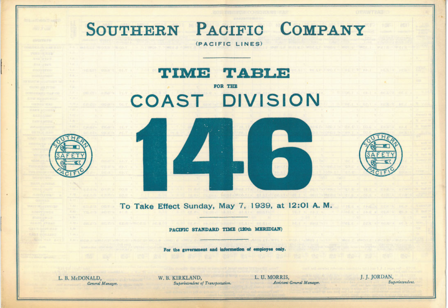
On the cover of employee timetables there appears a number designation (190, 165, 2, etc.). These are sequential issue numbers, and each Division had its own sequence. Periodically, numbers would restart at 1, generally after some major changes in Division alignments or other important matters which dictated an issue with substantially changed data.
For the Coast Division timetable numbers, for example, numbers went on increasing right through the issue of the 1951 rulebook.
Tony Thompson
The Coast ETT #1 was issued 4/28/1889. The Coast ETT #17 was issued February 1, 1896. The Coast Division Timetables spans lots of rulebooks.
Shasta division's last ETT before consolidation with Sacramento division on 9/15/1932 was #48 of 8/7/1932. The combined division was first shown in Sacramento Division Supplement 1 of 9/18/1932 to #148. On 7/1/1941, the old Shasta Division territory was removed from the Sacrament division and a new Sacramento-Shasta division #163 (note the continuation of the Sac division # sequence) was issued effective 9/9/1941. A new Shasta division #49 became effective 9/28/1941. The next effective Sacramento division ETT was #164 of 9/28/1941. The ETT correct dates and numbers were extracted from a list of SP ETTs compiled by David Bernstein.
Bob Pecotich
ETT Format
They continue as large format 'saddleblanket' ETT until #153 issued 4/14/1946. Numbering continues to ETT #186 which was issued Oct. 27, 1963. In 1964 the Coast Division was split with RR West of SLO going to the Western Division and RR East of SLO going to the LA Division.
Bruce Morden
June 2, 1946 marked the effective date of new timetables for all of the Pacific Lines divisions. With the two exceptions of the Coast and San Joaquin divisions, all Pacific lines ETTs were changed to the new, smaller fold-over format, which replaced the "horseblanket" format. The San Joaquin division changed to fold-over format with ##166 on 1/20/1946 and Coast Division changed with #153 of 4/14/1946.
Bob Pecotich
SP Station Numbers
There was a correlation between station location, station number and station mileage. It varied over time.
The numbers--with the letter prefix--are indeed station numbers. They are numbers that are made up of a route symbol (the letter) and a numeric value equivalent to the mileage of the station. So, it is more than just the mileage, and as the station book calls the letter-number set a "station number", so it is. W.
Wendell & Joe
Each line segment was assigned a letter symbol(1 to 3 letters). The principle mainlines were assigned as follows: A San Francisco to Ogden; B Martinez to Tucumcari; C Roseville to Portland via Ashland; D Oakland to Elvis via Tracy and E San Francisco to Burbank Jct. Between Tracy and Lathrop D was used as the route symbol, not B.
The other lines used other letter symbols, usually with the the first letter of the symbol being the letter of the principle route that it connected with. Examples are the San Ramon Branch BO, Monterey Branch EE, Coos Bay Branch CO, Mainline via Klamath Fall CF, Modoc line CFA and Chino Branch BAB.
In most cases the mileage was list as whole miles, but at some stations the mileage was carried out to the tenth.
This system of station numbers was used from at least 1904.
Cliff Prather
1883
There was an earlier time when there were station numbers which did not relate to mileage, but to sequence. In 1883, Tracy was station no. 43-1/2, Merced no. 69, and Fresno no. 81. Patterson is not listed as the west side line was not yet built. This system of numbering stations was gone by 1905 (could have been well before then), when I see a system based on mileage though with different miles (for instance, Fresno is B 207.
Wendell
1936
The alphabetical list of stations at the back of the 1936 "station book" includes a column for station number, but the number given is merely the milepost as given in the station listing by line/branch. All the stations of particular routes are given particular letter prefixes--such as the B on B151 for Merced. In this book, Tracy is D71, Fresno B206, and Patterson BA107. The B route is Martinez to Tracy and Tracy to Biola Junction (east side). BA is Tracy to Biola Junction (west side). And D is Oakland to Polk via Niles and Tracy.
1950s
By the 1950s SP was using unique station numbers that were not related to milepost locations. The SP did use a route symbol and the mile post to determine the station number until sometime before 1953.
Joe Strapac
Mileposts
The mileposts are usually expressed to the first decimal point, i.e. 70.8 is Tracy, for example. Still is, - was in 1935. It's easy to see how a trainman might round off to the nearest mile. Unless there was a renumbering between 1935-8 and 1953, what you are seeing are not station numbers.
Timetable Freight "Slots"
The numbers in the 400's are timetable freight "slots". That is, a freight could be run on timetable under those numbers. That did not designate WHAT the freight was.
Symbols
Symbols designated what the make up of train was as in TMW, NCP, PSS, MUG, etc. Any symbol could be assigned any timetable number. Having said that, day after day, night after night, they tended to to stay the same. I have a great photo of the MUG running as 1-427 in 1952. Additionally, any symbol freight could be run as an extra.
Those symbols that you mention though, are trainmen's slang, not SP symbols.
Paul Chandler,
Superintendent, Lathrop Subdivision
Western Division, 1954
Bulletins
Bulletins are notices affecting operating rules. SP Bulletins were pink in color and numbered consecutively. When the current timetable expired they all became void and it was necessary to start all over again with the number one. Bulletins covered such things as changes in the rules or timetables. They were posted at specified stations.
SP and Daylight Savings Time
Railroads, in general, did not observe Daylight Savings Time "back in the day"year round, with a couple exceptions. WWII was one exception, LIRR was another, and that's about it. (Maybe WWI too.) Most interstate trains would continue to operate on the same standard time schedules year around.
However during the time daylight saving time was observed, the trains operated an hour later in locally observed time. So the average guy who needed to be at work at 0900 PST in the winter needed to arrive at 0800 PST in the summer. The SP employee timetables up to about 1966 or 67 showed the times listed an hour earlier in respect to daylight savings time. As an example, SP commute trains need to run an hour earlier in the summer, as long as RR clocks continue to show Standard Time.
Short distance trains such as the Lark that needed to fit into local time periods would be adjusted twice a year to maintain the same local times of operation. The company issued new employee timetables, as well as public timetables, at the start and end of daylight saving time to adjust the time of trains to meet local needs.
California didn't use DST in the 1920-30s, or in 1946 or 1947. They did have it in 1948, then not in 1949, then maybe in 1950 and definitely in 1951 and every summer thereafter.
SP's summer timetables were frequently printed in standard time, even when California was on Daylight savings time. This would be particularly true of national timetables, and timetables where the trains passed thru states where some were on standard time and some were not. The above errors [in interpretation only] were summer timetables with the schedules in standard time, with local time being an hour later. After 1950 the Coast Div needed a new ETT twice a year, also the LA Div, since the Daylight/Lark operated like the commutes. But transcon passenger trains didn't, so UP wouldn't have to change ETTs so often. In October 1966 railroads started changing their clocks twice a year.
Commenting on Daylight schedule, the soundtrack indicated 7:15AM departure and 5pm arrival. The Daylight always left at 8:15AM and arrived 6PM LOCAL time. In the case of California, the state would be on Daylight Savings time, making local time one hour later than that printed in the timetable. Local timetables, for example the San Joaquin or Coast Routes, may have been printed in Daylight Savings time in summer.
Looking at the Western Division #5, effective April 24, 1966, shows EVERYTHING, freights and passenger on Standard Time, all times an hour earlier than normal... i.e. 98 leaving at 7:25a from SF instead of 8:25a.
Wesley Fox
For many years the clock faces on the tower at LAUPT bore the legend: Pacific STANDARD Time (emphasis in the original)
Standard Clocks
Standard Clocks were maintained on the SP at location listed in the timetable (the k symbol). These were usually points where train crews would go on or off duty. Operator at train order stations and signal towers were required to have an approved railroad watch when working any location that did not have a standard clock. The time could be checked at locations without a standard clock by calling the DS or a location that send out a time signal. A time check was made each day and all standard clocks had to be check and set to the correct time (the Santa Fe did not reset the clock, but noted the variation from the correct time on the clock or posted it "correct").
In 1946 (LA Division TT No. 185 10-6-46) there were 11 train order stations shown on the Ventura Subdivision between Los Angeles (LAUPT) and Santa Barbara. Standard Clocks were located at only four sites, Santa Barbara, Oxnard, Los Angeles Yard (Taylor Yard) and Los Angeles LAUPT.
There may have been secondary clocks at every TO office but only the major ones considered "standard," ordinarily wherever crews went on and off duty.
Tony Thompson
Specific Timetable Designations
1938 Ogden Timetable Abbreviations
B Bulletin station
D Diesel fuel station
f Flag stop
I Interlocking
K Standard Clock
O Fuel oil station
P Telephone (shown on almost all sidings and spurs)
s Regular Stop (placed before the figures of the schedule time at a station indicates a regular stop)
T telegraph?
T Turntable
TO Train order station
W Water station
Y Wye or turning track
1943 SP Rule and Regs Book Abbreviations
B Bulletin station
C Coal Fuel station
c Conditional flag stop (see Special Instructions)
CTC Centralized Traffic Control
D Diesel fuel station
DT Double track
f Flag stop
I Interlocking
K Standard Clock
O Oil station
R Train-register station
s Regular Stop
T Turntable
TO Train-order station
W Water station
Y Wye or turning track
1947 SSW Timetable Abbreviations
A arrive
C Coal
D Day Train-Order Office
DN Day and Night Train-Order Office
f Flag stop to receive or discharge traffic
L leave
N Night Train-Order Office
NS No Siding
O Oil
s regular stop
T Turntable
W Water
X Track Scale
Y Wye
* Mail Crane Stations
1950's Rio Grande 'Timetable Abbreviations
B Bulletin station
C Coal
P Telephone
O Oil
I interlocking
K Standard Clock
T turning facility
W water
Y yard limits
1960 SP Timetable Abbreviations
ABS Automatic block signal system
A-PB Absolute-permissive block system
ATS Automatic train stop
B Bulletin station
c Conditional flag stop (see Special Instructions)
CTC Centralized Traffic Control
D Diesel fuel station
DT Double track
f Flag stop
I Interlocking
K Standard clock
O Oil station
P Telephone
R Train-register station
s Regular stop
T Turntable
TO Train-order station
W Water station
Y Wye or turning track
1996 Western Region ETT Abbreviations
A Automatic interlocking
g Gate, Normal position against conflicting movement
G Gate, Normal position against this subdivision
G w/slash through it - Gate, left in position last used
M Manual interlocking
Q Radio base station
R Radio controlled Dual-control switch
S Railroad crossing protected by stop sign
T Turning facility
Y Yard limits
The California State Railroad Museum Library has extensive files of SP Coast Division employee timetables back to the 1900s. A telephone call (916/323-8073, Tues-Sat 1-5PM) to Ellen Halteman (Senior Archivist) will let you know specifically what issues they have that can be copied (some are in bound volumes only and cannot be copied; others are unbound and loose).
Regarding the B (bulletin station) and K (standard clock) designations, bulletins and standard clocks would be found at locations where train or engine crews or both went on and off duty. For example, Palmdale had the identification of B and K in a 1942 San Joaquin Division timetable because helper engines and their crews were based there at the time. Concerning Q - radio base stations, The SP didn't start using train radios until the mid-fifties and for many years, radios were limited to locomotive-caboose communications (i.e., no base stations). Equally unbelievable would be 1960 timetables indicating the presence of coaling facilities, (C - Coal Fuel station).
John Sweetser
SP Agency
In was a copy of a Circular 4, the list of Agencies, Stations, etc. book and the letter codes given are:
Letter code given for SP Agencies
C coupon (A coupon agency can sell tickets for connecting railroads.)
F freight
T ticket
X joint SP/REA
Articles/books concerning the Lark's schedule
One had the Lark leaving San Francisco at 8PM; another had the northbound Lark leaving Palo Alto at [it was 6:42 or 7:12AM].
Since some trains coming thru San Jose also went up/came down the east side of the bay to/from Niles and Oakland, a look at Western Division timetables may also be of interest. CSRM also has those.
Tony Thompson
Running Ahead of the official ETT schedule
Most basic rules prohibit leaving a station ahead of schedule, the ability to contravene that rule would be a very interesting operations detail. Some trains did run ahead of the ETT published schedule. An example would be a daylight-hours train with a Lark number is either running ahead of or behind the ETT Lark. But timetable authority only lasts for 12 hours after a scheduled time; and the trains in question were FIRST 75 or 76, not second.
Remember the Lark always left its origin cities after dark. Any shot of 1-75 or 1-76 in daylight, at a recognizable location in the first 300 miles of its run, will be solid evidence-- enough to justify head scratching, and more.
Tony Thompson
Since they can't operate ahead of schedule with that number then they must be running late. The lark schedule was an 8 hour trip and they left in the early evening there's plenty of daylight time in the morning on the south end before their 12 hours are up, if they left at 6pm they would have until noon the next day to complete an 8 hour trip, causing of an unusual delay, maybe due to a storm. Then there was no Lark passenger train at all, since it is 1-75.
Tony Thompson
Of course, time orders (Form E) cannot be used to run a train early. You could accomplish it by annulling the later Lark, then operating the "Advance Overnight" as an extra, but that neither helps with the eventual schedule of the passenger Lark, nor does it explain the use of "1-76" as a train number.
Tony Thompson
Signal Scenario & Timetable Schedules
Rules 86 and 87 were not changed and still require inferior trains to clear the main for superior trains with sufficient time to avoid delay. The timetable schedule for regular trains allows them to be up to 12 hours late and still have class and direction authority. Clearances and or form F orders can be issued to create sections of any scheduled train.
And sections can be created or annulled at intermediate points, so "1-75" could operate from San Luis Obispo to Watsonville Jct, or SJ-SF, or LA-SF.
The schedule, that is, the published ETT schedule, not the train name, nor symbol nor public TT, plus some simple rules, as "You must not leave ahead of schedule" is all that was between the train crews and death, tempered slightly by Automatic Block Signals, where available.
So you're at Sudden in the middle of the night as X1736W, light engine, and the phone is out, no operator on duty. The ETT says you have an hour to get to Surf ahead of #75's schedule and nothing opposing, (Timetable and Trainorders) so the switch is thrown and the block signal fails, or you miss it because the switch won't close, or the injector won't shut off, and The Overnite, "running an hour ahead of the Lark as 1-75", has already passed the signal at the other end.
1-75 can't stop in time. You are DEAD.
The signal scenario is recorded in the ICC wreck reports, but at Oceano, and no "run-ahead of schedule".
Yes, of course. But the "Advance Overnights" in question were operating in the early afternoon, to judge by the shadows. This is not a train which is 20 minutes ahead of schedule. Obviously some means of notifying other trains would have had to be used. Bruce Morden's comment about the change in rule 92 is fascinating, but does not seem sufficient to explain this situation.
One example (as "75" not 1-75) in what looks like midday is on page 115 of the Moaning Sun book on "Official SP Color Photography, Vol. 1."
Tony Thompson
The Overnite got "signals displayed for following section". PTT's usually did not exactly coincide with the ETT but often showed a departure a minute or two ahead of the ETT, and arrival after (public relations). How did the PTT/ETT arrival times at SF compare? Did the Overnite leave LA a couple hours ahead of the LArk (NO not as #75, but as 3-833 or X4420N or ??) and become 1-75 at San Jose, when the actual and bone fide Lark was close behind, but good power, almost straight track, flat profile, manned interlocking towers at Visitation, Mission Bay allowed everything to work without violating the rules, and PTT padding made the passengers think they got there "on time"??
The Overnite could run in front of the Lark.
The Overnite could NOT run ahead of the #75 schedule. Only by human error? NO way in hell by the basic rules.
If the dispatcher could make a train run three or four hours a head of it's ETT Time, then a 31 order would have to be issued to every person that carried a TTS In that area and the train could not move until every one named in the order got his copy. If the train left and you missed one person you will have a good chance of killing him and others and then you get to go and pick Apples because you will not dispatch trains any more. An extra can show any time but a ETT train can not move a head of it's ETT time. And in yard limits you do nor have to protect against extras. If you in YD LMT and open a main line switch you must wait 10 minutes before you can foul the main line.
Accepting that the photo wasn't doctored, how did they run the train as the first section? It's very easy to say that "thay can't do that", yet the photograph exists showing it was done.
"One example (as "75" not 1-75) in what looks like midday is on page 115 of the Moaning Sun book on "Official SP Color Photography, Vol. 1."
In the late 1950s a train showing "75" in the indicators was the last section of train 75-- the train in the above pic is running hours late. The evidence we're hoping for is a pic showing 1-75 in the indicators, in daylight.
Actual Schedule or "Approximations”?
If you mean: were intermediate cities' times slavishly followed, no. Only those trains noted as having critical connections would have attracted major attention on time-keeping. But yes, the desired timing is what is shown. Extras? I doubt it. Mac Gaddis told me that the symbol trains used whatever timetable train number was handy at the time they were ready to depart. You will note, Lou, that NONE of these hotshot trains are in the timetable--which would be backwards from the usual practice of timetabling hotshots and running drags, with VERY flexible timing, as extras.
Tony Thompson
These were sales and marketing tools to be able to show customers when and how their produce or products would be shipped, over what routes, and when. These were not train schedules. Each proposed train was a symbol freight as you point out, but it was up to the Chief Dispatcher at the originating terminal to assign the train to the schedule or run the train as an extra. Sometimes there was not enough tonnage for a particular symbol to run a daily train. Sometimes symbols were combined. Sometimes there was enough tonnage to run multiple trains of the same symbol daily.
The actual Employee's Timetable (ETT) typically would carry the assignation for first class trains, but second and third class (if used) trains would simply be listed as freights. Those assignments were strictly up to the Chief Dispatcher as to how best to get his trains over the road. AND, in truth, the Chief was probably taking his orders from the Trainmaster.
Paul Chandler
These are INTENDED schedules, and only the Dispatcher creates actual train movements. I would expect that parts of management DID want these schedules to happen.
Tony Thompson
Very seldom did the trains ( outside of certain hotshots like the BSM) actually perform according to these times listed. They were a guide for operating department personnel and a tool for marketing and sales for customer questions. At certain times did the senior operating people, when they talked to OP&C ( Operations, Planning and Control in SF), request actuals against the schedule and over the years taking this info down, I found that, as I said with the exception of a few trains, many were off schedule by 3-18 hours, especially the lower rank trains listed on the sheet.
Wesley Fox
Scheduled vs. Extra Trains
A train over 13 hours late is no longer a timetable entity. It has to be an extra train.
You were still cinderella at 11 hours and 59 minutes but turned into a pumpkin at 12 hours. It did not automatically become an extra. At the witching hour it could not run any further. Then the dispatcher had to issue a train order making it an extra. If he wanted it to run as a passenger train with right over other trains He had to issue such an order and then make u schedule for it.
The photo of #101 coming into Elko that Kalmbach printed in "Our GM Scrapbook" was shot it on the night of April 11, 1968, but that it was actually the first of two #101's that night. The train was running something like 18-20 hours late, with the classification lights illuminated on the SDP45's nose. The train was, in fact, running as an extr that night.
Had they been running as a regular timetable train with white lights all hell would have broken loose. The first Open OS station would have reported it as an extra that was not on the line. Any trains it had met would have refused to move after he went buy because the timetable train had not arrived and an extra that they had nothing on would mess with them. The dispatcher would have the next OS station put a red order board on them and with no orders being handed up it would have been required to stop and back up for orders and then catch He** from the dispatcher. The conductor then would be all over the engine crew.
Scheduled Stops
Stops at SLO
Steam Powered Daylights could stop at SLO, take on water, couple or uncouple a helper, service the locomotive with grease and oils, get necessary train orders, change crew plus make sure passengers detrained and boarded. All this in five scheduled minutes. Today the Amtrak Starlights, with non-servicing diesels and no helpers are scheduled for a 13 minute stop.
Jim Elliot
Flag Stops
Passenger on Train
When a passenger on a train wants to stop to go home, they have to ask the Train conductor for the stop. Early passenger cars had a signal cord that the trainmen could pull to send a signal to the engineer. Rules required a running air brake test when leaving the originating station of the crew. (This rule applies even today). This signal cord is what the rear brakeman used from the rear car to let the engineer know that the brakes applied and released on the rear car. I'm sure this same signal cord was used to make a flag stop.
Mike Smth
The signal cord could also be used by trainmen to signal the engineer to stop. Trainmen would know where a passenger wanted to get off when they took his ticket. The signal cord in the car vestibule was pulled a certain number times to signify a stop. By the way, it really wasn't just "early passenger cars" that had signal cords. The rider coach on No. 7 was a lightweight stainless steel car.
John Sweetser
Passenger at Station
You would go to the depot and buy your ticket. Either the agent sent out a telegram or called the agents down line and told them there were passengers boarding a few minutes before train time they went out and started waving a flag once the train appeared at the first crossing.
John Patterson
The SP rulebook had a rule 28 that appear through, at least, the 1943 book of rules that stated that a green and white signal must be used to stop a train at authorized flag stops. At a later time the rule was omitted from the rulebook.
To board a train at the station when there was no station agent, when the train came into the station you would just waive. The engineer would stop the train. This was not a huge problem due to the slower speeds. The speed was either 25 or 35 MPH.
Richard Todd
In high speed territory, the Hogger slowed down to take a look see before he "kicks them off" and blows through town. If the train is ahead of schedule, the flag stop becomes a station stop until departure time at that station. Amtrak has flag stops to this day.
Some trains like the Coast Mail had numerous flag stops at non-agency station and in later years, passengers would stand at the station location and wave their arms to get the train to stop. Getting the train to stop for passengers already on the train was easier as the conductor would use the communication signal to Instruct the engineer to stop at the next station (rule 16d. Three shorts -when running stop at next station). The later use of the radio would make flag stop communication easier.
Cliff
Register
When the time at a station is printed in "Bold Face" type it is a scheduled meeting place with another regular train. If the time is also underlined it is a meeting point with two or more trains.
A station by station history of SP east of Montello, is at the link:
All trains normally have to register. That is how another crew knows that a train which may have to be cleared has (or has not) arrived (or departed).
Tony Thompson
Through the assignment of train numbers is that it appears many branch line crew schedules called for its daily duties to include operation of both the eastward and the westward trains on the branch in question.
For instance, the Raymond Branch mixed (#456) crew, it appears, would work east from Berenda as a second class train, register when it arrived at Raymond, then work west as a third class train (#459) to Berenda. The reason for the jump in numbers was that it also had to serve as the Knowles Mixed, which had its own numbers. So it left Berenda as 2nd class train #456, marked up as 2nd class train #459 at Knowles Junction, ran to Knowles, registered (to prove to itself that it had arrived), ran back to Knowles Junction as 3rd class #457, then re-marked up as 2nd class #456, ran to Raymond, registered (to prove to itself that it had indeed arrived there), turned, and returned to Berenda as 3rd class #459.
Here we see that a train had to register to prove (to itself in this case) that it had arrived at its timetable destination, and we also see that it ran in the "outbound" direction as a 2nd class train, so that it would be superior to itself as a returning train, which by timetable authority returned as a 3rd class train. ETTs of the period make note of the fact that (for instance) "Train 459 may depart after the arrival of train 456." In the event two crews were called, this would save the dispatcher a lot of time and headache.
Modern day thought may look at this as an archaic way of doing things, but of course given the order of the day, this method assured an orderly carrying out of timetable and other operational responsibilities without dispatcher interference (or the need for a dispatcher to spend time dealing with ordinary operational matters).
No Tony, all trains were not necessarily required to register at every train register station. Far from it. The Special Instructions in the timetable often designated which trains were required to register and which were not. For example the special instructions in Oregon Division ETT #1, Oct. 28, 1973, Page 44 contains the following under Rule 83-A. "AT THE FOLLOWING STATIONS ONLY TRAINS INDICATED WILL REGISTER," and Rule 83-A in the book of rules states, "An extra train will register only at a register station where it originates or terminates.” Most Special Instructions contained similar instructions. A train could also be instructed by train order to register or not to register.
Presumably for divisions on which most trains were scheduled (or were sections of scheduled trains, which amounts to the same thing), Rule 83-A would refer to a minority of trains. One type of train order for extras would identify times at particular stations, obviating the need to register at intermediate points.
To compare an earlier era, I looked at Coast Division ETT #186 for October 6, 1946. Most subdivision special instructions on Rule 83-A excuse "all trains except first class trains" from registering at one or two stations (but not all); some subdivisions except light engines also.
Tony Thompson
It was interesting how the railroads handled scheduled trains on branch lines that might not have an open train order office on them. In Ken's example of the Raymond Branch, assume that the superior direction was westbound (odd numbers trains) and since the trains heading out on the branches were eastbound the SP had the eastbound trains superior by class (second class vs third class). This prevented an eastbound train having to wait for a superior westbound train that was actually the same train since the same crew and locomotive/caboose ran as each schedule on the branches. Another way that other railroads (and perhaps the SP)handled the problem was to have a note in the timetable making a train superior to another. The SP uses timetable notes on the schedule pages to make important trains such as the Coast Daylight superior to other first class train when it was running in the inferior direction. Registers were used to control access to certain line segments, such as a branch line. The special instruction would note that if a train was registered on the line, then another train could not enter the line.
Destination Symbols
Origin - Destination Symbols
* indicates through connection
CodeLocation CodeLocation
ACAcco CO BABay Area (Oakland CA TOFC)
ADAPL (Detroit MI) BCBarbours Cut TX
AIAxial CO BDBender TX
ALAlbina Yard (UP; Portland OR)*BGBanning UT
AMAlamosa COBIBlue Island IL
ANAnaheim CABKBakersfield CA
APArapahoe COBLBloomington IL
ARArco CO or Arenal TXBMBeckmann TX
ASAlton & Southern (E. St. Louis IL)*BNBurlington Northern*
ATATSF (Santa Fe Railway)*BOBodine TX
AVAvondale LA (New Orleans)BRBelt Railway (Chicago IL)*
AYAlbany OR BRBrooklyn Yard (Portland OR)
AZAztec AZ BTBeaumont TX
BUBlack Butte CA or Burnham Yard IL
BVBrownsville TX
CodeLocation CodeLocation
BYBaytown TX
CACarlin NV DADallas TX (Miller Yard)
CBCarbondale CODEDeming NM
CCCorpus Christi TXDG Dragoon AZ
CECline TX DH Dalhart TX
CGCraig CO DN Denison TX
CHChicago IL DODolores Yard CA
CICity of Industry CADRDrake (Colorado Springs CO)
CKCherokee Powerplant (Denver CO)DUDunsmuir CA
CLColeto Creek TXDVDenver CO
CMCameo CO DYDayton TX
CNCalifornia Northern (beets)*
CNChicago & North Western*ECEl Centro CA
CPCo-op UT (Acco Spur)EGEagle Pass TX
CQCochise AZ ELElmendorf TX
CRConrail (E. St. Louis IL)*EMEmpire CO
CSCastle Gate UTENEnnis TX
CVConverse COEPEl Paso TX
CWCaldwell TXESEast St. Louis IL
CXCSX (New Orleans LA)*EUEugene OR
CYCyprus AZ EYEnergy CO
FCFrench Camp CA GAGalveston TX
FE Fernley NV GFNew Gulf TX
FOFort Ord CA GJGrand Junction CO
FRFresno CA GKGalena Park TX
FWFort Worth TXGLGlidden TX
GMGemco Yard (Van Nuys CA)
HAHamilton CA (CFNR connection)GRGranite City IL
HEHearne TX GTGrand Trunk Western*
HFHermosillo Mexico (NdeM; Ford plant)*GUGuadalupe CA
HGHarlingen TXGV Geneva UT
HMHammond TX
HNHerington KSICIllinois Central*
HO Houston TX (Englewood Yard)IL Illmo MO
HPHelper UTIOIone CA
HUHutchinson KSIPInternational Power (Delta UT)
JAJansen Mine CO or Joint Agencies KAKaiser CA
(KCity MO)
JRJames River (Portland OR)KCKansas City KS
JYJ Yard (Los Angeles CA)KEKenedy TX
KFKlamath Falls OR
LALos Angeles CAKIKing City CA
LBLong Beach CAKKKelker CO
LDLordsburg NMKRKerr TX
LFLafayette LAKTKaiser Terminal CA
LHLos Angeles Harbor (San Pedro CA)KYK Yard (Los Angeles CA)
LULufkin TX
LVLovelock NVNANacogdoches TX
LXPort of Long Beach CANDNiland CA
NFNorfolk Southern*
MBMission Bay (San Francisco CA)NGNogales AZ
MEMedford OR (on CORP)NNNixon CO
MFMemphis TNNONew Orleans LA (Avon Yard)
MGMagma AZ NPNorth Platte NE (UP)*
MJMojave CA NSNorfolk Southern (E. St. Louis IL)*
MNMinturn CONTNorth Texas TX
MOMoapa NV (UP; Nevada Power)*
CodeLocation CodeLocation
MPMissouri Pacific*OAOakland CA
MVMarysville CAODOro Grande CA (UP)*
MYMelendy TXOGOgden UT
MZMartinez CA (Ozol Yard)OKOakridge CO
OXOxnard CA
PAPort Arthur TXOZOzol CA
PBPine Bluff AR
PCPacific Coast (express)RB Red Bluff CA (beets) or Roseburg OR (on CORP)
PHPhippsburg CORCRiverside Cement (Oro Grande CA)*
PIPittsburg TXRIRichmond CA
PMPermanente CARNRosenberg TX
POPaonia CO RORoper Yard (Salt Lake City UT)
PRProvo UT RVRoseville CA
PSPotash UT
PTPortland ORTATrona Railroad CA*
PUPueblo CO TCTerror Creek CO
PXPhoenix AZTHTehachapi CA or Thorne NV
TITucumcari NM
SASan Antonio TXTKTexarkana TX
SESeattle WA ( Burlington Northern)*TNTenaha TX
SFSpringfield IL or Stafford TXTPTopeka KS
SGSaugert IL TRTracy CA or Terminal Railroad Association*
SHJessup KY TUTucson AZ
SJSan Jose CATVTennessee Valley
SKSparks NV TXTenaha TX (Texas Eastman)
SLSoo Line (Kansas City MO)*TYTyler TX
SNSkyline Mine UT
SOSouthern (Norfolk Southern)*UEUte CO
SPShreveport LAUPUnion Pacific*
SQSan Luis Obispo CA
SRStrang Yard (Houston TX)VAValla CA
SSSuisun City CAVCValcam UT
STStockton CAVIVictoria TX
SUSunnyside UTVLValmy NV
SYSalinas CA VVVictorville CA (UP)*
WAWash UT YAColo-Yampa CO (Energy Spur)
WCWest Colton CAYUYuma AZ
WJWatsonville Junction CA
WLWendel CA
WOWoodland CA (CFNR)*
WRWharton TX
WSWarm Springs CA