Southern Pacific Lines
Coast Line Division
“The Route of the Octopus”
Southern Pacific Lines
Coast Line Division
“The Route of the Octopus”

General Information
Marker Lights
SP used two oil type "markers" lights SP used green and red lenses. Red faces to the rear while green is to the side and front. The 1951 SP rules book mentions only green and red lights. Incidentally an engine running backwards would at night would have markers lit on the pilot beam. However a train operations book of 1916 written by the SP Chief Examiner mentions green or yellow if used. Amber does make sense when you consider Santa Fe practice and Tehachapi and mixing equipment from both roads. The Class lights on locos would never be Red running in reverse, there would be marker lights lit on the pilot instead.
1930 Rule Book
Rule 19 states in effect that rear markers are to be red to rear, green side and front unless in a siding to be passed. Then front, side and rear are all to be green. There is also an instruction to display one red(outside or away from second track) and green on in-side (against a second track) when running AGAINST the current of traffic on double track. In reference to another portion of this discussion, all signal lamps, both front and rear, whether displayed on locomotives, tenders or cars are referred to as markers or marker lamps.
Red always faces to the rear while the train is moving. There are special instructions for turning the markers when the train is waiting for a meet or a pass, but shouldn't we assume that you won't be turning the markers on your models?
Marker lamps ever carried on streamlined passenger trains, especially those without observation cars (which usually had rear facing lamps)
That may be the practice while the FTs were in service, however, you’ll notice red class lights facing rearward on pushing helpers and on the last unit of light engine movements. That is, until the demise of class lights altogether. as seen on both the Sierras and Tehachapi pass.
Certainly class lights would not be red unless being used to substitute for markers when running in reverse (you’ll never seen pilot markers on F units). But red lights facing rearward on pushers are presumably class lights being illuminated in a red color to serve as markers.
On a diesel, it would seem quite practical to be able to use the class lights as markers in the situations described.
Tony Thompson
Diesels retain their classification lights have two colored spectacles that can be turned in place. They are green and red, enabling the class lights to display four aspects, white, green, red and out, depending on the situation. Therefore, the class lights are able to be used as markers when an engine is running at the rear end of a train. The red mars/gyralight has also been used as an auxiliary marker in this situation.
1953 Rule Book
The 1953 rule book, p34, indicates when running backwards by night without cars or at the rear of a train pushing cars that markers be displayed at location CC (on the pilot beam), the class lights would also be illuminated. By 1953 the rules should have noted exceptions for markers on diesels.
You might not have ever seen an F unit (or any other road diesel) with lanterns on the pilot to serve as markers. Indicators (formerly called "class lights") displayed red to the rear, not only on F units but early hood units too.
1960 Rule Book
The 1960 rule book shows the use of green in markers, but the 69' only requires red to the rear. By the mid 60's, green was no longer used and all the green lenses were removed from SP cabs and passenger cars.
From the Special Instructions No. 10 for the Sacramento Division dated March 3, 1963:
"Rule 19. Last sentence of Item (5) is cancelled."
So we can assume that green was no longer in effect at least as early as March 3, 1963.
SP streamline passenger cars had marker light clips on the corners at each end. If the last car was not an observation, marker lights (usually electric) were hung on the corners and (in the 50's and 60's) a red mars light was hung in the doorway.
Some rear end cars had "bullet" markers on the sides at the end of the letterboard. The rounded-corner 10-6s (called in some circles "blunt end" as if the other ends were not blunt) designed for rear end service had a large oscillating red light in the center of the roof over the end door. It appears that at first its use was akin to that of the red oscillating light on locomotives (UDE, for example) On either side of this was a pair of much smaller, vertically mounted, lights which it appears also served as markers This light package was also present on business cars and other rear end cars. Early pictures show the lower of each of these lights to have been red. The rulebook is indecisive about exactly how these lights were to be used, perhaps it may be safe to assume that at the outset they were used in the same fashion as traditional markers. Absent this array, a red light or flag to the rear was the substitute. The rulebook even stipulates how the rear end is to be identified absent the customary markers.
To be clear, this is an applicable section from the 1960 rulebook Rule 19 (items irrelevant to this discussion are omitted):
"(2)Side electric lights or roof line lights permanently installed on certain passenger cars, or portable single unit electric red light." "(3)Combination oscillating electric red light and auxiliary green light Red light must be extinguished and green light displayed when train has stopped clear of main track to be met or passed by another train."
On the SP, indicators were the changeable number boards on locomotives. Lights of various colors were either markers or classification lights. The class lights on dismal grinders could also serve as markers (red) when running on the rear of a train in reverse.
It is interesting to note that the 1960 rulebook kept the same drawings and basic rules for the display of markers and indicators as were in the 1943 and 1930 rulebooks, even though the drawings were of steam engines which had a pilot beam sufficient to serve as a support for the lights being displayed as markers. A quick glance shows no accommodation for diesels, and since there are no correction pages (in my two copies of the 1960 book), The deletion of the "pilot" requirement was by bulletin. The 1969 rulebook eliminated the drawings and most of the older rules, but added the requirement that both markers and green or white indicators on locomotives must be illuminated day or night.
Frog-eyed Caboose Lights
Rule 19 would apply for SP’s bay-window caboose with operating frog-eyed lights. The red was displayed toward the rear when the train was in motion.
Rule 19:
19. A marker or markers must be displayed at the rear of every train and may consist of flags, lamps, flashing lights or reflectorized devices. At night, markers must display an illuminated or reflectorized red to the rear.
Exception: When train is clear of main track at night in Non-ABS territory, markers must display an illuminated or reflectorized green to the rear.
19 (A). When the prescribed markers cannot be displayed, a red flag must be displayed on the rear of rear car by day; by night, a light or red reflector must be displayed. When clear of main track at night in Non-ABS territory, the red reflector will be replaced with a white light.
19 (B). When the rear of a train is equipped with built-in markers, they must be lighted.
19 (C). In Non-ABS territory, when the markers of a train on a siding display red to the rear, a following train may proceed only at reduced speed until it can be determined that the train on the siding is clear of the track being used.
Dennis Drury
Class Lights (in CTC Territory)
In CTC territory there were usually no classified freight schedules so they were all extras. The rules usually permitted display of train numbers that were used on adjoining territory that was TT&TO territory, as when a train ran through the isolated CTC segments on the Western Division. In AC days, on the Shasta route. in the CTC section between Redding and Black Butte, locomotives carried the train numbers that were applicable for the timetable and train order territories beyond the CTC section even though all trains technically were extras in CTC.
Note that the classification lights are used as the "source document" to tell other trains whether you are a regular train, a regular train with a following section, or an extra. The indicator board supplements this, and foreign engines without the boards can be run.
Mike McGinley
Indicators
Train indicators displayed (usually on the lead engine) the authority under which the train operated. That authority was either a *schedule* in the Employe (sic) Timetable, or *movement* as an *extra train* authorized by *train order*, in the case of which the indicators would display "*X*####" (generally the number of the lead locomotive of the engine consist). This practice was
terminated on July 1, 1967, after which time the indicator became simply a number board indicating the number of the locomotive to which it was attached. The exception to this change was the Peninsula commute service, which continued to carry train numbers in the indicators.
Pre-1951
On the SP, indicators were the changeable number boards on locomotives. Rule 21C covers use of indicators. Schedule trains not displaying signals for a following section will indicate the schedule number only.
An an example is shown in the 1943 rulebook where a indicator has the number 2 in the indicator and the note that the last section would use only the number 2. This is a good example of how rules varied from railroad to railroad in the years before unified rules.
Probably the last section was still supposed to carry its section number in the indicators. The 1951 book is different.
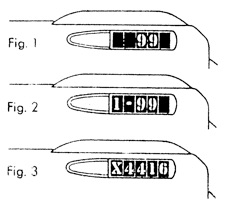
Recall that until at least 1943, SP still used green flags; all sections except the last were supposed to carry green flags, in daytime. So any pre-1943 pic of a train carrying a section number in the indicators, in daylight, with no green flags-- is evidence that at that time the last section did show its section number.
Post 1950
After 1950 or thereabouts if SP train 804 had three sections, the three engines would carry "1-804", "2-804" and "804" (rather than "3-804") in the numberboards. The 1951 and 1960 rulebooks say that "804" in the numberboards denotes the last (where "last" might mean "only") section of 804.
It was a 1960 rulebook that had rule 21C about the last section running with only the schedule number in the train indicator. Remember, Sections were run 1st 2nd 3rd, etc. First section would run before Second before Third...and the last section would not have a section number prefacing the train number.
Train Numberboards
The original boards were black with white lettering. Only one shop (Sacramento) could make replacements if they were damaged. To keep a locomotive running, roundhouse employees would “cobble up” replacement boards—and send in a request to Sacramento for the Real Thing. So occasionally you might see white number boards with black numbers. Black on white was NEVER the standard!
Joe Strapac
A photo for GP9 #3851 from 1979 shows the numberboard where they are black, a few photos from 86/87 where they are white, and then back to black in a photo from 89'.
Jamie Miller
Train/engine number boards are always lit; though rarely is this obvious by day. These are seldom bright.
Modeling Train Numberboards
Different techniques for train numberboards
Irish Tracklayer
1. Irish Tracklayer (irishtracklayer. com) has etched brass SP train indicator numbers in both HO and O scale. These should be fairly easy to make up in various train numbers to a frame with a couple small flat wire clips on the back to fit over the number board castings.
Scratchbuilding
2. A small piece of thin styrene painted black and numbered as you need (repeat as necessary), and put some 'Tacky Glue' on the back and they stick pretty good; store these on a hunk of cellophane or an old negative sleeve, between uses. The Tacky Glue is sold at many craft stores and is also useful for figures and placards, as it sticks and then comes off without leaving much (if any) residue. Make sure your base surface decals are well sealed.
They make many other grades: http://www.save-on-crafts.com/alortacglu.html
3. Some people put the north bound train number on one side and the south bound on the other. You can only see one side of the locomotive on the layout, the correct number shows from the operating position.
4. Buy 8 x 11 sheets of laser printable matte transparent film by the box. It’s sold as a drafting supply so one can print up a company logo and title block for velum drawings. When you peel off the paper backing you have a sheet of what looks like 3m Magic mending tape (a matte finish transparent office tape). Since the clear film is being laser printed it can be black letters on clear or clear letters surrounded by black.
The tricky part would be cutting out the train numbers to size.
Train Indicators on Helper Units
On "Point" helper, the train number (ie. 99) would be in the indicator. However, on Mid or Rear helpers, the indicators were left either all black or with only two spaces "blank". Most photos show the mid/rear units with two spaces left blank and the rest black. Most of these helper unit photos were taken on Cuesta.
Mike Madonna
In Santa Marguarita and SLO, they didn't know if the helper would be on the point with a passenger train or in midtrain on a freight. It would be easier to have just two open spaces to slip in passenger numbers than to have to put all back in. It would make no difference on a mid-train.
Jim Elliot
Green Flags / Signals for Section Following
Green Flags
Green flags and/or green light was the signal that was displayed to indicate that another section of a schedules was following, one at each side of the rear end of the last passenger coach on trains. This was the same before and after the rules changed about placing the section number in the indicator of the last section. If, for example, there were two section of a train running under the old rules then the second section would have a two before the train number to identify the train but no flags/lights because there was no following section. In pre ‘50 photos the last section with a section number in the indicator and no flag is operating under the rules.
Cliff Prather
Rules 19 and D-19 from the 1907 rule book cover this subject, and D-19 reads as follows:
"The following signals will be displayed, one on each side of the rear of every train, as markers, to indicate the rear of the train:
By day, green flags; by night, green lights to the front and side and red lights to the rear, except when the train is clear of the
main track, when green lights must be displayed to the front, side and rear, and except when a train is turned out against the
current of traffic, when green lights must be displayed to the front and side, and to the rear, a green light toward the inside and
a red light to the opposite side."
The 1903 rule book has a generally identical stipulation. There is no differentiation as to freight and passenger trains. The next book is 1923, wherein all has changed and red (at night) or dark (during the day) is the rearward display. Locomotives do not display markers, except when running light (on the tender if running forward or on the pilot beam if running in reverse).
Green flags by day, green flags and lighted green class lamps at night, in their usual place on the smokebox. A loco might also display green flags on both the smokebox (classification) AND the pilot beam (markers), if it was running backward by day at the rear of a train, or even if it was running without cars as a section of a following train. At night, the pilot beam green flags would give way to red marker lights.
Turns out there are lots of pics that seem to show trains carrying a section number on the engine, with no flags. After 1950, the SP dropped flags completely.
SP green "following section" flags fabric measures 17 by 19 inches and is mounted on a wooden staff that measures 27 inches long and is tapered at the end that fits into the mounting bracket.
Barry Anderson
Whistle Indication
One long and two short blasts of the whistle is an indication that a train is displaying (green) signals for a following section and will be given at both front and rear end of the train affected thereby. Two short blasts of the whistle and by the rear of the train by the trainman (conductor)is in accordance with rule 12 (g). If not answered then the passing train will be stopped and the reason for not answering obtained. A report of such violations shall be reported to the superintendent from the first open train order station.
Observation Car End of Train Device
Gyralight as rear markers on Espee passenger trains are a circa 1950s practice, whether fixed position (roof-mounted) or portable units hung on the tail gate of the last car. This is found as a larger portable can-shaped unit, maybe a MARS device, on the COSF. The portable sort in Pyle National Gyralite cases get smaller as the '50s progress.
The earliest Daylight-liveried ob car with an oscillating red rear rooftop lamp is the former set of Coast Daylight parlor obs cars assigned to the new Shasta Daylight. Thereafter SP gets pretty much into the retrofit of other obs cars with oscillating rooftop red lamps, including a large number of the division superintendents' and higher-officials' business cars and in new construction with the blunt end sleepers for the Lark, Cascade, COSF and Sunset.
Kevin Bunker
The "white" backup lamp at the center rear of the roof on the Coast Daylight was only illuminated when the train was being turned as a whole in reverse on a wye, or when the consist was being backed down into LAUPT or S.F. station (or if the the train on the road had to make some sort of a special backup move), and definitely would not be flashing. It was also an emergency (red) light. Otherwise only the side markers were lit, red to the rear, green to the sides. They ought NOT to be simultaneously red and green. The SP most certainly DID use green to the rear when the train was in the clear on a siding, whether freight or passenger.
Tony Thompson
The two side lights and the red Daylight sign would work as markers.
Paul Vernon
The above assumes the train is operating on single track or with the current of traffic on double track. If it is in a siding or running against the current of traffic then a different light arrangement was specified.
SP used green to the rear on the side of the train in the siding that was clear of the main line. The side of the train that was not affected by a passing track remained red.
Ken
This only applies when running against the current of traffic on double track, or on a siding in such a situation. When in the clear on single track, it is indeed all green to the rear. Rule 19 clearly shows this.
Tony Thompson
When the parlor obs cars were altered later on to have the former backup lamp turned into a fixed-beam red center marker, the tail lamp was illuminated along with the side markers.
End of Train Device
The year SP started to use End of Train devices was the spring of 1985.
Blue Flag
The SP blue flags are12 x 13 inches, is metal, and is lettered "MEN AT WORK", and not a "blue flag." The metal ones are attached to hooks or staffs so that they can be put onto brackets or stood up in the track. Without those things, they could not be used in the normal way. Mine has a staff and a hook on one end.
Tony Thompson
The “blue flag” were bolted to a bracket that either was designed to clamp on to the track, hang on the end of a car or hang on the locomotive in plain view of the engineer.
Paul C. Koehler




Photo courtesy of Brian Moore