Southern Pacific Lines
Coast Line Division
“The Route of the Octopus”

Southern Pacific Lines
Coast Line Division
“The Route of the Octopus”
PFE Facilities
PFE had separate listings for Ice Manufacturing and Ice Transfer plants. PFE did not own smaller icing stations. They contracted with local commercial ice companies, such as Union Ice, to run them. A few were small enough to need ice brought in by means of ice service reefers.
Ice Manufacturing Plants (IMP)
PFE termed them IMP as the source of ice for a big ice deck. PFE did indeed build and operate such plants (Roseville was the largest artificial ice plant in the world in its day), but the great majority of PFE facilities were not like that.
Tony Thompson
Modeling the Icing Process
If you want to show the complete Icing Process on your layout, you need 3 things:
citrus packing plant, wood crate manufacturer, and icing plant with loading platform(s).
Ice Transfer Plants (ITP)
Even as busy a place as Watsonville Junction in California did not manufacture its own ice, but only had an ice storage house, from which the car icing operations were fed. PFE called such facilities “Ice Transfer Plants” or ITP, a good name because the ice came from somewhere else.
An ITP might be built and owned by PFE, or it might be a commercial ice company, and if the latter, the ice deck itself might be built and operated by PFE or by the ice company. Evidently some ice companies did not want to be in the car icing business except to supply the ice itself. In the case of Guadalupe, California, Puritan Ice Company supplied the ice to a PFE-built deck, but Puritan employees iced the cars. It was a ten-car length deck, pretty small in PFE terms.
Tony Thompson
Modeling the Icing Plants
It built a combination ice plant and cold storage plant. It's totally freelanced in design. It started as a kitbashing of City Classics Smallman St. Warehouse. I didn't use the supplied windows. Three were just enough panel pieces to make a 22-inch long flat building that's about 1-1/2-inch thick. The new windows are printed on gloss photo paper from scaled photographs.
It needs a big cooling tower for the roof. That'll be more work than the basic building. The icing platform has chain drive for ice blocks plus a conveyor system for moving ice blocks from the ice house to the platform. I built the wood ice deck years ago.
Bob Chaparro
Here is a link to several images of an HO scale ice plant and icing platform built by Charles Smiley:
http://www.modelrailroadforums.com/forum/showthread.php?20559-Ice-deck-amp-ice-plant
PFE Icing Platform
Every single PFE employee, at any level, called it one and only one name: ice deck. The official name, as shown on more than one PFE drawing was icing platform.
Tony Thompson
On the PFE, some platforms had a roof over it for the entire length and some didn't.
Rail measurements
On PFE, the standard distance for ice decks, from the rails (center of track) about 8', 4 inches from the track center line or more.
Tony Thompson
Reference
Numerous photos of icing facilities are in the PFE book, along with a drawing of the standard deck cross-section. In the PFE book, every PFE icing facility throughout SP and UP territory; is individually described, and photos of many are included.
All the former PFE photo archives are now at CSRM.
Tony Thompson
Drawing
Pacific Fruit Express, pg. 294
Modeling PFE Icing Platforms
A ten-car length deck, pretty small in PFE terms, is pretty darn big to model.
CMA (Creative Model Associates) / Tichy
The CMA kit is based on the Pacific Fruit Express drawings. The Creative Model Associates HO scale kit has the ramps or doors that are used to load ice into the cars spaced to match those on a string of HO scale 40-foot reefers.
The Tichy deck, formerly CMA, has an accurate repeat length for the actual length of reefers. It is 36" long.
Tony Thompson
There are 18" and 36" extensions available from Tichy.
Ken Adams
Paint & Weathering
The kit is easier to paint and weather if the parts are painted and weathered before assembly. To reflect wear and tear that decking receives after years of use, masked off the decking on either side of the center ice delivery chain. Paint this area with two light coats of Badger ModelFlex 16-03 Grimy Black. After the paint dried, Mask the center section and paint the remainder of the deck with Badger ModelFlex 16-173 Mud, to begin the weathering process. When this dries, dab various spots of the deck with streaks of rubber cement. Now painted the deck with Badger ModelFlex 16-02 Reefer White. Let this dry overnight. Use a pencil eraser to rub the deck over the now-visible (through the white paint) spots of streaked rubber cement. This allowed streaks of the wood-colored wood (the area painted with Mud color) to show through like worn paint. Dry-brushed the chain area with rust and light brown to show use and wear.
Mike Barry
Assembly
Construct the model in four 18-inch sections to make it easier to transport if desired. Assemble all of the truss posts first. The diagonal braces were then cemented to each of the legs. Cement the completed truss posts to the underside of the deck. Once a post was set in its location, a drop of cement was used to attache each leg to the deck. Three deck pieces were then cemented together to form an 18-inch section of platform. The handrails and doors were installed next. The doors (the ramps leading from the platform to the roofs of the cars) that were to be installed in the "down" position were drilled with a number 77 drill bit, and a Detail Associates 2203 nut bolt-washer was used to attach a piece of Builders In Scale chain to the post. A Detail Associates 2206 eye bolt was used to attach the chain to the door ends. Cut the chain to the exact length needed so it would be in tension when the doors were lowered into the proper position. Apply a drop of thin cyanoacrylate cement to each chain. The cement will run down the chain to "freeze" it in a straight position so no sag or kinks appear in the chain. The six roof sections were assembled and the joint sanded smooth.
Mike Barry
Final Painting & Weathering
When the model was completely assembled, touch up the visible glue seams with white paint. The complete deck area was drybrushed with powdered burnt umber pastel chalks. The burnt umber highlighted the wood grain and subdued the white. I used powdered black pastel chalk to highlight the molded-in nut-bolt-washer details. When complete, I protected the weathering with a light coast of Testors Dullcote.
Mike Barry
Reference
The Journal, Mike Barry
Intermountain
The IM is the Tichy kit assembled. It's just an icing platform with the drop down sections to direct the ice into the car. It does not have a building, but the platform does have a roof over it for the entire length. Reserving at $49.95 .
Suydam Structures
They made a Union Ice Company that included the factory building and icing platform.
Walthers
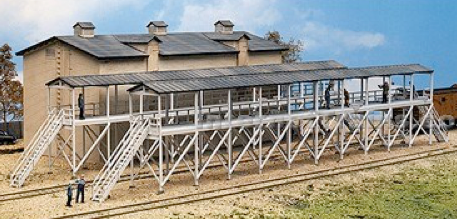
Walther’s has a icing facility and a packing house. I would recommend AGAINST the Walther’s icing platform, as it has too short a repeat length for structure elements, and if you line up one car correctly with the drop-down aprons, no other cars will be lined up correctly. Of course you could probably kitbash it to be correctly spaced.
Tony Thompson
The ramps or doors that are used to load ice into the cars are NOT spaced to match those on a string of HO scale 40-foot reefers. If you opt for that kit, check the positions of any doors you want to place in an "ice-loading" position and mark the deck so the doors will be positioned properly.
Mike Barry
PFE Ice House
The prototype ice houses were built with two walls between 12 and 24 inches thick with a hollow space between the inner and outer layers of brick to provide insulation. Thus, the doors and windows were recessed a scale foot or more. The typical ice house had wagon-level loading doors so the icemen could pick up their loads for delivery to homes and businesses. The ice house had doors at a height to allow the ice to be loaded onto the ice platform's deck and conveyor.
Mike Barry
Modeling Ice House Kitbash
To make a "generic" brick-walled ice house, try a variety of Design Preservation Models modular wall sections for the ice house.
Mike Barry
Paint & Weathering
Paint the assembled model white and weathered it with a dilute mix of back acrylic paint.
Mike Barry
Reference
The Journal, Mike Barry
Paint
PFE Standard Exterior Gray
In the second edition of the Pacific Fruit Express book, on page 419, there is a color panel showing an example of what PFE called "PFE Standard Exterior Gray." The caption for the color panel notes that there is apparently no CS 22 color number.
Don Strack
PFE owned the facility and it would have been their standard gray once upon a time. They were certainly not painted yellow and brown, as it was not an SP structure. How faded that color might be at the time of a particular photo is hard to say.
Tony Thompson
Modeling PFE Ice Structures
Paint
Make it a shade of gray that's consistent with what you seen in a contemporary photo.
Reefer Clean Out Track
About all that is needed for a Reefer Clean Out Track is a paved walkway alongside, to bring carts of repair and cleaning supplies alongside. Reefer operators like PFE, SFRD, FGE (and WFEX, BREX) and ART did this cleanout themselves, rather than rely on the railroads to do it, so in most cases cleanout would take place at facilities of those owners, not in local yards.
Tony Thompson
On the cleanout track an elevated rail was used to tilt cars to one side. For reefers this allowed gravity-assisted removal of water, ice and debris from the car. Typically, the rail furthest from the adjacent access road was raised a couple inches so the debris in the cars would be easier to sweep or hose out.
Interiors were swept clean of debris and cleaned with hot water, steam or specified cleaning solutions. Interiors were dried, water drains and air grills cleared and the car checked for odors.
The cleanout tracks typically had a "burn" pile where scrap wood and paper was burned, or in later days, a row of dumpsters. Other features included a shed for brooms and tools, water hoses, steam cleaning and compressed air equipment, welding equipment, and ladders or a fixture for accessing the tops of cars. The area between the rails and around the track sometimes would have large drainage grates.
What your reefer servicing tracks all depends on the railroad and the place.
Here is a link to a picture http://www.pbase.com/paulv99k/image/54676914
of the Santa Fe reefer icing tracks at Bakersfield, CA probably in the 50’s. Bakersfield was the largest such facility on the ATSF. Note the large ice houses on the left side. There are four long tracks and two actual docks. SP had similar facilities.
Paul Nash
Blue flags are required for those operations which require a workman to be on, under or between cars for the purpose of inspecting, testing and repairing. There is an argument on whether blue flags were required for a cleanout track.
Once clean, cars were conditioned in another area of the yard. Conditioning was the process of repairing and preparing cars for outbound loading. Hardware was repaired or replaced and seals, hatch covers and plugs checked.
Reference
There is a photo of the Roseville PFE cleanout track in the PFE book, 2nd edition, page 428.
Tony Thompson
While not specifically refrigerator car cleanout tracks, here are some boxcar cleanout track examples:
Bob Chaparro http://www.trainweb.org/screamingeagle/other/r_merrick/merrick_012-096/87_06MAY.jpg
Specific PFE Facilities
El Paso PFE Icing Platform & Decks
The PFE had icing machines at El Paso. The icing platform had two levels. The upper was for hatch icing. The ice machines also put ice into the hatches. The lower level was for putting ice inside the cars, body ice or crushed ice. The lower level had a track on which the icing machine traveled.
Charlie
Santa Barbara PFE Icing Plant & Decks
1948
During the 1948 date, the ice plant and ice dock was serving local perishable traffic and Southern Pacific employed over 250 in the Santa Barbara area. It was a good time for the railroad in Santa Barbara and everywhere else.
Bruce Morden
1960’s
The PFE ice decks came out in the mid to late 1960s. The Santa Barbara Ice Co still operates out of the same location. The citrus packing houses continued to operate both in Santa Barbara and Carpinteria into the late 1970s though the traffic had been lost to trucks.
G. T. Paine
Santa Maria PFE Icing Plant & Decks
PFE Equipment & Men
PFE Icing Machines
PFE had icing machines at a number of the biggest facilities. They are all identified in the PFE book. Note: SP did not ice cars. PFE did.
Tony Thompson
They weren't automated, just mechanized. These have been used on an open (unroofed) ice docks. PFE removed the roofs, for obvious reasons, when icing machines were installed. Most PFE icing machines were installed after 1953. The Roseville icing machines, on icing platforms, were not installed until 1956.
Tony Thompson
Reference
A good source for photographs is Tony Thompson's great book "Pacific Fruit Express".
Modeling PFE Icing Machines
CMA (Creative Model Associates)
Use on a PFE model from CMA.
They would look funny on one of our typical 5-car layout icing decks. Now if you can service maybe 40 cars . . .
Tony Thompson
Ice Blocks
Ice was covered with burlap to keep it from melting before it was shoved into the reefer's roof hatches.
Ken Patterson
Modeling Ice Blocks
Model Tech Studios
http://modeltechstudios.com/hoscaleiceblocksvarietypack.aspx
Sunshine Scale Models
Sunshine Models offers ready-to-use HO scale "ice". This clear cast-resin "ice" is enough to serif 4 to 6 cars. It includes both large blocks and broken pieces.
Sunshine Models
Box 4997,
Springfield MO 65808-4997 $30.00 plus $4.00 shipping and handling.
Ice Blocks Kitbash
Cut the ice into smaller pieces. To simulate the ice that was covered with burlap, cover with a single layer of facial tissue held in place with the artist's gloss medium. The tissue is painted with a mixture of Mud and Black to match the burlap.
Ken Patterson
Sand clear plastic blocks to make them cloudy. Ice is not clear. Position the ice carefully, including some dropped onto the ground, to match prototype photos. Small "puddles" of clear artist's gloss medium were used to hold the ice and to reproduce water puddles.
PFE Tools
The workers used a variety of tools. Two important ones were a U-shaped fork and a gaff hook.
Modeling PFE Tools
Scratchbuilt Tools
I scratchbuilt two tools, a U-shaped fork and a gaff hook. Apply a dab of solder to a piece of .010-inch brass wire and slowly lifted the hot tip of the soldering gun to produce an icicle-like hook. Try several times until you obtain just the size. I then cut the .010-inch wire into a scale 6-foot handle length. I bent the U-shaped hook from .010-inch wire and soldered it to the end of a second piece of .010-inch wire. I drilled .012-inch holes in the worker's hands to accept the .010-inch wire tool handles.
Ken Patterson
PFE Workers
Modeling PFE Workers
Preiser Kitbash
Use prototype photographs of icing platforms to establish the positions and postures of the workmen that would be loading ice. Use an assortment of Preiser workmen as the basis for the ice-loading crew. Dismember each of the figures to move their arms into the positions to match those of the workmen in the prototype photograph. Use flush-cut diagonal cutters to remove the arms and cemented them back in place with thickened hobby-type cyanoacrylate cement. Fill in any gaps around the shoulders with spots of automobile body putty. In some cases remove the head from one figure and replace it with a head from another figure to obtain the right hat.
Ken Patterson