Southern Pacific Lines
Coast Line Division
“The Route of the Octopus”

Southern Pacific Lines
Coast Line Division
“The Route of the Octopus”
General
AAR Car Designations
Class “R” – REFRIGERATOR CAR TYPE
RB – Bunkerless refrigerator car similar in design to an RS car with or without ventilating devices and with or without devices for
attaching portable heaters. Constructed with insulation in side ends, floor and roof to meet maximum UA factor requirement of
250 BTU/F/Hour for 50-foot cars and 300 BTU/F/Hour for 60-foot cars. Effective for cars ordered new after March 1, 1984.
Cars built or rebuilt prior to March 1, 1984, must have been constructed with a minimum of 3 inches of insulation in the sides
and ends and 3-1/2 inches in floor and roof based on the insulation requirements given in AAR Standard S-2010 or a thickness
reduced in proportion to the thermal conductivity of the insulation.
RBL – Car similar in construction to an RB type car, but equipped in addition with adjustable loading or stowing devices.
(10/57-4/99). Note: Cars equipped with interior side rails only, built new, rebuilt or reclassified on and after January 1, 1966, in
order to qualify for the "RBL" designation, shall have a minimum of four (4) usable side rails on each wall of car, each extending
from doorway to approximately four (4) feet from end of car.
RC – Refrigerator Car similar to an RB car using a cryogen to produce temperatures to transport frozen commodities.
RP – Mechanical Refrigerator car equipped with or without means of ventilation and provided with apparatus or other device for
furnishing protection against heat and/or cold. Apparatus operated by power other than through the car axle.
RPB – Mechanical Refrigerator. Similar to RP type car but designed primarily for use in bulk potato or similar type loading as cars
are equipped with interior slope sheets and conveyors and/or equipment for mechanical loading and unloading.
RPC – Mechanical Refrigerator car similar in design to an RP but equipped with permanently affixed container(s).
RPL – Mechanical Refrigerator. Similar to RP but equipped in addition with adjustable loading or stowing device.
RS – Bunker Refrigerator car equipped with ice bunkers. Designed primarily for use of chunk ice and with or without means of
ventilation.
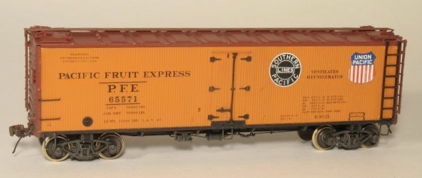
SP PFE cars
Until 1978, PFE was jointly owned by UP and SP. After that year, the fleet was divided up and the UP cars became UPFE and the SP ones, SPFE, although SP retained ownership of the remnants of the PFE corporation. Some were sold to UPFE, which has had an aggressive program of reconditioning and/or rebuilding older mechanical cars from many sources, to meet UP's modern needs. Others were indeed scrapped. Many went to Golden West. The history of all this prior to 1992 is covered in the PFE book. Note: The PFE ice facility at Roseville was torn down in 1974.
Tony Thompson
Reefer Car Rosterings
Steel cars "started showing up" when PFE built its first ones in 1936 (Class R-40-10). But PFE continued to roster wood-sheathed cars into the 1960s, and was hardly in a position to scrap the older cars in favor of steel cars. It was not until the mid-1950s that the steel cars exceeded 50 percent of the PFE fleet. In the PFE book the survival tables for the wood and steel cars will show you the percentage of each at various dates.
Tony Thompson
Details
Hinges
Most all reefer owners placed the hinges toward the car center, because it permitted an open hatch cover to lie flat on the roof. Only the Santa Fe had cars with hinges at the outside or car-end edge of the roof. As for vent flow, think about it. The "downwind" hatch scoops air into the car with car-center hinges, the "upwind" hatch scoops air with the car-end hinges.
Tony Thompson
Ice Hatches
Many prototype photos of freight trains or freight yards reveal some refrigerator cars with ice hatches latched open. This represents what the Protective Services Tariff called “ventilation service,” and it meant that ice was not placed in the bunkers, but the cooling of outside air was considered sufficient for the perishable cargo. A frequent case was onions, which are preferably shipped at temperatures well above refrigeration temperature, and so will travel all right under vent service. When the hatches were latched open for “vent” (ventilation) service, they were not open very far.
Cars with hatches latched open are not “empties being dried out,” but are loaded cars with cargoes in vent service instead of iced. In fact, PFE people interviewed all said they had never even heard of cars being “dried out” that way. Some railfan photographers have also been guilty of this belief, and have captioned photos of cars in vent service as “empties.”
Tony Thompson
Modeling Ice Hatches
You may need a few cars exhibiting vent service, if you model a somewhat cooler part of the year (spring or fall), or model perishable traffic which falls into the frequent use of vent service. A few cars that way can’t be spotted as empties to be loaded (the hatches would be latched open after the car is loaded). They definitely offer a nice variation in the reefer fleet. There are three keys to modeling open ice hatches to make them look right.
First, the hatch plugs should be evident on the underside of the hatch cover, whether it is wood or steel. Plugs should be visible underneath the hatch cover, as are the hooks which permit locking the hatch from inside. Add styrene blocks underneath the hatch covers to represent the plugs. Paint these light gray. The steel ice hatches in Red Caboose kits have a hatch plug molded underneath, which only has to be touched up with a canvas or light gray color.
Second, though only a glimpse of the car interior is possible, it is still necessary to install a view block to represent the bunker bulkhead. Modeling the internal bulkhead is most easily done with a sheet of styrene, made as a slip fit into the car interior. Ice bunkers were about 3-1/2 feet long. Use 0.015-inch thickness sheet, with a corner reinforcement at the bottom. Notch to clear the roof. The bunker interior walls need to be gray (they were usually galvanized steel, which oxidizes light gray).
Third, on some models, the very thin hatch cover latch bars are fragile, and in ordinary layout operation, sooner or later some of them break off (Tichy). Use something much stronger than thin styrene for latch bars. Try flat brass wire to modeling open hatches on an Athearn reefer. Some modelers make the mistake of setting the hatches at 45 degrees or steeper, which clearly is not prototypical.
The reason for modeling some hatch covers which are not even attached is done to show hatches entirely open, as for icing, or simply set them in place for closed hatches. Show a car with the hatches closed at one end, open for icing at the other.
Tony Thompson
Preco Fans On PFE (& Other) Reefers
In the 1950s various packing houses, and some of the shippers specified that cars be equipped with Preco fans.
Jerry Britton's Keystone Crossing website sheds a little more light on these fans and states "A modeling/spotting feature on ice reefers is a "sill-mounted Preco fan". The first patent was issued to William E. Van Dorn in September, 1940, a second in May, 1944. Pacific Railway Equipment Company (PRECO) began marketing them and PFE began their use in 1941. FGEX followed three years later. By 1945, 7000 reefers had them and by 1950 one-third of the reefer fleet had them. Mechanical drive was superseded by electrical drive in the early 1950's, allowing the fans to be mounted near the ceiling. Purpose was to stimulate internal air circulation. These worked sufficiently well to put off the conversion to mechanical refrigeration a few years." Preco fans are well covered in the PFE Book by Thompson, Church and Jones.
Route Cards
An important detail are route card boards and where they are located. It turns out that PFE changed location of placard boards, though not of route card boards, on almost every class of steel cars in the transition era, that is, up to 1955. The first PFE steel ice cars were built in 1936 and 1937, Class R-40-10. As was common for reefers of many owners at the time, these cars had no placard board. Their route card board was on the side sill tab at the left bolster. Many car types had this left-bolster location for route card boards.
Tony Thompson
When a car was shopped in the years after its construction, it normally would have its placard and other boards applied or moved in accord with current practice at that time. Thus older cars in a year like 1953 would mostly have updated board locations. Older cars with paint schemes from later years should definitely have placard board patterns matching the era of the paint scheme.
Tony Thompson
See photos in Pacific Fruit Express (2nd edition) for my modeling is for PFE steel refrigerator cars. The photos show the route card board locations, not as outstanding portraits of the various classes.
See Tony Thompson blog linked here: http://modelingthesp.blogspot.com/2011/11/route-cards-3.html .)
Modeling Route Cards
Few models of steel PFE cars have had a route card board at the bolster and many have lacked or had incorrect placard boards as well. If needed, placard boards are easily added with thin styrene sheet. The prototype placard board was 16 inches high and 24 inches long, often tongue-and-groove construction so without a visible separation of the boards, or in later years sometimes plywood. Occasionally scribe the board separations but in most prototype photos they are not visible. The smaller boards on reefer car sides varied, but were often about 8 inches square. The same appears true of the route card boards on steel box car doors.
Tony Thompson
For modeling, see photos in: Pacific Fruit Express (2nd edition).
Paint
PFE had a stricter timeline for repainting: 4 to 7 years on wood cars, 10 years on steel cars. Data show clearly that PFE worked hard to convert the entire car fleet from yellow to orange sides after the adoption of orange in 1929; all or very nearly all cars were orange by the end of 1934.
pre-1929
Before 1929, PFE reefers were a much more yellow color than the SP Daylight Orange.
Dick Harley
1947-1950
PFE did have a policy of repainting wood- sided cars every 4 to 6 years, but of course that varied with era; during World War II painting was cut back, whereas during 1947-50 the shops were VERY busy and repainted a very great number of cars (data are in the PFE book). And prior to the mid-1950s, PFE tended to repaint anything that was repaired, rather than touch up the paint. Among other things, this means that the early 1950s do show a proportion of the black-white scheme (introduced June 1950) which seems high, presumably due to shop activity remaining high.
Tony Thompson
1949-1951
Many painting changes took place. Examples of 1949, 1950 and 1951 schemes could be found in 1951.
post - 50’s
They were regulars on the SP, painted as SPFE in white. Prior to that, PFE cars in their former UP/SP dark yellow had the black UP herald painted over. The former paint foreman from PFE, said that ownership of the car could be determined by which of the two heralds was closest to the radiator air intake of the car, one with the SP herald next to the air intake and one with the UP herald next to the intake. SP painted and rehabilitated their former PFE cars as needed, but due to losses to 18-wheelers many of the cars were sold or scrapped.
1990-1991 SPFE repaints
SP started to repaint SPFE reefers in 1990-91.
Tony Thompson
Underframes
Reefers had black underframes.
Hardware 1949
In 1949, most side hardware became orange instead of black.
Hardware 1951
In 1951 all remaining side hardware that had stayed black in 1949 became orange. Along with the entire car side, side sills and center steps also became orange. By this time, shops had caught up with the older cars and repaints, and rebuilding had been stopped, so these latter changes arrived more gradually in the fleet. Although most railcars would show more and more dirt, the older their paint scheme, PFE did wash cars in this era, so truly dirty old cars can be paired with relatively clean old cars.
Tony Thompson
Roof
On PFE (SPFE & UPFE) mechanical reefers, new in the early Seventies, the roofs were never unpainted metal.
Tony Thompson
Aluminum Reefers
The PFE aluminum reefers sides were natural aluminum.The ends and roof natural aluminum with a clear lacquer overcoat.
Tony Thompson
Lettering & Numbering
The PFE paint schemes from the 1920s onward always contained both UP and SP emblems, except for the WP cars. Until 1946, there was a UP emblem on one side, SP on the other. The two roads owned PFE exactly equally, so nothing to do with that. After 1946, there were various schemes with BOTH emblems on both sides. You will note in the single emblem schemes that the SP emblem was always on the left side of the car. For other info, see the PFE book, which is QUITE thorough on paint schemes.
Tony Thompson
PFE Herald Colors
The differences (in years of use) between the PFE with colorful heralds and the PFE with black/white heralds. It's in the book. The B&W emblems were begun in 1950. Shops were active in those years, so by around 1953 or '54, the red-white-blue ones would have been pretty darn rare.
Tony Thompson
SP Herald Position on the Steel Ice Cars
Cars had the SP herald on one side, UP on the other until 1946. On the orange steel refers, in every pic (with both a SP and a UP herald on the car), the SP Herald is always towards the "B" end of the car, regardless of the side. Painting diagrams from 1922-1946 and 1951 on had the SP herald towards the B end. From 1946 to 1951 the SP herald was positioned towards the center of the car on both sides.
Sometime between the "large Scotchlite reporting marks" scheme circa 1975, and the circa 1981 all-white scheme, SPFE began covering over the UP shield with a "Perishable Freight Experts" emblem. This happened after the 3-1978 breakup of PFE.
PFE markings between 1942 and 1951
1942
This scheme, with single heralds on each side and with the UP herald lacking the diagonal “Overland Route” slogan, had only come in during 1942, so aside from wartime repaints, was not applied to a great number of cars. UP logo with the Overland lettering was dropped 1942 - it was the simpler UP shield after that).
1946
Since a new paint scheme had been adopted in 1946 (the two heralds-per-side, with UP in color), called 2C for short, many of the newly maintained cars, and of course all rebuilds and new cars, got that scheme. The previous scheme, with single heralds on each side and with the UP herald lacking the diagonal "Overland Route" slogan, had only come in during 1942, so aside from wartime repaints, was not applied to a great number of cars. The 1946 2C scheme was changed in subsequent years in several ways, which are summarized in the PFE book on page 418 (2nd edition).
1950
In 1950 the UP herald became black-white, a scheme called 2BW for short. Then both heralds side by side and smaller, the UP shield changed to black and white in 1950.
1951
In 1951 the UP and SP heralds were restored to their positions from the 2C scheme. The arrangement of medallions had the SP emblem near the B end on each side (both car sides being different) with the emblem reversed between the two. Periods went away in "PFE" in 1953. Because so many cars were repainted with 2C in 1946-1949, that scheme would certainly still be around in some numbers in 1953. The variations of side hardware color and the 2BW scheme are each going to be less numerous because they are spread out in a span of time. By 1951, 25% of the fleet would have been repainted with B&W logos.
Tony Thompson
1952
Stripes around initials and number went away in 1952. By 1952, it was six years since 1946 and ten years since 1942, so both wood and steel cars would be losing older paint schemes. My first recommendation is that in 1952 and thereafter, the "Overland Route" UP heralds were pretty rare and would be most likely on prewar steel cars. The plain UP herald in the 1942 single-herald scheme should also be fairly rare.
Stripes around initials and number went away in 1952, periods in “PFE” in 1953. By 1952, 50% of the fleet would have been repainted with B&W logos.
1953
Periods in “PFE” went away in 1953. By 1953, 75% of the fleet would have been repainted with B&W logos.
1954
By 1954, color logos would be a rarity in the fleet.
1955
By 1955 the black & white heralds predominated, judging from photos of reefer trains.
Tim O'Connor
UP System Herald Colors
1929-1934
Data show clearly that PFE worked hard to convert the entire car fleet from yellow to orange sides after the adoption of orange in 1929; all or very nearly all cars were orange by the end of 1934. That means that all those newly repainted cars had the "UP System" emblems which also had "Overland" banners.
1936
The word "System" was dropped in 1936.
From 1936 to 1942, PFE shop reports show a huge level of activity, with both repainting and rebuilding.
1942
In 1942, the UP emblem had the "Overland" banner removed, but during the war only modest numbers of cars probably got the new paint. UP logo with the Overland lettering was dropped 1942 - it was the simpler UP shield after that).
1945
But at the end of the war, the PFE shops almost immediately became extremely busy, as shop work reports show, including applying the new double-herald, color-UP scheme to new, rebuilt, and repainted cars.
pre-1946
I don't recall seeing any photos of the pre-1946 UP Overland heralds in the 1950's.
Tim O'Connor
1950
By 1950, when the paint scheme changed to B&W UP heralds and also returned to having the SP emblem toward the "B" end on both sides of the car, I would doubt that any "UP System" emblems could still exist, and certainly any wood-sheathed cars would have lost the "Overland banner" emblems. I'd personally doubt that many steel cars still had "Overland banner" schemes either, because the older cars like R-40-10 were receiving fans and thus got repainted even if the old paint was still all right. But probably there were still examples around of the single-herald, plain-UP scheme, but probably few except on steel cars.
Tony Thompson
SPFE Herald Colors
SP started to repaint SPFE reefers with the small logos in different colors in 1990-91. I have photos of that scheme from 1991.
Tony Thompson
PFE Black Rectangles ("Black Square with White Reporting Marks")
PFE began putting lettering in the "black box" in the fall of 1965. (The black rectangle was introduced with the R-70-16s NEW 5-66 with box).
Tony Thompson
Some reefers were "black patched" for their numbers and was used in new and repainted cars until 1970.
Steven Bechtold
PFE "Lettering Arrangement" drawings call that scheme "Black Square with White Reporting Marks" - even though the Black was not really square.
PFE Lettering Arrangement drawing RR-6731 for R-70-15 cars #452001-452750 was changed to that scheme on 1-13-66 (rev. F).
PFE Lettering Arrangement drawing RR-4830 for R-70-12 cars #301213-302212 was changed to that scheme on 1-17-66 (rev. P).
PFE Lettering Arrangement drawing RR-5000 for 50-ft Cars with Flat Sides was changed to that scheme on 1-17-66 (rev. J).
Since the R-70-15s would be less than three years old in "late 1967," it’s doubtful that many (if any) would be repainted in that scheme in late 1967. As mentioned, the R-70-16s and R-70-17s would be in that scheme in late 1967.
Dick Harley
Reporting Marks and Numbers in the Early Seventies
On the SPFE cars in the early Seventies, reporting marks and numbers were white or all black, depending on class and when repainted.
Tony Thompson
No PFE cars were built with other than black reporting marks. In 1975, white Scotchlite lettering began to be used. Actually, PFE used white reporting marks since long before all-steel cars were ever built on the ENDS of the cars.
Tony Thompson
The official split of PFE as a corporation between SP and UP became effective on April 1, 1978. However, it was 1971 that it was decided for cars to be marked with SPFE or UPFE as appropriate. Southern Pacific started changing PFE to SPFE on the reefer small black square reporting marks. These marks first began appearing on new car deliveries effective with the R-70-24 and R-70-25 class cars built during that period. See: “Pacific Fruit Express” pg. 224.
Rob Sarberenyi
Roof Car Numbers
PFE, SFRD, and others painted car numbers on roofs at various times. It is a common practice today for tank cars.
Tim O'Connor
Some PFE reefers had numbers on the roof. This is shown in some 1940's and 1950's photos. There on wood sheathed reefers (e.g. R-30-9 #92508 in 1954).
Tim O'Connor
Both SFRD and PFE did paint car numbers on roofs for a time, but neither stuck with it. The icing machine operator has a perfectly good diagonal view as he comes up on a car (look at the photos in the PFE book, such as p. 415 in the 2nd edition) and in any case he has a paper copy of the consist so knows the order of cars in the string. (This info was transmitted by teletype for reefer blocks.) PFE roof numbers were on the ice hatches in the 1920s; see page 86 in the book.
Tony Thompson
REA express reefers did not have the car number painted on the roofs. Look at any icing deck photo. Carmen could easily see the end numbers.
Tony Thompson
References
Pacific Freight Express by Tony Thompson The PFE paint schemes are summarized on page 418 of the PFE book, along with references to pages for detail photos of same.
John White's "The Great Yellow Fleet," which is a general reference on the history of refrigerator cars: lots of technical and design information as well as photos of facilities. But beware of the photo captions. The post-1920 photos were added by Donald Duke, who also wrote the captions, and though a publisher with high standards, when it comes to history Duke is a couple ribs short of a barbecue. (For those wishing to verify the latter, with specifics, see the book reviews by Richard Hendrickson and me, when the book first appeared.)
Tony Thompson
Small word of caution -- my series of articles in RMC were written before I had completed all the research for the PFE book. There are in a few cases minor discrepancies between the magazine version and the book, and in all such cases you should trust the book over the articles.
Tony Thompson
There's a few pics in Railcarphotos.com, taken in 1987. The scheme might date a bit earlier..
Chris Butts
Hydra-Cushion & "CUSHION CAR” Lettering
In the PFE fleet the cars which had Hydra-Cushion underframes were so lettered on the door; all other cushioning apparatus was signified by "CUSHION CAR" on the door lettering.
Tony Thompson
Modeling SP PFE Cars
There are two separate series for you modelers, one with the SP herald next to the air intake and one with the UP herald next to the intake.
If modeling is 1970 through 1975. you do NOT want "all mechanical reefers," as the old ice cars were not only in ice service until September, 1972, but continued for several years afterward in top-ice service.
Tony Thompson
West Rail Kits
You can get the specially molded parts that West-Rail kits of the 80's or 90's included for detailing Athearn PFE reefers. These kits were produced by Western Model Railroad Equipment Co. of Cotati, CA., Richard Hendrickson's company.
It depends on which parts you want, and how many. Some were commercial parts that are still available from the original sources, and I have a few of the custom molded parts, plus the original masters and some usable molds. You can contact me directly at this e-mail address: rhendrickson@opendoor.com
Richard Hendrickson
Richard Hendrickson’s long-gone Westrail company had made a resin W-corner-post end to fit the Athearn body.
Tony Thompson
Sunshine Kits
W-corner-post ends are not offered on any commercial reefer kits other than Sunshine resin.
Tony Thompson
Paint
Floquil Reefer Orange is too dark and too red, and not a match to the Daylight Orange which is correct. Floquil paints should be relegated only for weathering your models. Not as much so now, but certainly in the past, their colors had a tendency to be all over the map with regard to accuracy, not to mention varying considerably from batch release to batch release. For example, the orange and reds could be several shades apart depending on when you purchased another bottle. Same thing with Floquil's SP Lark Dark Gray for diesels, all over the place color-wise.
Look into Star Brand paints. Star Brand offers a line of high quality, very accurate SP paint colors. The paints can be ordered direct through P-B-L http://www.p-b-l.com
Select "Online Catalog" from the left hand navigation bar, then at the top of the next page under "Categories", select "17 - Paints / Cements". Available colors include pretty much anything you'd want for painting Espee models, including the correct Dark Olive (or for Gene Deimling, "Dark Oliver") used on passenger cars and head end equipment in the older schemes.
Rob Sarberenyi
Modeling Lettering & Numbering
Decals for Specific Periods
Jan. 1936 to July 1942
(color 42-inch UP medallion without "System", but with Overland banner)
is presently covered by either the Microscale -4021 minical set (Revised 03/06) or the Champ SHS-190 set with substitute UP medallion.
July 1942 to June 1946
(color 42-inch UP medallion without the Overland banner)
is presently covered by either the Microscale -4021 minical set (Revised 03/06) or the Champ SHS-190 set with substitute UP medallion.
June 1946 to June 1950
The June 1946 to June 1950 period (with the double medallions and the color 45-inch UP medallion) is presently covered by either the Microscale -414 set (REVISED 4-95) or Champ SHS-190.
Post-1950
For post-1950 "transition era" ice reefers. Microscale also announced a PFE decal set that is the long awaited replacement for set 87-501.
Post-1956
For post-1956 on more modern cars, the Microscale 87-3 set is available but for most cases, does not have the correct character style of SP lettering.
April 1960
PFE ice reefers came in the Gothic lettering scheme that started in April 1960 and was applied until 1978.
Black 9-inch PFE reporting marks were applied from 1960 to 1966. Microscale 87-1340
1966
White lettered Black Square reporting marks (started in 1966). Microscale 87-1340
PFE Herald Decals
Measuring the SP medallion
Micro 87-414, version 3 - 45" correct lettering
Micro 87-414, version 2- 44" overly thick lettering (NG)
Micro 87-414, version 1 - 45" overly thick lettering (NG)
Micro 87-501 - 45" slightly skinnier letters than 414, ver 3
Champ SHS-190/HH-59 - 45" slightly thicker letters than 414, ver 3
Clover 9206-01 - 45" overly thick lettering (NG)
Measuring the UP medallion (vertical tip to tip)
Champ SHS-190/HH-39- 46" lettering looks close (black & white)
HH-20 - 45" undersized road name (red white blue) (NG)
Bill Welch special - 45" undersized road name (red & white reversed)
Micro 87-414, version 3 - 45" correct lettering (red white blue)
Micro 87-414, version 2 - 41" undersize lettering (NG)
Micro 87-414, version 1 - 40" undersize lettering (NG)
Micro 87-501 - 46" lettering a bit thick (black & white)
(*NG - NO GOOD, don’t use)
Champ Reefer Decals
Champ SHS-190 set with substitute UP medallion. (1936-1942)
The Jan. 1936 to July 1942 period (color 42-inch UP medallion without "System", but with Overland banner) and the July 1942 to June 1946 period (color 42-inch UP medallion without the Overland banner) is presently covered. The Champ medallions are pretty good.
Champ SHS-190 set with substitute UP medallion. (1946-1950)
The June 1946 to June 1950 period (with the double medallions and the color 45-inch UP medallion) is presently covered by either the Microscale -414 set (REVISED 4-95) or Champ SHS-190. The Champ SP medallion is about 6% oversize, and their UP medallion is hopelessly wrong - shape and lettering. Champ's version of "Pacific Fruit Express" is pretty good; The Champ capy. and dimen. data are too extended. Champ provide data with and without "lbs.", "ft." and "in." Those units were removed from PFE lettering in 1947.
Champ BRH-340 Express Reefer set
Decals for the Dark Olive express reefers with Imitation Gold lettering.
Microscale Reefer Decals
Microscale -4021 minical set (Revised 03/06) (1936-1942)
The Jan. 1936 to July 1942 period (color 42-inch UP medallion without "System", but with Overland banner) and the July 1942 to June 1946 period (color 42-inch UP medallion without the Overland banner) is presently covered by either the Microscale -4021 minical set (Revised 03/06). The Microscale medallions are pretty good.
Microscale 87-414 (1946-1950)
The June 1946 to June 1950 period (with the double medallions and the color 45-inch UP medallion) is presently covered by either the Microscale -414 set (REVISED 4-95) or Champ SHS-190. The Microscale medallions are sort of ok; "Pacific Fruit Express" -414 version is too short and has some funny letter shapes. The -414 class and capy. data is much too extended, and the dimen. data is about 80% of correct size. The Microscale provide data with and without "lbs.", "ft." and "in." Those units were removed from PFE lettering in 1947.
Microscale 87-501 (post 1950)
The medallions are sort of ok, but the new ones are better. The reporting marks and road numbers are about the right size, but are spaced wrong. The words "Pacific Fruit Express" are ok, except the "A" is the wrong shape and the PAC in Pacific is spaced way too far apart. "Refrigerator" and class numbers are about 85% of correct size. "Fans, Stage Icing", capy. data, and dimen. data are about 75% of correct size. There is a spreadsheet in the new instructions that tells you what data goes with which class. The repack stencils are pretty good. REMEMBER: The new set has two identical sheets, which are not dated.
Revised Microscale decal sets 87-501 (HO scale) and 60-501 (N scale) are now available (I have one in my hand). These decals are for 40ft wood or steel PFE ice reefers painted between June 1950 and April 1960. The set contains two identical sheets, has lettering for at least six cars, has capy. and dimen. data for 16 different classes, and has plenty of extras to improve pre-painted factory
lettering.
This set was completely redrawn from scratch using PFE, UP and SP drawings for the medallions and all the lettering shapes and sizes. Then, all lettering was compared to a multitude of photos do be sure everything was scale size and spacing. It was during that photo comparison process when I discovered that there were two versions of the 45-inch black & white UP medallion (due to a UP drawing dimensioning error) - note the space above the word "UNION". Both versions are included.
Dick Harley
Microscale also announced a PFE decal set for post-1950 "transition era" ice reefers. This is the long awaited replacement for set 87-501. The previous iteration of 501 had almost all the data blocks WAY undersize and with limited options for different classes, not to mention using some too-skinny typefaces for some of the lettering.
When the PFE scheme with two black-white railroad medallions was introduced in 1950, the PFE shops evidently were pretty enthusiastic about converting the fleet, because within a few years photos show most PFE cars in a string would have the 2BW scheme (as we might call it). Certainly any post-1950 modeler, and especially any post 1953 or so modeler, DOES need the 501 set.
Tony Thompson
The new Microscale 87-501 PFE decal set
Microscale has released a revision of the long-available decal set 501 (both 87-501 for HO scale and 60-501 for N scale), which is for PFE cars lettered after April 1950, when the black-and-white UP emblem was adopted. It will be most welcome to many PFE modelers of the 1950s. It covers 16 different classes and has extras of the little things missing from factory painted models.
The old set had a limited amount of some lettering, had way undersize capacity and dimensional data blocks, had somewhat wrong character shapes, to just mentions some of the shortcomings. It did have fairly good black-white UP emblems, which was mainly what I used to use it for. But this new set corrects all those shortcomings, even the UP emblems, and adds much more lettering.
In previous my posts about PFE Class R-40-26 posts, I described various ways of cobbling together car lettering for the post-1950 lettering scheme from various sets, including the old version of 87-501. See:
http://modelingthesp.blogspot.com/2013/07/kitbashing-pfe-class-r-40-26.html
http://modelingthesp.blogspot.com/2013/05/correcting-brass-model-of-pfe-car.html
Some similar discussion was also involved in my description of how I lettered a PFE Class R-40-14 car, kitbashed from an Athearn model, which is at: http://modelingthesp.blogspot.com/2013/05/upgrading-old-models-athearn-reefers_9.html .
The set includes two copies of this sheet; six cars can be entirely lettered with the full set. See the set at:
Tony Thompson
Microscale 87-3 (post 1956)
For post-1956 on more modern cars, the Microscale 87-3 set is available but for most cases, does not have the correct character style of SP lettering.
Microscale 87-1340 (1960-1978)
These decals are for lettering PFE ice reefers in the Gothic lettering scheme that started in April 1960 and was applied until 1978.
This is a two-sheet set that will do six cars, plus lots of extras. The sheets are identical, and each sheet will do one side and one end. There are 16 different CAPY data sets and 18 different dimensional data sets, plus some extras, and dozens of repack dates. Both the black 9-inch PFE reporting marks (applied from 1960 to 1966) and the white lettered Black Square reporting marks (started in 1966) are included. The instruction sheet contains a spreadsheet that lists applicable data for all classes and number series.
Dick Harley
Microscale 87-1341 (1960-1980)
They have recently released their new decal set 87-1341 for peaked-roof PFE mechanical reefers (replacing set 87-17).
This set has much new class data for these reefers, as well as highly accurate medallions, and covers paint schemes applied in the 1960s. Anyone who models the SP in the 1960s-1980s should get this set.
Harry Wong
SPFE Decals
Microscale
For renumbering some SPFE cars (white numbers for orange reefers) try set MC-4379.
Weathering
It also depends on era. PFE cars were washed until 1955. Extreme filth would be rare before then.
Ernie Fisch
Of course this is a relevant topic for all kinds of model rolling stock, but refrigerator cars generally are of particular importance because their (almost always) light-colored sides showed dirt and grime far more readily than their boxcar-red brethren among the freight car fleet. This was accentuated because the cooler sides of working reefers had a greater tendency to condense water from the steam exhausted by locomotives, particularly in tunnels, and this tended to trap dirt, dust and cinders (or oil smoke particles).
As modelers, we need to depict this grime accumulation, but also to recognize that a string of reefers would show a range of dirtiness, from fairly clean to pretty darn dirty.
It’s natural to think of cars longer in service, and with older paint schemes, as needing to be modeled with greater amounts of dirt and grime. But Pacific Fruit Express washed its cars from time to time up until about 1955. During the 1945 to 1948 period, for example, about 11,000 cars were washed per year, at a time when the total car fleet numbered about 40,000 cars. This means that there is not always a strong correlation of paint-scheme age and amount of dirt on PFE cars.
One reason to emphasize these prototype photos is that most modelers, myself included, tend to have a particular degree of grime that they are comfortable with, and to weather car after car to about the same extent. Such a procedure is not realistic.
Note in particular that brownish tones were usually dominant as the orange car sides got dirty.
Tony Thompson
For the most part refrigerator car models can be weathered as one would generally weather boxcars, tailoring the results somewhat to whether the car is wood or metal sheathed. However, there may be some weathering effects particular to refrigerator cars and further specific to ice bunker reefers vs. mechanical reefers. Salt stains and residue around ice bunker hatch covers probably is one effect and oil and soot around diesel motor housings on mechanical reefers might be another.
Bob Chaparro
From my own photo surveys that these effects are far from universal on ice or mechanical cars, and thus are easily overdone by modelers seizing on a "cool new weathering feature." To me, it's like paint failure on car roofs -- you need to do some of it, but you sure should not do a great deal of it.
Tony Thompson
Most of the ice bunker cars featured on the links were towards the end of their service life or retired. To get a better feel for a balance in weathering your reefers be sure to also review some of the photos of reefer blocks in books such as Tony's PFE book.
Bob Chaparro
Remember, during the 1920’s thru 1950’s thousands of reefers were washed every year. So weather lightly. You can’t determine the age of a car by how dirty it is.
Reefer Weathering Factors
You’ve seen pictures of long strings of produce reefers where the cleanliness of the reefer ranged from newly shopped bright new paint to so dark brown that the lettering was almost totally obscured. While the residue of coal burning engines, ash and dust and grime would typically fall on roofs of cars, it would generally be particulate in nature.
The residue of oil burning steam engines would have included little in the way of ash or solid particles, but would include unburned hydrocarbons, and or something that in the trade used to be called oil smut. This oil smut can be quite acidic.
When a steam engine was operating in the open, most of the smut or what have you, would have gone strait up into the air with a small amount falling on the roofs of the trailing freight cars. An oil fired steam engine in a tunnel would have been something else. All of the unburned hydrocarbons trapped in a tunnel with the freight cars would be quite likely to attach glue like to any surface the particle touched, and they would have touched the sides of the trailing freight cars. This is in addition to the poor combustion that might have occurred due to lower oxygen content of the tunnel air that a trailing mid train helper might have to deal with.
Paul Kolbeck
The comments above was from the Railway Bull Shippers Group in response to comments about weathering factors for reefers.
Weathering Reefers
For the most part refrigerator car models can be weathered as one would generally weather boxcars, tailoring the results somewhat to whether the car is wood or metal sheathed.
However, there may be some weathering effects particular to refrigerator cars and further specific to ice bunker reefers vs. mechanical reefers. Salt stains and residue around ice bunker hatch covers probably is one effect and oil and soot around diesel motor housings on mechanical reefers might be another.
Bob Chaparro
The reefers can be weathered by airbrushing the underframe and lower portions of the sides with a dirty mixture of Floquil Roof Brown, Black and Concrete thinned about 75 percent. This was streaked before it dried completely, with a one-inch-wide brush dipped with turpentine. Pull the brush straight down the side of the car. This creates the effect of rain-washed dust. The roofs are dry brushed with Floquil Silver and Burnt Umber.
Ken Patterson
Reference
http://modelingthesp.blogspot.com/2011/03/modeling-pfe-reefers-in-1953-2.html
Express Reefers
Before World War II, Reefer Express cars were regularly in the Coaster and the mail train. After WW II, you see them very rarely in photos of passenger trains. They could have operated in perishable trains.
Tony Thompson
During strawberry season you could see solid WB consists of express reefers. In San Jose in the early sixties. Every afternoon a train would come into the SJ station, first from the Santa Maria area, then the Salinas-Watsonville area. Eventually headed to eastern markets.
Glenn Joesten
Solid trains of express reefers would be dispatched from Watsonville to eastern markets. Several cars on a siding with placards signifying strawberries. In the steam era, they would switch the yard with 2-10-2s to assemble reefer blocks for points East.
Gene Deimling
BAR Reefers
The AAR Class of passenger reefers, BR cars, of course include PFE cars but also express cars from others in the REA pool, including REX, GN and NRC cars, along with MILW cars which were seen in SP trains in California.
Tony Thompson
The BAR cars were leased off (potato) season to PFE. You would see them loading citrus at the packing houses in Riverside, Ca. from time to time. BAR reefers were common in the early 80's. There seemed to be a fair number of BAR reefers in the same trains as PFE reefers over Donner Pass. From the early 1950s onward, PFE had agreements of varying kinds with BAR to share cars in certain seasons. Whether these continued with SPFE after 1978, I don't know. This is mentioned on page 67 of the PFE book.
Tony Thompson
BR-1
BR-1 50' express reefers (originally R-E-1)
Series 500-699 blt 1923 ACF
Series 700-799 blt 1923 GATC
Though PFE cars were not built with platforms, they all had them added in the mid-1930s. It had an arched roof.
Paint
The PFE had cars that were painted in green.
References
Pacific Fruit Express, pg. 100 - 104
Drawings
Pacific Fruit Express, pg. 102
Modeling 50’ PFE Express Reefer
Lettering & Numbering
Decals
Champ BRH-340 Express Reefer set
Decals for the Dark Olive express reefers with Imitation Gold lettering.
Athearn
Athearn is close. The Athearn has one major drawback, no ice hatch platforms. And the Athearn truck is REAL wrong for PFE.
Tony Thompson
Among its defects are inaccurate lettering, straight-across instead of curved end fascia, too-narrow doors, cast-on grabs and huge ladders, and too-low mounting of the hand brake. It lacks the roof end platforms that the cars had from the early 1930's onward.
On the plus side, the basic proportions look pretty good, especially with some modified Central Valley trucks that match the plan. Also, the weight of the car is a whole lot better than brass.
Challenger
They use to import two versions of the PFE wood express reefers.
MDC
The MDC is not close.
Main Line Model Co.
They had a kit for the 50' PFE Express Reefer #502.
WP Car
"WP Car" imported a nice model years ago, and now
BR-40-10
PFE fitted 50 rebuilt R-40-10's cars for passenger train service in 1952 and re-classed them as BR-40-10. These only lasted in express service until 1960. These had the 4-4 dreadnought ends with Apex steel grid running board. These cars were equipped with Symington-Gould XL high speed trucks.
These were leased to the American Railway Express.
Lettering & Numbering
There is some lettering to the left of the car number. The upper word is FANS and under that it says STAGE ICING.
Tony Thompson
Reference
RMC April 1987
PFE book, pg. 165
Modeling PFE BR-40-10
Intermountain BR-40-10
The new kit-IM #45532 BR-40-10 is a reasonably accurate model of the PFE reefer. It's correct for 50 of the R-40-10's, re-classed BR-40-10
Intermountain has made at least three runs of the BR-40-10. The stock one is inaccurate, since it is really an R-40-23 in the green coloring and lettering. It has the 3-3 dreadnought ends of an R-40-23, and the instructions are clearly marked R-40-23.
A smaller run of RTR BR-40-10s was made and marketed as a Trainquest Premiere Series with numbers PFE926-PFE950. These had the correct 4-4 dreadnought ends. Bethlehem Car Works makes a Symington-Gould high speed truck which, although quite an XL, is a close cousin.
For the Bakersfield SPH&TS convention a special run of BR-40-10s was commissioned with a number in the 901-925 range for a BR-40-10 that came equipped with Chrysler FR-5 truck. The Chrysler truck is similar to the AAR truck, but with snubbers. In all cases the running board should be replaced with an Apex steel grid running board. Both Kadee and Detail Associates make Apex running boards.
PFE GACX 50’ Express Reefers
PFE cars were clearly very close dimensionally to the "standard" General American and AC&F express cars of the day. They had seven-rung ladders.
Paint
The black roof area is standard.
Modeling PFE GACX 50' Express boxcars
Walthers
Details differ and some modification is needed to make a PFE car out of the Walthers model. The door latch bar needs to be corrected, end grabs aren't right, and the row of bolt heads defining the ice bunker location should not be there for a PFE car. Fix the door latch bar and remove those ice bunker bolt heads. They have six-rung instead of seven-rung ladders, with the Walthers ladders are pretty coarse. Also, without ice hatch platforms, they are only correct for pre-1930 for PFE.
Tony Thompson
To get as close as possible on the HO drawing in the PFE book, do the following:
- Get a package of Tichy Wood Ice Platforms #3023 for a pair of these cars. By adding one board with a styrene strip on the outer edge and sanding the inside to the round contour and then likely adding slightly higher supports on the outer edge that these will look fairly close.
- Cut partway back and file flush the Tichy platform supports
- Get a package of CMA Freight Car ladders #1010. CMA ladders have the same width and pin size as the Walthers. Cut a seven rung for the sides and a six rung for the ends. You can use the bottom holes on the car and only need to drill for the two top pins
- Remove the roof. It has eight little snaps holding it in place but came off easily.
- Pry off the ice hatches and carefully the ladders on both sides and ends.
- Cut, file and or sand hatch frames and roof grabs to roof contour.
- Carefully trim off the rivet detail on sides and ends by the ice compartment.
- Add new styrene supports cut from .030 x.040 that extend out beyond the edge enough to add two more planks cut from .020 x .040 styrene (or one .020 x .060)
- After letting the solvent cement sit overnight, place a strip of 220 grit sand paper on the roof and using the roofwalk as a edge sand the underside of the platforms to the roof contour and to fit flush with roofwalk height.
- Scrape away the paint in the area and cement the platforms into place and add the hatches and latches as desired and the wire rail.
- Cut away the door latch mechanism from the vertical rod to the beginning of the handle.
- Bend a piece of brass rod to give the shape shown in the drawing and glue with ACC from the handle to the vertical rod then shaping a small piece of .010 styrene as the flat part glue it over the brass and vertical rod.
- Install the Walthers grabs as instructed.
- Do not widen the fascia board but you can do this if desired but you will need to redecal after painting. The facia board is "about" 8", perhaps 9". It should be 10". A small difference, but it DOES seem to standout. Overlay it with a piece of .01" thick 10 scale inch wide styrene strip.
- Put the roof back on and you have a fairly close PFE Express reefer to go on the headend of your train.
- For a running train the trucks are fairly close.
Paint
The black roof area can be masked off and repainted to try to match the black OK and then glue. Use Floquil that is a good color match.
Brush paint the ladders, latches, grabs and rivet removal areas with Accuflex GN green #16-65 which is a very good color match but is a bit more glossy, then spray the roof and car sides with either Dullcoat or a mixture of Dullcoat and Glosscoat to even out there appearance.
Lettering & Numbering
PFE Decals
Champs
Use Champ decals.
Western Pacific
WFEX Reefers on the Espee
PFE reefers ran between the Valley and Ogden. Western Fruit Express reefers coming down from the Hill Lines and being reloaded in California for the trip back to the Great Northern (or whichever). Not likely. As observed several places in the PFE book, there was a very strong tendency for on-line PFE customers to receive PFE cars in all but the most extreme car shortages. Thus only at the peak of some crop's production would you expect to find a significant number of non-PFE cars being loaded. Second, there were agreements with a very few operators for out-of-season exchanges, notably BAR. The major operators, such as FGE and ART, were to some extent competitors and their cars were rarely loaded on-line, even if they were made empty in PFE territory. And of course those attitudes went in SPADES for the SFRD (and was equal in the other direction, too).
Tony Thompson
Also the 200+ slides include a URTX/Soo Line reefer (possibly in beverage service), WOBX/Great Northern overhead brine tank reefer, FHIX/FGEX/Fruit Growers reefers (several), and a number of others plus insulated box cars like MODX (an ART fleet car owned by the Missouri Pacific -- a Wabash owned car would be WADX). No shots of NP reefers, but at least one NRC (affiliated with MDT) and several SFRD's.
References
Pacific Fruit Express, pg. 104 - 107
PFE’s Western Pacific cars by Tony Thompson
In 1922, Southern Pacific was endeavoring to prevent the Central Pacific part of the railroad from being divested by court order. As part of an agreement before the Interstate Commerce Commission, SP negotiated several agreements with Western Pacific. One was a contract between WP and PFE, to incorporate WP-owned refrigerator cars into the PFE fleet. These cars were built to PFE blueprints, and were entirely operated and maintained by PFE. Any repairs or upgrades to the cars beyond routine maintenance would be done by PFE and billed to WP.
The contract between WP and PFE specified that WP would provide enough cars to carry its proportional share of the total PFE perishable traffic. In 1923–1924, this was computed to be 2775 cars. PFE already owned about 36,000 cars at this time, so the WP contribution was 7.7 percent of that total. The WP cars were numbered PFE 50001–52775.
One hears that the WP cars were preferentially returned empty to WP for loading by Western Pacific customers. From interviews with retired PFE employees that were there say no policy said to do that, nor could it have been very common. The whole PFE fleet was operated as a single fleet.
Paint
One observations about WP cars was that the WP cars were never different in color from the rest of the PFE fleet. When new, the WP cars were a color close to Armour Yellow, as were all other PFE cars at that time. In 1929, when PFE adopted Light Orange to replace yellow, WP cars were repainted in the new color right along with all the other PFE cars. (This color was later chosen by SP as part of the color scheme of the Daylight trains, and today is best known as Daylight Orange.)
Lettering & Numbering
The WP cars were numbered PFE 50001–52775.
Modeling PFE’s Western Pacific Cars
With less than 1000 WP cars at the time of (1953), I need a maximum of one of these cars in my fleet. The modeling strategy of one PFE car per 1000 prototype cars, as a simple way of obtaining a realistically proportioned model fleet.
Tony Thompson
WP R-30- Reefer Cars
WP R-30-9-12
The Western Pacific acquired 200 R-30-12's and 2500 R-30-13's.
These cars were "reconditioned" about the same time that PFE did the R-30-9-12 - except the PFE cars received steel superstructures, while the WP cars did not. The cars with new steel frames were 8" or so taller than the original cars.
Modeling PFE’s Western PacificR-30-9-12
Tichy R-40-2 vs. Red Caboose R-30-9-12
Thus for late 1940's, both of these kits are more accurate for WP/PFE cars than for SP-UP/PFE cars!
The Western Pacific cars survived in virtually original form until 1950 to 1953, when all of the survivors (500 or so?) were rebuilt with steel superstructures and looked almost exactly like PFE's R-30/40-x rebuilds with wood bodies. Some of the WP cars had Hutchins roofs, for another variation. Whether any rebuilt WP cars retained their Hutchins roofs is a matter of educated speculation. Note the well known WP "ice service" cars were rebuilds, not the original cars.
Sunshine
Sunshine offers a Western Pacific 1950's rebuilt car also. Now offers R-30/40-9 rebuilds (the total number of kit variations is around 60 or 70!!). Sunshine offers a Western Pacific 1950's rebuilt car also.
WP R-30-11
References
Pacific Fruit Express, pg. 107
Modeling Western Pacific Cars R-30-11
WP R-30-12
The Western Pacific acquired 200 R-30-12's. Evidence indicates the first 200 cars purchased by WP had the Bettendorf single-beam underframe (characteristic of PFE Class R-30-12.
By 1938, PFE was rebuilding its huge fleet of Class R-30-12 and -13 cars to more modern standards. The PFE rebuilds received steel-framed superstructures. The WP cars equally needed rebuilding, but WP declined, and the WP cars instead were “reconditioned,” meaning that they got new wood-framed superstructures, instead of steel. The remaining service life of the cars was only expected to last eight years, in contrast to the 15 to 20 years PFE expected for its steel-framed cars.
By 1950, less than 1000 of the WP cars remained in service; most of the original 2775 cars had been scrapped (or returned to WP for use in company service). The remaining cars in service were substantially deteriorated by this time, and in late 1952 PFE recommended that they be given solid steel roofs and Dreadnaught steel ends, as PFE was applying to its own rebuilds. Once again, WP requested a minimum-cost project. This time the cars did get steel-framed superstructures, along with car fans. This work was done during 1952–1953.
Tony Thompson
Paint
In 1929, when PFE adopted Light Orange to replace yellow, WP cars were repainted in the new color right along with all the other PFE cars. (This color was later chosen by SP as part of the color scheme of the Daylight trains, and today is best known as Daylight Orange.)
Lettering & Numbering
They were renumbered as 55001–55899.
Modeling PFE’s Western Pacific Cars R-30-12
If a 1953 modeler, you could choose to model either a 50,000-series reconditioned car or a rebuilt 55,000-series car.
Red Caboose
These can be built accurate for WP R-30-12's for 1953. The first 200 cars purchased by WP had the Bettendorf single-beam underframe (characteristic of PFE Class R-30-12). The Red Caboose kit with that underframe should have a number within the first 200 WP cars. Red Caboose has numbered their kit cars in accord with that.
Building the Red Caboose kit needs Kadee no. 78 couplers installed in Kadee boxes, attached with 2-56 screws; added Reboxx wheelsets in the Accurail sideframes supplied by Red Caboose in the kit; and car weights (a pair of 5/8-inch steel nuts attached with canopy glue). Paint the inside of the car sides black to minimize translucence of the orange plastic body molding.
Tony Thompson
Lettering & Numbering
Decals
Add a patch of fresh paint and a reweigh location and date, in this case TUC 9-50, meaning the PFE shop at Tucson.
Weathering
Weather this car with acrylic washes, using a mixture of Neutral Gray, Burnt Umber, and Ivory Black.
Westerfield
Westerfield offers R-30-12 original cars, and "modernized" cars with safety appliances. Also they offer a WP model with a Hutchins roof.
WP R-30-13
The Western Pacific acquired 2500 R-30-13's. The remainder of the WP fleet had what PFE called a “built up” underframe, the same as PFE Class R-30-13.
By 1938, PFE was rebuilding its huge fleet of Class R-30-12 and -13 cars to more modern standards. The PFE rebuilds received steel-framed superstructures. The WP cars equally needed rebuilding, but WP declined, so the cars instead were “reconditioned,” meaning that they got new wood-framed superstructures, instead of steel. The remaining service life of the cars was only expected to last eight years, in contrast to the 15 to 20 years PFE expected for its steel-framed cars.
By 1950, less than 1000 of the WP cars remained in service; most of the original 2775 cars had been scrapped (or returned to WP for use in company service). The remaining cars in service were substantially deteriorated by this time, and in late 1952 PFE recommended that they be given solid steel roofs and Dreadnaught steel ends, as PFE was applying to its own rebuilds. Once again, WP requested a minimum-cost project. This time the cars did get steel-framed superstructures, along with car fans. This work was done during 1952–1953.
Tony Thompson
Paint
In 1929, when PFE adopted Light Orange to replace yellow, WP cars were repainted in the new color right along with all the other PFE cars. (This color was later chosen by SP as part of the color scheme of the Daylight trains, and today is best known as Daylight Orange.)
Modeling PFE’s Western Pacific Cars R-30-13
If a 1953 modeler, you could choose to model either a 50,000-series reconditioned car or a rebuilt 55,000-series car.
Tichy
stand-in for R-30-13 PFE or WP to prewar
stand-in for WP R-30-13's to 1953
Westerfield
Westerfield offers R-30-13 original cars, and "modernized" cars with safety appliances. Also they offer a WP model with a Hutchins roof.