Southern Pacific Lines
Coast Line Division
“The Route of the Octopus”
Southern Pacific Lines
Coast Line Division
“The Route of the Octopus”
General Information
By spring of 1952, all 33 articulated chair cars were assigned to Daylight/Starlight).
The Lark had articulated chairs 64-ACM-ACW.
Articulated Coach SP Pullman Standard Plan 7377-78
Plan 7377-78 is a 50-seat articulated coach as delivered for general service, the Challenger and the Californian.
Paint
Interior Paint
The interior walls appear to be a light tan, with a slightly darker floor and multi-colored seats. This is from inspecting black and white builder's photos. The Daylight book covers interior paint schemes for similar cars ordered for the Daylights but does not cover these cars used in general service.
Reference
The Illinois Railway Museum have the Pullman files and should be able to sell you a copy of the original spec sheets.
Modeling Articulated Chair Cars
MTH vs BLI articulated chairs
The MTH cars had windows with rounded corners.
The MTH cars had thinner grab irons and antenna than the BLI cars too.
The MTH cars can handle 44" curves.
The BLI cars can handle 24" curves.
The BLI cars had squared corners windows.
The BLI Daylight chair cars do not have "plain, square" corners. They have three levels of corner details. On the BLI models the outside level of the car side the window opening is square as on the prototype. The middle level is a small rounded corner, painted Daylight Orange as on the prototype. The inside level, the 'glass' has rounded silver, 'metal', window gaskets as on the prototype. The BLI grab irons are much thinner than those on my earlier Coach Yard cars.
Ken Clark
The BLI Articulated Chair Cars with the Full Width Diaphragms (FWD) run thru a right hand 27.5" curve, across a #6 crossover and into a 27.5 " radius left curve with out any problem. The FWD on the inside of the curve compresses nicely, on the outside of the curve there is a gap between the diaphragms, on the straight the diaphragms touch. I am very happy with the cars and can't wait for the rest of the train.
Paul Deis
Athearn
The Athearn Daylight cars have a much 'cruder' looking rounded, window corner however the 1937 cars that Athearn modeled did not have the same windows as the 1941 cars BLI modeled. The Athearn prototyped id not have the middle level rounded corner or the drip edge on top which gives the squared yet rounded look of the BLI prototype's windows.
Ken Clark
Details
Articulated 1939 Daylight Cars Passenger Trucks
They had 6 wheel pax trucks.
Modeling Articulated Pax Car Trucks
Bethlehem Car Works
#1272 these trucks are the best that are currently on the market. Keeping in mind of course that these are not a match for the original trucks used by SP for these cars, given that they are metal.
See www.bethlemcarworks.com under Kit Bits, Trucks
Use Intermountain roller bearing wheel sets in these trucks or Bethlehem's #1263 "Challenger" trucks.
Branchline
Use #2410/2411 trucks on some of their heavyweight Pullmans. Just remember to be careful if you use their wheels as they are a bit too long. Use either the .990 or .995 Reboxx wheels instead.
To build up the bolster with Branchline Trains HW car kits, use AMB attachments kits for the trucks.
Jim Eaton
Central Valley
There trucks are for both the Lark and Daylight diners. They are not available now and are not just right for these six-wheel trucks. However they are very close to the prototype and if you look around at the different train shows they show up from time to time. The operating quality is well worth the trade off for just the right looking trucks.
D & G
They only offer the four-wheel trucks. There trucks are the only way to go both for looks and operating quality.
Model Die Casting
Outdated instructions recommend the Model Die Casting #2931 for the six-wheel articulation truck, but you can't find them anywhere.
Articulated Chair Car References
Prewar Articulated Chair Cars(*see PT2-64)
Southern Pacific Passenger Cars Volume 1: Coaches and Chair Cars.
SP Passenger Trains of the Coast Route, Vol. 1 & 2 authored by Dennis Ryan and Joe Shine.
The Official Pullman-Standard Library, Vol. 5: Southern Pacific Prewar Cars
The Official Pullman-Standard Library, Vol. 6: Southern Pacific Postwar Cars
The Official Pullman-Standard library books published by RPC Publications do contain plans, in this case builder generated floor plans showing the placement of interior fittings, windows etc., all with dimensions. They also include simplified side elevation drawings. The two volumes published on Southern Pacific P-S passenger cars are *very* much worth finding and adding to your collection:
RPC Publications' website: http://www.rpcbooks.com/
All three of the RPC volumes listed above are currently out-of-print.
RPC also publish the Passenger Car Library Series; volume five contains the Budd and ACF cars built for ATSF and SP.
Drawings
Contact the Pullman-Standard museum in Chicago, IL. They still have available for sale erection drawings (blueprints) for most of the P-S passenger cars. You'll need to get their catalog and order by the correct lot number(s) for the car(s) you're interested in.
Call for information: (773) 660-2341 http://www.pullman-museum.org/thePeople/
Rob Sarberenyi
Reference
Southern Pacific Passenger Cars, Vol 1: Coaches & Chair Cars, pg. 48-49
Drawing
Southern Pacific Passenger Cars, Vol 1: Coaches & Chair Cars, pg. 48, 99
Plans, SP Artic. Chair Car. #3 NMRA Bulletin June 1973
Articulated Chair Cars
ACW & ACM Lt. Wt. Chair Car
Articulated Chair Women's restroom (ACW) operated forward on the Daylight. The ACW was always even numbered car of artic. pair. ACM was odd numbered. Hence #2404-2405, 2420-2421, T&NO 502-503, etc. lined up this way fwd-aft.
(*see PT2-126, Ladies first rule)
The Lark had articulated chairs 64-ACM-ACW.
Paint
A stainless steel car painted silver is a simulated stainless steel car, (Daylight, Lark painted silver).
Lettering & Numbering
Pre ‘58 SchemeRed Letter board, underbody silver
Post ‘58 SchemeRed Letter board is wider, underbody dark grey
References
Another source of useful information is The Official Pullman-Standard Library, volume 6, Southern Pacific Postwar Cars by David Randall and William Ross. This book has several pages of both exterior and interior photos plus floor plans for both the Shasta Daylight triple unit diner and the Cascade triple unit dining - tavern lounge.
Southern Pacific Passenger Train Consists and Cars, 1955-1958, by Harry Stegmaier, TLC Publishing Inc. also has some color photos of the Shasta Daylight and Cascade triple unit diners.
Southern Pacific Passenger Cars, Vol 1: Coaches & Chair Cars, pg. 321
(*see PT2-78)
Drawing
Southern Pacific Passenger Cars, Vol 1: Coaches & Chair Cars, pg.
Modeling Articulated Chair Women’s Cars
Union Station
Use the Union Station Products car sides to build a Shasta Daylight triple unit diner, six of the high window coaches, and the baggage car.
Specific Articulated Chair Cars
64-ACW & ACM
The Lark had articulated chairs 64-ACM-ACW.
64-ACW-1
#2402, 2404, 2406, 2408, 2410, 2412
steel, seats 50, women’s restroom, built by Pullman in 1936, scrapped 1970
Articulated Chair Car #2402-2403 used on Coast Daylight train #98
Articulated Chair Car #2402-2403 used on Lark train #76It had friction bearings, steam ejector a/c
Reference
Southern Pacific Passenger Cars, Vol 1: Coaches & Chair Cars, pg. 321-322
see (PT1-57)
Drawing
Southern Pacific Passenger Cars, Vol 1: Coaches & Chair Cars, pg. 322
64-ACM-1
#2403, 2405, 2407, 2409, 2411, 2413
steel, seats 50, men’s restroom, built by Pullman in 1936, scrapped 1970
In the Daylight book there were almost no 37 builder's photos for any of the other cars either! There are exterior shots of the 64-ACM-1, plus a coupled shot of the 64-ACW-1, and an end shot of a 77-PRO-1, but other than a couple of under-construction shots that's all there is.
Articulated Chair Car #2404-2405 used on Coast Daylight train #98
Articulated Chair Car #2404-2405 used on Lark train #76It had friction bearings, steam ejector a/c
Reference
Southern Pacific Passenger Cars, Vol 1: Coaches & Chair Cars, pg. 321-323
PT1-57
Drawing
Southern Pacific Passenger Cars, Vol 1: Coaches & Chair Cars, pg. 323
64-ACW-2
#2455 - 2456
SP 2455-2456 (64-ACW-2/64-ACM-2) - stored on CWR as ex-AMT 7523-24
TNO #500, 502, 504, 506
Reference
Southern Pacific Passenger Cars, Vol 1: Coaches & Chair Cars, pg. 321-322
Drawing
Southern Pacific Passenger Cars, Vol 1: Coaches & Chair Cars, pg. 322
64-ACM-2
TNO #501, 503, 505, 507
Reference
Southern Pacific Passenger Cars, Vol 1: Coaches & Chair Cars, pg. 321-323
Drawing
Southern Pacific Passenger Cars, Vol 1: Coaches & Chair Cars, pg. 323
64-ACW-3
#2414, 2416, 2418, 2420, 2422
Reference
Southern Pacific Passenger Cars, Vol 1: Coaches & Chair Cars, pg. 331-333
Drawing
Southern Pacific Passenger Cars, Vol 1: Coaches & Chair Cars, pg. 332
64-ACM-3
#2415, 2417, 2419, 2421, 2423
Reference
Southern Pacific Passenger Cars, Vol 1: Coaches & Chair Cars, pg. 330-331
Drawing
Southern Pacific Passenger Cars, Vol 1: Coaches & Chair Cars, pg. 333
66-ACW & ACM
66-ACW-1
#2442, 2444, 2446, 2448, 2450, 2452
SP 2445-2446 (66-ACW-1/66-ACM-1) to CWR (1st) 683A-B "Juan Creek", later CWR (1st) 685 "Juan Creek" -- these appear to have been the last PSCM Daylight cars with original fluted side panels and letter board fascia.
#2442, 2444, 2446, 2448, 2450, 2452 steel, seats 46, baggage elevator
Reference
Southern Pacific Passenger Cars, Vol 1: Coaches & Chair Cars, pg. 338-343
Drawing
Southern Pacific Passenger Cars, Vol 1: Coaches & Chair Cars, pg. 338
66-ACM-1
#2441, 2443, 2445, 2447, 2449, 2451
steel, seats 46, #2445 & 2451 radio & antennae
Reference
Southern Pacific Passenger Cars, Vol 1: Coaches & Chair Cars, pg. 338, 343
Drawing
Southern Pacific Passenger Cars, Vol 1: Coaches & Chair Cars, pg. 339
66-ACW-2
#2453 - 2484
SP 2467-2468 (66-ACW-2/66-ACM-2) to CWR (2nd) 685A-B "Albion"
Kevin Bunker
SP #2467-2468 is a survivor at Orange Empire Railway Museum.
David Coscia
#2458, 2460, 2462, 2464, 2466, 2468, 2470, 2472, 2474, 2476 steel, seats 46
Reference
Southern Pacific Passenger Cars, Vol 1: Coaches & Chair Cars, pg. 346-350
Drawing
Southern Pacific Passenger Cars, Vol 1: Coaches & Chair Cars, pg. 338
66-ACM-2
#2457, 2459, 2461, 2463, 2465, 2467, 2469, 2471, 2473, 2475
steel, seats 46
The skirts should measure 18” below the nearest stripe between the trucks.
Details
Trucks
They had 6 wheel pax trucks.
Paint
In 1952 the cars were dark green or two-tone gray operated on Starlight.
All painted Daylight colors by 1953.
Reference
Southern Pacific Passenger Cars, Vol 1: Coaches & Chair Cars, pg. 350-355
Drawing
Southern Pacific Passenger Cars, Vol 1: Coaches & Chair Cars, pg. 339
Modeling 66-ACW / ACM-2 Articulated Chair Cars
Use for those modeling the early 50’s.
They are definitely a signature feature for an SP passenger train. It is not possible to find a kit of the Pullman Standard “Daylight” articulated chair cars in HO.
BLI
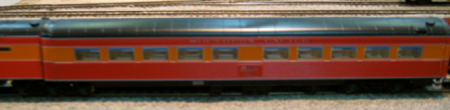
BLI SP Coast Daylight articulated car set #2465/2466. 1953 post war version. Full width diaphragms. The straight parlor must run vestibule to the rear as the parlor-observation doesn't have it's own vestibule. The seats in BLI's single chair cars are positioned to have the vestibule at the front. On the articulated chair cars, the women's car ran ahead of the men's. But presumably BLI has the seats set up that way.
Jeff Cauthan
Brass
Models are only available in brass. You’ll find a car sides mfg in the southeast that has a product line that included an early SP articulated coach with corrugated sides. They also offered a 3 section diner.
Limited Editions
Back in the late 70's Bill Anderson made them under the kit name of Limited Edition. You can still find them from time to time at train shows and on E-Bay. A word of warning: they are not easy to put together but when finished they make a very good looking model. With the new full width diaphragms from Coach Yard and the D&G trucks you can do a nice job if you are careful.
Limited Editions did two versions of these cars, one extruded aluminum which was difficult to assemble and later resin cast sides which had different problems. There were two many flaws in the sides to consider assembly. Some of the LE details are no longer state of the art and need replacing as well. Also the LE roofs do not look as good as those of the body core that you have to shorten when using the Union Station sides.
Earlier runs of the Limited Editions cars had an aluminum roof insert that did not match the width of the lower car body, and this was difficult to correct. Later runs were OK. If you do choose to buy the cars, this is one "flaw" to watch for in the kits with painted window strips. They appear to have the top rib of the corrugation missing. This may have been done due to the limitations of the stamping process used.
MHP
Nothing seems to capture the look of corrugated metal like corrugated metal. With the exception of the missing corrugation, the MHP car sides have not been surpassed yet.
It might be interesting to use the sides on one of the more modern "core kits" to get more accurate roof and underbody detail. These were wood, with the underframe detail being just blocks.
The MHP car does come up short on corrugations, but did come as a complete kit with then "state of the art" Central Valley trucks. For the money and ease of assembly, use the MHP cars. The MHP kits paint was "real" Daylight Red and Orange direct from Dupont.
Your are right to stay away from the cast resin body kits. However to this date these sides out of aluminum are by far the best representation of the corrugation on the sides of the PS Daylight cars as no one has come closed to matching them not even in the very expensive brass car market. The advantage of the first kits is that the ends and roof parts were made from plastic and look very good. The underbody parts made of the cat resin, don't look bad at all once they are under the car and painted. The ends and roof detail of the pot metal and cast resin do leave a little bit to be desired. These parts are even harder to find than the kits themselves.
The MHP cars where good for their time, early 60's. They look very nice but the corrugation was not right. The trucks that came with the MHP kits where something that did not even come close to what should have been under these cars. However that is what was available at the time before D&G trucks which is the only way to go.
MTH
#2463-2464
The skirts are poor. They only measure 15” below the nearest stripe between the trucks.
Union Station
You can use a TSP core and Union Station Products sides to model a workable facsimile in HO You have to workout the articulation yourself, accept a compromised fluting pattern and check with D&G for the correct trucks. See the following:
Union Station used to make their siding separately so that you could take a smooth side car and add correct corrugations. The smooth side brass car (SOHO) looked much better than the corrugated versions from the same importer. The Union Station cars are easier to build than any of the Limited Edition kits. The SP Pullman -Standard book Vol 5 "SP pre-war" will help detail the cars.
Union Station does make some very nice underbody parts that have filled some of these needs left by LE. There is an article on the Lark cars for RMC, March 2004. The Union Station are much easier to deal with as they are made of plastic and make a very nice looking model. These kits are not for the novice.