Southern Pacific Lines
Coast Line Division
“The Route of the Octopus”

Southern Pacific Lines
Coast Line Division
“The Route of the Octopus”
General Information
Coach Cars
Chair Car and coach bodies were basically the same, but the interior differences are explained in Volume 1 and shown in photos and floor plans.
Jeff Cauthen
By far the most numerous, these are just what they sound like, a passenger car with lots of seats. Coaches often saw many years of service and more than one rebuild during their lifetime, and many survive today not only in Amtrak service but as commuter coaches and tourist or excursion cars. Like head-end cars, these were typically owned by, and often built by the railroads that operated them. Coach cars tend to have a fairly symmetrical row of windows running most of the length of the car on both sides, with smaller windows at the end where the restrooms were located. Nomenclature for Coach cars = C.
Coach vs Chair Car vs Commute
#2170 is a coach with standard seats that had leg rests. The seats were the kind that you push the back forward to sit facing the other way. (Walkover?) foot rest would follow it.
#2175 is a chair car. It has reclining seats with adjustable foot rests and fewer seats with more room. These seats replaced the original seats. They are like the seats in a streamliner. I do not know why SP put modern seats in a coach made in 1921. Subs have 96 seats and they all are the push forward type. Foot rest falls back. CSRM has both cars SP #2170 and #2175.
All LW cars were chair cars. HW's were a mix. Double deck commute cars were coaches. Chair cars had better seats and less of them. Chair cars usually had larger lavatories. The Coach and Chair car book from SPH&TS details the differences
References
Pax Cars(*see T-20/13)
Pax Trains (*see T-33/10-13)
SP Pullman Standard Plan 7377-78
Plan 7376 is a 48-seat coach delivered for general service, the Challenger and the Californian.
Paint
Interior Paint
The interior walls appear to be a light tan, with a slightly darker floor and multi-colored seats. This is from inspecting black and white builder's photos. The Daylight book covers interior paint schemes for similar cars ordered for the Daylights but does not cover these cars used in general service.
The Illinois Railway Museum have the Pullman files and should be able to sell you a copy of the original spec sheets.
HeavyWeight Sleeper / Coach
They are 6-axles Clerestory style cars.
Paint
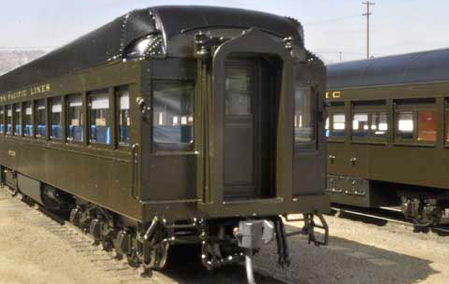
Painted 'Lark' 2-Tone Grey
Modeling HeavyWeight Classics
Walthers
They are 6-axles Clerestory style .
Put SP number or names on some Walthers Heavyweight classics.
Here's the list of the suggested number with those model ;
- 932-10109, Pullman Coach,Paired Window, (Plan#2882-B) :SP 2350 to 2359
The coaches numbered 2350-2359 are not SP either.Not SP
Modeling Coach Cars
Athearn
Athearn does have a truck mounted generator, roller bearings, narrow width diaphragms, factory installed grab irons, ladders, etc.
Athearn does not have a baggage loading door, skirts
Paul Vernon
Paint
Two tone gray (TTG)
Lettering & Numbering
Lettered SOUTHERN PACIFIC
Electrical
The Athearn cars have the flicker free lighting system.
References
Coach Articles
Railroad Model Craftsman February 1938 - Plans, SP 54ft Coach of 1894.
Railroad Model Craftsman July 1954 - Plans, Plans, SP 54ft Coach of 1894.
Railroad Model Craftsman September 1954 - Plans, SP Coach 60ft steel.
Railroad Model Craftsman August 1988 - Plans, T&NO Common Std. Harriman Coach 60-C-5.
Railroad Model Craftsman May 1969 - Although not SP exactly, Plans for Bi-level Commute Coaches - C &NW ones were close to the SP Gallery Cars.
Coach References
The Official Pullman-Standard Library, Vol. 5: Southern Pacific Prewar Cars
The Official Pullman-Standard Library, Vol. 6: Southern Pacific Postwar Cars
The Official Pullman-Standard library books published by RPC Publications do contain plans, in this case builder generated floor plans showing the placement of interior fittings, windows etc., all with dimensions. They also include simplified side elevation drawings. The two volumes published on Southern Pacific P-S passenger cars are *very* much worth finding and adding to your collection:
RPC Publications' website: http://www.rpcbooks.com/
All three of the RPC volumes listed above are currently out-of-print.
RPC also publish the Passenger Car Library Series; volume five contains the Budd and ACF cars built for ATSF and SP.
Drawings
Contact the Pullman-Standard museum in Chicago, IL. They still have available for sale erection drawings (blueprints) for most of the P-S passenger cars. You'll need to get their catalog and order by the correct lot number(s) for the car(s) you're interested in.
Call for information: (773) 660-2341 http://www.pullman-museum.org/thePeople/
Rob Sarberenyi
Specific Coach Passenger Cars
60-C Class Cars
60-C-1
#1347-1348
Blt by SP CO, 1906 1 Total Pac. Line
These became “All Day Lunch Car” and were renumbered.
Reference
Southern Pacific Passenger Cars, Vol 1: Coaches & Chair Cars, pg. 18-19
Drawing
Southern Pacific Passenger Cars, Vol 1: Coaches & Chair Cars, pg. 18
Modeling 60-C-1 Coach Cars
Ken Kidder brass
The Ken Kidder cars are from the early days of brass; they have a too-shallow roof curve (which isn't noticeable when these cars are in a train by themselves), missing roof conduit and the wrong air vents, no interior detail, a wood floor, and no floor detail.
To improve the cars, get rid of the wood floors and fabricate my own underframes for these cars out of styrene. The floor is 0.020 inch sheet styrene. so that they fit between the floor support brackets on the Ken Kidder cars. Add enough detail to make these cars interesting. Add a battery box, brake cylinder, and brake valve, generator, brake rods and piping, one or two air tanks, and vapor regulators. The vapor regulators are part of PSC's underframe kit, and were used for venting steam lines. These are short pipes that stick down from the floor. Regardless of whether they're prototypical, they help make the underframe look busy.
Robert Bowdidge
60-C-2
Blt by SP CO, 1909 1 Total Pac. Line
Reference
Southern Pacific Passenger Cars, Vol 1: Coaches & Chair Cars, pg. 19
Drawing
Southern Pacific Passenger Cars, Vol 1: Coaches & Chair Cars, pg. 18
Modeling 60-C-2 Coach Cars
Ken Kidder brass
60-C-3
#1085, 1099, 1141, 1142, 1149, 1177, 1180, 1191, 1228, 1232, 1236, 1238, 1240, 1253, 1259, 1260, 1273, 1275, 1361, 1367, #1619, 1670, 1685, 1686, 1691, 1825, 1843, 1844
1945
#1092, 1095, 1097, 1149, 1150, 1363, 1825, 1828, 1829, 1831, 1832, 1836
no A/C
Blt by Pullman, 1909-10 84 Total Pac. Line
Reference
Drawing
Southern Pacific Passenger Cars, Vol 1: Coaches & Chair Cars, pg. 18
Modeling 60-C-3 Coach Cars
Ken Kidder brass
60-C-4
#1065, 1066, 1068-1071, 1076, 1078, 1079, 1108, 1119, 1128, 1136, 1144, 1146, 1159, 1163, 1171, 1175, 1326, 1338, 1340, #1343, 1349, 1372, 1379, 1394, 1413, 1426, 1527, 1569, 1573, 1576, 1578, 1827, 1833, 1840, 1841, 1846, 1848, 1849, 1851, #1854, 1862, 1864, 1867, 1868, 1871, 1873, 1874, 1876, 1877, 1878, 1949, 1952, 1954, 2301
no A/C
#1169, 1170 no A/C, narrow windows, former T&NO 754, 756
#1181 no A/C, former T&NO 738
#1182-1186 no A/C, former T&NO 735, 736, 739, 741, 747
#1572-1578 steel, Harriman cars, dbl vestibule, used on Daylight until 1924
#1858, 1859, 1861 no A/C, former T&NO 744, 746, 750, narrow window
#1349-1398 Pacific Line Cars
#1400-1426 Pacific Line Cars
Blt by Pullman, 1909-11 135 Total Pac. Line
1945
#1108, 1119, 1127, 1128, 1131, 1145, 1171, 1379, 1385, 1394, 1413, 1519, 1561, 1569, 1571, 1835, 1847, 1851, 1853, 1857, 1868, 1877, 2300
Paint
Two tone gray (TTG)
Lettering & Numbering
It had "COMMUTE" in the letterboards near the doors.
Reference
Southern Pacific Passenger Cars, Vol 1: Coaches & Chair Cars, pg. 27, 53-54
Photo of SP #1185 60-C-4 class coach Southern Pacific Passenger Cars, Vol 1: Coaches & Chair Cars, pg.128.
Drawing
Southern Pacific Passenger Cars, Vol 1: Coaches & Chair Cars, pg. 18, 61-62
Modeling 60-C-4 Coach Cars
Ken Kidder brass
60-C-4#1864 72 seat Harriman coach.
60-C-5
#1196-1199
#1956-1978
#2302-2311
#1010-1012*, 1196*, 1200-1202, 1208, 1961, 1963, 1964, 1966, 1972, 1974, 2302-2305, 2307-2309
no A/C, *former NWP 400, 454, 455, 458
#1203, 1958, 1968, 1265
#1965 72 seat, 2 compartment Harriman coach. air conditioned in 1937
Blt by Pullman, 1912-14 37 Total Pac. Line
1945
#1201-1205, 1963, 1965, 1974
Reference
Southern Pacific Passenger Cars, Vol 1: Coaches & Chair Cars, pg. 30-33, 55
Drawing
Southern Pacific Passenger Cars, Vol 1: Coaches & Chair Cars, pg. 30, 61-62
Plans, T&NO Common Std. Harriman Coach Railroad Model Craftsman Aug. 1988 -
60-C-6 Chair Cars
#1007-1009 no A/C, former NWP 403-405
#1013-1015 no A/C, former NWP 462, 465, 468
#1874 a/c, small window, used on Coast Mail (Train 72)
#2026, 2032, 2037, 2045, 2049
#2033, 2041, 2046, 2160, 2161, 2163 no A/C, used on Coast Mail (Train 71)
Blt by Pullman, 1915 30 Total Pac. Line
1945
#2026, 2029, 2046
Reference
Harriman Chair Cars PT1-159
Southern Pacific Passenger Cars, Vol 1: Coaches & Chair Cars, pg. 36, 39-40
Drawing
Southern Pacific Passenger Cars, Vol 1: Coaches & Chair Cars, pg. 37, 63
60-C-7
#2050, 2051, 2053, 2055, 2057, 2063, 2064, 2067, 2068 no A/C
Blt by Pullman, 1915 20 Total Pac. Line
1945
#2050
Reference
Southern Pacific Passenger Cars, Vol 1: Coaches & Chair Cars, pg. 36, 39
Drawing
Southern Pacific Passenger Cars, Vol 1: Coaches & Chair Cars, pg. 37, 97
60-C-8
#2164
Coach GH&SA 823, Class 60-C-8, was built by Pullman in Lot 4395 (Pullman Plan 2924) in November 1916. It was rebuilt at Houston General Shops April 19, 1927 to T&NO 987, Beaumont; renamed Victoria April 19, 1927; sold to SP March 16, 1941; renumbered to SP 110, May 16, 1941; sold to NWP August 10, 1941; renumbered and named NWP 06, Redwood September 1941; name removed December 1954; it was retired to NWPMW 211, November 20, 1958. SP always referred too them as official or business cars.
Jeff Cauthen
Blt by Pullman, 1916 0 Total Pac. Line
1945
#1208, 2164
Reference
Southern Pacific Passenger Cars, Vol 1: Coaches & Chair Cars, pg. 37, 50-51
Drawing
Southern Pacific Passenger Cars, Vol 1: Coaches & Chair Cars, pg. 37
60-C-9
#1801, 1803, 2167, 2169, 2172, 2176, 2185, 2186 no A/C, former SDAE 203, 205
#2165, 2166, 2170, 2174 A/C, narrow windows
#2073 A former three-digit TNO car was a -9.
All had 12 roof vents.
Blt by Pullman, 1921 0 Total Pac. Line
1945
#2165, 2166
Reference
Southern Pacific Passenger Cars, Vol 1: Coaches & Chair Cars, pg. 46-47, 56
Drawing
Southern Pacific Passenger Cars, Vol 1: Coaches & Chair Cars, pg. 46, 96
60-C-10
These heavyweight coach cars were only five on the system
#2180 A/C, former H&TC-847
#2181, 2182, 2183 no A/C, former H&TC 848, 849, 850
#2184 A/C, former H&TC 851
#2712 no A/C, former 60-CC-1
All had 12 roof vents.
Blt by AC&F, 1924 0 Total Pac. Line
Reference
Southern Pacific Passenger Cars, Vol 1: Coaches & Chair Cars, pg. 46-47, 57
Drawing
Southern Pacific Passenger Cars, Vol 1: Coaches & Chair Cars, pg. 46, 95
Modeling 60-C-10
Precision Scale
Three Precision Scale HO models of S.P. heavyweight passenger cars: all had identification or car-number problems.
#2073 C-60-10. This looks like a -9 since it has 20 roof vents rather than a -10's 12.
#2168 C-60-10. This also looks like a -9 because of the vent number. Unfortunately, #2168 was a 72-C-1.
Clerestory Roof Coaches
70-C Class Cars
70-C-1 Harriman Chair Cars
#1048-1056 HW Coach Cars
These cars, acquired when SP purchased the EP&SW, were numbered into the SP system.
As clerestory cars they LOOKED different from most SP coaches.
Tony Thompson
Obvious differences are the air-conditioning duct and the lavatory windows, which are offset upwards on the SP cars. The ducts are smaller than what we're used to seeing on Pullman cars (e.g. New England Rail Service ducts). The clerestory's may be different widths, and that might account for the difference in the appearance of the air conditioning ducts.
#1049 Coach car appears in a 1939 SUNSET LTD. consist in Wayners' book "Passenger Train Consist 1923-1971.
#1052-1054 were rebuilt into business cars in 1930. Only one 70-C-1 lasted to 1961.
#1055 & #1056 had their window size altered such that the "seat" windows were shorter than those nearest the doors.
Out of a total of nineteen (coaches and chair cars) acquired from the EP&SW, no less than seven were ultimately converted into official cars by S.P., a valedictory after a fashion. The EP&SW cars gave long and good service.
Paint
1. Green
2. Two-tone gray. There is a photo SPHTS Volume 1 on page 223 of SP #1056 in two-tone gray.
3. Daylight colors, silver roof during 1957.
Reference
Southern Pacific Passenger Cars, Vol 1: Coaches & Chair Cars, pg. 197, 223
Drawing
Southern Pacific Passenger Cars, Vol 1: Coaches & Chair Cars, pg. 201
Modeling 70-C-1 HW Coach
Walthers
The Walthers heavyweight coach, appears that the only SP car that would qualify to be represented, based only on window patterns and not dimensions would be SP #1048-1056. #1048 appears to match the Walthers car much better, if one adds the AC duct.
Paint
The Walthers car is being produced in TTG for SP but photos seem to suggest that these cars remained in green. Walthers also is producing a green version [probably Pullman Green] unlettered. The best course of action to use one of these cars for an SP car might be to letter the green car.
73-C Chair Cars
73-C-1 Chair Cars
#2331-2347 A/C
#2335 used on the Coast Mail{Train 72}
The 73-C-1 HW Coach class lasted in good numbers to 1961 and finally disappeared in 1966.
SP Harriman passenger car gas tanks
Gas tanks were used to power the gas lights installed under SP Harriman coaches and chair cars. They appear in photos to be approximately 16" or 20" in diameter, and about 6-8' long.
Paint
Green
Two tone gray. There is a photo in SPHTS Vol.1 on page 223 of SP #1056 in two-tone gray.
Daylight - silver roof during 1957.
Reference
Southern Pacific Passenger Cars, Vol 1: Coaches & Chair Cars, pg. 206-209, 215, 226-229
See: PT1-159
Drawing
Southern Pacific Passenger Cars, Vol 1: Coaches & Chair Cars, pg. 207, 216, 218, 226, 231
Modeling 73-C-1 HW Coach
Coach Yard
Coach Yard did the 73-C-1 (misidentified as 73-CC-1)
http://www.thecoachyard.com/Pages/AllImages.lasso?StockNo=0905
http://www.thecoachyard.com/Pages/AllImages.lasso?StockNo=0906
Arch Roof Coaches
Arch Roofed Cars Nomenclature
Arch roofed cars were Common Standard steel cars to the SP. SP referred to the roof style as an arch roof in most cases. Clerestory roofs were referred to as Clere-Story on the SP. Pullman called the arch roof an oval roof. From an engineering standpoint, oval is more correct. The design is most certainly not a Roman arch.
Calling an arch roof steel car is much more appropriate that calling it a Harriman. Common Standard arch roof steel car is even more correct. No arch roofed cars were ever referred to as "Harriman cars" by SP or UP or by the builders Pullman, ACF, etc.
Jeff Cauthen
72-C Class Cars
72-C-1 Harriman Chair Cars
#2070, 2072, 2073, 2074-2076, 2077-2084 A/C, former coach, news agent space, held 90 pax,
#2074-76 rebuilt to 40 seat cafe lounge cars in ‘28 renumbered #10907-10909,
#2080-84 converted to parlor cars in ‘31 and renumbered in ’41.
#2168 looks like a C-60-9 because of the vent number. However, #2168 was a 72-C-1.
Reference
72-C-1, 72' Harriman Chair Cars Trainline #62; History, plans, pix, roster; by Don Munger
Southern Pacific Passenger Cars, Vol 1: Coaches & Chair Cars, pg. 131-134
Drawing
Southern Pacific Passenger Cars, Vol 1: Coaches & Chair Cars, pg. 133, 179, 186
72-C-2 Harriman Chair Cars
CP #2312-2315 A/C, former coach, news agent space, former CP
Reference
72-C-2, 72' Harriman Chair Cars Trainline #62; History, plans, pix, roster; by Don Munger
Southern Pacific Passenger Cars, Vol 1: Coaches & Chair Cars, pg. 131
Drawing
Southern Pacific Passenger Cars, Vol 1: Coaches & Chair Cars, pg. 133, 187
72-C-3 Harriman Chair Cars
TNO #862-871 72' Harriman Chair Cars, former H&TC
Reference
72-C-3, Trainline #62; History, plans, pix, roster; by Don Munger
Southern Pacific Passenger Cars, Vol 1: Coaches & Chair Cars, pg. 135
Drawing
Southern Pacific Passenger Cars, Vol 1: Coaches & Chair Cars, pg. 133, 170, 189
72-C-4 Harriman Chair Cars
#2001, 2002, 2004-2006, 2008-2011 72' Harriman Chair Cars, A/C, former coach, news agent space, former O&C
Reference
72-C-4, Trainline #62; History, plans, pix, roster; by Don Munger
Southern Pacific Passenger Cars, Vol 1: Coaches & Chair Cars, pg. 131
Drawing
Southern Pacific Passenger Cars, Vol 1: Coaches & Chair Cars, pg. 133
72-C-5 Harriman Chair Cars
#10092-97 72' Harriman Chair Cars, A/C, former coach
#2012-2015, 2017-2021, 2316, 2317, 2319-2324, 2326-2330 2326- 2326-2330
A/C, former coach, former T&NO #872-881 transferred to Pacific lines, 1931 becoming #2012-2021,
#2316-2320 steel, standard seats
#2321-2330 steel, bucket seats, higher windows, used on Daylight, former CP
Reference
72-C-5, Trainline #62, pg.10; History, plans, pix, roster; by Don Munger
Southern Pacific Passenger Cars, Vol 1: Coaches & Chair Cars, pg. 131, 141-144, 188-190
Drawing
Southern Pacific Passenger Cars, Vol 1: Coaches & Chair Cars, pg. 133, 143, 144, 179, 186
Modeling 72-C-5 Harriman Chair Cars
Coach Yard
#1151 HO Brass Southern Pacific SP Harriman Coach Class 72-C-5.
75-C Chair Cars
75-C-1 Chair Cars
#2348 destroyed in accident 1939
#2349 A/C, former 75-O-1
Reference
Southern Pacific Passenger Cars, Vol 1: Coaches & Chair Cars, pg.
Drawing
Southern Pacific Passenger Cars, Vol 1: Coaches & Chair Cars, pg.
75-C-5 Chair Cars
These were heavyweight cars.
77-C Chair Cars
77-C-2 Chair Cars
#2431-2433, 2437
Lightweight Coach, 48 seat, used on Cascade train.
Paint
Painted “Cascade”.
Modeling 77-C-2 Harriman Chair Cars
Coach Yard
79-C Chair Cars