Southern Pacific Lines
Coast Line Division
“The Route of the Octopus”

Southern Pacific Lines
Coast Line Division
“The Route of the Octopus”
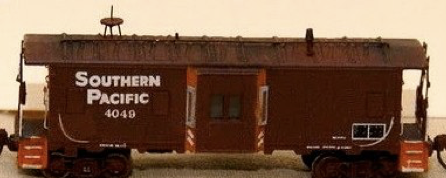
General Caboose Information
AAR Car Designations
Class “N”
NE – All cabooses.
SP Caboose Details
Bars on SP bay window cabooses
Bars were not applied uniformly. Some can be seen in photos in the early 1950s, but there are also cabooses without them as late as the late 1960s. They were often referred to as "safety bars," indicating their purpose.
Tony Thompson
Caboose Marker Lights
Markers were still the classic kerosene lamps in 1949. Marker lamps had one red and three green lenses. It is a red lens and not a bulb. Red was to the rear in most circumstances. The dual kerosene markers went away between 1955 and 1960 (mostly). The single mounted lights above the doors, on the car ends happened after 1980.
http://mancosbob.rrpicturearchives.net/showPicture.aspx?id=1172230
John Huey
The SP cabooose had both Handlan Buck and Adlake marker lamps. In the 40's & 50's era, both styles utilized a larger RED lens facing the rear with the other (3) green lenses facing in their respective directions. They were turned, of course, as required by the rule book when in the clear.
Ken
The first SP cabooses delivered new with the roof mounted "frog eye" lights were the C-40-4's in 1961, and that was the beginning of the end of marker lamps.
Tim O’Conner
Cabooses scheduled for phased overhauls got the new electric rooftop markers; older cabooses destined for scrap used kerosene markers until the cars left the roster.
Kevin Bunker
Some Espee cabooses received single marker lights vs. the double "frog eyes" in their later years. This was a late development, circa 1980, to replace the double-light "frog eyes." Soon thereafter, the end lights began to be moved off the roof and placed above the end doors. Several photos of showing both the single and double rooftop style marker lights can be found in the book "Southern Pacific Freight Cars, Volume 2: Cabooses", by Anthony W. Thompson, Signature Press, 2002, ISBN # 1-930013-10-8.
There's a 1943 dated photo of C-40-3 #1210 on page 186 of the above mentioned book.
For information about the display of markers, http://www.sphts.org/rulebuk3.html
Look at the lower right frame. The copies are from the 1960 rulebook but the drawings were in rulebooks many years before that the upper light held a red bulb. http://espee.railfan.net/jpgs/bob_dengler_6/bob_dengler_sp-h24-66-3033b.jpg.
Viewing that last photo brings up an old question--was it really a red bulb or actually a small red lens over a clear bulb? Not that it really matters, of course, since the effect is the same.
Tony Thompson
Marker Lights Frog-eye Type
Red and green frog-eye marker lights first installed in the 1959 Cotton Belt order of 25 Wide Vision Cabooses. Stopped around 1978.
Caboose Track Damage Light
Looking at the steel cupola cabooses reveals a lamp to the rear of the caboose very low below the end sill at almost axle level. Some, but not all SP C-40 series steel cupola cabooses had the clear lights mounted below the end sill to the right of the air hoses.
The old Kero ones were used to inspect the track behind you in case something was dragging or derailed. That was one of the duties of the rear brakeman. The ones on the official cars were there so they could inspect the tunnels during the day and the RofW any time they wanted.
On the mountain subdivision on the old Sacramento Division there was an instruction for the rear brakeman to ride looking out the rear of the caboose to observe the track behind his train for track damage caused by derailments or dragging equipment. Since very little of the train could be seen in the miles of snowsheds and tunnels this was a derailment detector. The lights were installed to give the necessary illumination. This procedure was discontinued when the snowshed mileage was reduced. An unexpected place to hang a light!
Joe Strapac
There’s a picture of the 1031 in Thompson's book (SP Freight Cars, Volume 2: Cabooses, page 197) with a light and still in Silver. These show up quite well in several caboose photos on Photobob's website.
Train Number Indicators on Cabooses
Discontinued about 1930. C-30-2 and before had them. Train number indicators were on the cupola.
Caboose Radio
SP had no train radio in 1949.
Caboose Trucks
If they are the original trucks, they would be arch bars. Those were rapidly replaced in the 1930s and early 1940s with Vulcan's. So whether this is the "right" truck depends on the era being modeled. The Vulcan side frame is in many issues of the Cyc, if that is what is wanted. There were several different Vulcan sideframes, as well as some other patterns (L and T section Vulcan, Andrews, etc.). That's in the time before WW II. Later there were others, such as Barber-Bettendorf.
The C-30-1 era, after about 1935, was totally dominated by Vulcan trucks, so that would be the ideal sideframe. Gotta have leaf springs, very few SP cabooses had otherwise.
Tony Thompson
Caboose Wheels
The speed of the Overnight (as with the speed of passenger trains) required steel wheels instead of cast iron. But all SP's wood cabooses had cast iron wheels. Only the new steel cabooses had steel wheels. If a steel cab wasn't handy, you could use a coach, because it would have steel wheels. I was told that this was unusual but did happen from time to time. Remember that MOST cabooses were assigned to individual conductors in those days, so this problem could only arise if a conductor was called for an Overnight who was not assigned a steel caboose.
Tony Thompson
Caboose Stove
SP used coal in their caboose stoves from the early 1940s through the middle 1950s. There was a hiatus in SP caboose purchases from 1951 to 1961. When new bay-window cars again were ordered in 1961, they came with diesel-burning heaters. As one trainman told me, "You weren't supposed to be able to cook on them, but it took us about 10 minutes to figure out how to do it."
Tony Thompson
In LA the SP purchased the coal in sacks and sacks were placed into the coal bins in the cabooses.
Paul C. Koehler
The SP 1101 caboose in Niles Canyon has the coal bin next to the stove. Most of the time we burn wood but every once in awhile we buy a bag of coal. When the coal is burning very little smoke is visible but there is a very unique smell.
Joe Mann
Axle-mounted Generator
Used to charge batteries that provide for lights and power on a caboose. (*see MR 9/99, pg. 36)
Paint
Painted blue in color.
General Painting of Cabooses
Exterior Color Paint
SP paint tended to weather towards a medium brownish oxide, but you can find examples of almost every shade from orange-pink to black.
The first CS color chart was in 1907, with these same colors. CS 11 was also used for wooden gondolas and flat cars, as well as for steel cars like gondolas, hoppers and tank cars (in that era).
At least as of 1909, the SP paint standards call out the use of CS 11 "metallic paint" (what we know as mineral, or boxcar red) for bodies of box, caboose and stock cars, and for roofs and ends of refrigerator cars.
Restoring SP1107 to look as close as possible to her as-built condition means NO ORANGE ENDS!
The SP color before 1945 was a dead match for the PFE mineral red, and there is a very accurate paint chip of that color in the back of the PFE book. I would strongly recommend using it. It was matched at the printing plant with the original paint color drift to ensure it really matched, and it does.
Tony Thompson
SP's standard freight car red changes just after WWII. Good chips for the later color are again at CSRM, called "Drift Panels", dated 1963 and there is good information on previous color circa 1912 or so, with samples chips in the UP Museum in Omaha, (these are on line, but don't trust a color as shown on a monitor) and supporting descriptions of color use at CSRM, but less information on the period in between.
SP Caboose Silver Paint
The silver scheme was a relatively short-lived lettering applied in 1955 for use on the early TOFC trains. There were only eight cabooses like that. In the early 1960s all were repainted into normal box car red like other SP freight cars The first SP bay window cars were built in 1947. After that date, SP never built or bought another cupola caboose (though subsidiary Cotton Belt did). None of the various classes were ever painted in the silver scheme. But the cupola cabooses survived well into the 1970s.
Tony Thompson
Steve Goen has a photo of one of the T&NO cars with the test red ends, and there is a photo of a silver BW one, and in his Coast Line book, a photo of a cupola car with silver end.
Tony Thompson
Orange Ends
The orange ends are essentially a 1955 and thereafter scheme. By that time the entire car bodies were being sprayed mineral red when repainted. Of course there is evidence that a few cabooses got orange ends with no other painting applied, so a black roof on a car with orange ends is NOT impossible, though rare.
Tony Thompson
SP Caboose #1210
Caboose #1210 probably received her orange ends-was during the time period that all cabeese received it. The program for this painting went on over a period of years. #1210 received the Daylight Orange ends at LA General Shops on November 23, 1955.
Silver Ends
Std & Bay Window caboose colors
A few standard cars received "silver" ends, but none of the bay windows cars were painted silver (aluminum). the caboose end color experiment with aluminum and then Daylight Orange didn't start until March 1954. Each division was instructed to paint two of its cabooses with aluminum ends, as a test, as the vermilion (on the bay window cars) was not perceived as visible enough. This color choice was not impressive to most observers, and a year later, the same two-caboose-per-division experiment was repeated, this time with Daylight Orange. That color succeeded, and became standard on October 12, 1955.
Tony Thompson
Vermillion Ends
SP Bay Windows and CA-1's Color
All three of the 1947-1951 caboose classes were put into service with vermillion ends, as pointed out in both Joe's review and in my book. We don't know for sure when this went away but apparently about 1952 or 1953.
Tony Thompson
Not only bay windows but C-40 cupola cabooses in the fifties were bright red on the ends. See the photo p.32 Southern Pacific in Color, volume 1 as an example.
Richard Percy has steel cabooses discussed and presented in photos on his site http://espee.railfan.net/caboose_steel.html
Roof
There are plenty of photos of black roofs into the 1950s, though there had begun a practice of painting the entire body one color.
Underbody
The underbody color was black before WW II.
Interior Color Paint
At least as of 1909, wood floors in several kinds of cars, including baggage cars, were CS 15, maroon, the interior walls and ceiling were CS 15, Green. The green paints may have changed over time. One note on Linseed oil based paints, they can darken if not exposed to light. Sometimes you need to give them some time (typically less than an hour) to come back to their "nominal" color.
There was indeed a dark green originally used inside. Bob Church found this also in his SP cupola caboose. The later "Sea Foam" green, as also used in diesel cabs, is substantially lighter. Repainted interiors would have been the later color. CS 15 color drift is quite a dark green, some what like what is called forest green. Sea Foam is quite a lot lighter.
Tony Thompson
All the interior was painted green ('seafoam green'). See page 325 of Tony Thompson's SP Freight Cars Vol. 2 Cabooses).
In the 1916 era, SP cabooses all had varnished wood interiors, and it's possible the NWP narrow-gauge did too.
Tony Thompson
History of Caboose Paint
It depends on what year, the SP changed its Mineral red about 1947. Before that date it was a very brown mineral red, afterward it is much lighter, and more red than brown.
Tony Thompson
1947 and 1949
The red ends often lead to questions about the later orange ends. The 1947 and 1949 cars were delivered with red ends, but no other cabooses seem to have received this end color.
1948
The white handrails came in 1948.
1954
In March 1954, SP set out to test whether aluminum ends might be a good visibility paint, and that color was to be compared to the red already in service. Each division was to paint two cabooses with aluminum ends and observe performance. By that fall, it began to be concluded that aluminum was really not much better (think of it in a snowy environment), but then the suggestion was made to try Daylight Orange. It was a success.
1955
In October 1955, the orange was made standard and cabooses system-wide began to receive that new color.
The relatively short-lived silver scheme was applied in 1955 for use on the early TOFC trains.
References
Southern Pacific Freight Cars, Volume 2: Cabooses, pg. 254-255
See Tony Thompson's excellent book SP Freight Cars Volume contains numerous photos of C-30-1s, along with every other class of SP caboose. The book includes some drawings that are very useful, including one for the C-30-1.
If you look at the caboose photos in the new caboose book, you will be hard pressed to find ONE example of evident wood grain. Some failing paint, sure, but wood grain, nope. The railroad had paint shops handy and did maintain the wood cars well, until very late (e.g. 1960 or so). The new caboose book does not have correct color chips, but the color is the same (exact match to my eye) with the PFE red used for roofs and ends, and that chip is in the PFE book.
Tony Thompson
Also look at Joe Strapac's "1981 Southern Pacific Review".
Modeling SP Cabooses Paint & Color
Unless you have a genuine drift card to match, and are modeling a car fresh out of a paint shop, it hardly matters what color of "box car red" that you use.
Scalecoat "boxcar red" is a good starting point for SP freight car red. Polly Scale makes a "boxcar red" and "D&RGW red" that seem like two shades with a brownish-maroon cast, and several more shades like "PRR maroon" and "mineral red" that have a reddish-oxide cast. Remember that manufacturer's colors are just ingredients that go into a recipe.
So which should it be: Light Freight Car Red or Dark Tuscan Oxide Red?
Use a Tamiya color called Hull Red for his base, and tone it down with small amounts of black and white until you are satisfied with the results. The result is quite authentic in appearance to a slightly weathered box car red.
Tony Thompson
Exterior Color Paint
Accu-Flex
Mix Accuflex
2 parts Lt. Tuscan Oxide
1 Part Dk. Tuscan Oxide
Accu-Paint
Accu-Paint AP 12 matches this drift panel quite well.
Floquil
For a correct color for cabooses, try Floquil, one part Tuscan to one part Box Car Red. It just works fine. After WW II, SP's box car color was very similar to the Floquil "D&H caboose red" though that particular color is discontinued.
If you want a color panel to compare to paints, the box car red used by PFE and reproduced on page 418 of the PFE book exactly matches the SP color drift panels which I have.
Tony Thompson
Polly S
Use Polly S brand water based product. The Polly S requires a mixture of 2 parts boxcar red and one part roof brown.
John Ford
Scalecoat
Use Scalecoat Box Car Red #2. It is a close match to the PBL Star 30 and the old Accupaint AC 12
Jim Elliot
Tru-Color
An alternative, with an accurate SP freight car color matched to drift cards, is Tru-Color Paint, their color no. 211. Go to their page called "Freight Car Color Index," it's listed on the home page;, and scroll down to Southern Pacific.
Tony Thompson
Lettering & Numbering
History
The history of SP caboose lettering is: up until the mid forties (ca. 1946) the lettering was a simple SP initials only ( + plus the number ).
1946
After that time the lettering was spelled out SOUTHERN PACIFIC in RR Roman, sometimes with a bar over the name. The 1946 spelled-out road name had stripes above the name and below the number.
1952
The stripe application was discontinued in 1952 and there are plenty of photos of cars evidently relettered between 1952 and 1956 with the full name and no stripes. The name used Roman characters but was NOT "Railroad Roman" as we have had inflicted
on us by some decal makers, nor was it the "standard" MCB lettering either. It was SP's own lettering design.
Tony Thompson
1955
In the mid fifties ( ca. 1955 ) large white Gothic words were used with orange added to the ends.... S and the P appear to be ca. 24", and the rest of the letters appear to be around 15" or 16 ".This lasted on some C40-1/3 cabooses until the end but some were re-lettered in a stacked smaller Gothic.
Tom Cockle
The later scheme had exactly 24- inch initials and 16-inch other letters. This size was used on a number of cars, including covered hoppers in the early 1960s.
Tony Thompson
Size
The Roman lettering on cabooses was 9-inch road name and 7-inch numbers, exactly like other freight cars.
Tony Thompson
SP Caboose #1107 Font & Color
Caboose SP1107 RR Roman fonts, including "Southern Pacific" style sold by RailFonts.com do not appear to be quite right. The closest version sold by RailFonts is the RR Roman-Northern Pacific style. That is to say, the basic font style is correct, but it looks to me by comparing the font printout to the photos of 1145 and 1133 that the printout version has very thin "legs" of the "N" and "U". Maybe when expanded to 9" tall they will paint out OK, and not look so very thin. It seems that it could be that the stencils used to paint on the sides of the cars were slightly modified from the strict font styles used on paper?
Fonts are really specific to computers, type, or typefaces for traditional printing, and railroads used drawings for their standard lettering, from which was made stencils or other layout systems.
The California State Railroad Museum library has a number of lettering plans for SP equipment. The drawing catalog is on line. Be aware that most of the SP drawings are stored off site, so you have to request them in advance of your visit.
The SP ones were pretty condensed. The drawing for ALL the characters is in SP Freight Cars Volume 1. There is NO FONT, including the recent Railfonts "digitized" ones, that truly match the SP freight lettering.
Tony Thompson
Hill Caboose Service
The three photos in Tony's volume 2 of converted B-50-6 temporary service caboose #18282 (all taken on the San Francisco peninsula) is lettered "HILL CABOOSE SERVICE." It is the only caboose lettered this way in the book's photos. One picture shows a chalked "FOR GOOD" between "HILL CABOOSE" and "SERVICE."
Stenciled “HILL CABOOSE SERVICE” to the left of the door. All boxcar lettering was left intact.
Post ‘46 lettering spelled out Southern Pacific
Post ‘55 lettering is large Gothic
Pre ‘46 initials SP used instead of spelled out Southern Pacific
The use of "SP" without periods began in 1931 and continued until June, 1946, when the name began to be spelled out in SP's Roman (NOT, by the way, "Railroad" Roman). Photos show some cabooses still with initials only as late as 1948.
Tony Thompson
SP Caboose Trailer-Flatcar Service" logo
On page 240 of SP Freight Cars Vol 2 it shows a picture of caboose #1342 with the "Trailer-Flatcar Service" logo.
It's the only photo or other evidence I've seen of a bay-window cab to have been lettered this way.
Tony Thompson
Caboose L Designation
These were cabooses restricted to local service (switching jobs, etc.) due to imminent retirement, lack of roller bearings, or other equipment missing. There were a number of them in Southern California.
Joe Strapac
"L" was for "Local" service only. A few cupola cabeese were marked "Local Service Only" in the Bay Area.
Rich Christie
They were nothing more than mobile chairs and radios for local crews. On most of them, the windows were plated over, in some cases including those in the cupola. This covered a relatively short period of time in the 70‘s and ‘80s.
Ken Harrison
http://www.pbase.com/rxr/image/153262446
http://photo.qip.ru/users/calif2000/3851637/90738608/#mainImageLink
Tim O'Connor
“Watch Your Step” on SP Caboose
1954 was the earliest the words “Watch Your Step” was introduced on cabooses. In the Southern Pacific Cabooses book there is one photograph on page 190 of car #1204, dated July 18, 1954 that shows the "WATCH YOUR STEP" stenciling, and the car has the pre-1952 lettering (with SOUTHERN PACIFIC spelled out and lines above the road name and below the car number). Similarly, on page 193, there is a picture of car #1205 taken on the same date with the same pre-1952 lettering but it has not had the warning applied yet. This was likely mandated by law or to comply with other safety standards because of the seemingly rapid deployment. Otherwise, the notice would have been applied at a more convenient time when the cars were repainted with the post-1952 scheme.
Warren Weiss
Modeling Lettering & Numbering
Decals
Microscale
The later Gothic san serif style lettering used on cabooses isn't quite the correct size on Microscale's decal set. You want to
obtain set #3 for SP box cars. It contains Southern Pacific Gothic-style billboard lettering in several sizes, including one which better fits that used on cabooses, both bay window and cupola. Discovered this a while back when decaling bay window cabooses and found the caboose set didn't work, but the box car set does.
Rob Sarberenyi
Modeling Cabooses
HO scale models which are based on a prototype
visit http://webpages. charter.net/ altalair/ sp_models_ ho.html
Brass Caboose Prices
On a sliding scale of brass prices, Challenger fetching the most by far, but their detail is most excellent also. Most other brass outfits have made them at one time or another; Overland, Westside, Balboa, Trains Inc, Precision (very nice cars for the money)
1. Challenger over $225 and climbing
2. Precision and Overland between $150 and $200 usually
3. PFM nice details at $175 and up
4. Balboa, not bad either, but somewhat dated; $100 area
5. Westside nice also for the early era cars, around $150 or so.
6. Trains Inc. as made C-30-4 and a C-40-1 below $100 usually.
Brass SP Cabooses
( * means not factory painted )
CIL 2396.1 SP C-30-1 caboose postwar
CIL 2400.1 SP C-30-3 caboose
CIL 2401.1 SP C-30-4 caboose postwar
CIL 2402.1 SP C-30-4 caboose 1961
CIL 2403.1 SP C-30-5 caboose postwar
CIL 2404.1 SP C-30-6 caboose billboard
CIL 2405.1 SP C-40-1 caboose postwar
CIL 2406.1 SP C-40-3 caboose postwar
CIL 2407.1 SP C-40-3 caboose aluminum
CIL 2412.1 SP C-30-5 caboose billboard
CIL 2413.1 SP C-30-4 caboose 1248 billboard
CIL 2414.1 SP C-30-5 caboosebillboard
CIL 2415.1 SP C-30-5 caboose billboard
CIL 2416.1 SP C-30-6 caboose 1338 billboard
CIL 2417.1 SP C-30-6 caboose billboard, late version, blocked out windows
CIL 2418.1 SP C-40-1 caboose billboard
CIL 2419.1 SP C-40-1 caboose 1031 aluminum
CIL 2420.1 SP C-40-3 caboose billboard
CIL 2421.1 SP C-40-3 caboose aluminum
OMI 1151 SP C-50-7 caboose*
OMI 1152 SP C-50-8 caboose*
OMI 1153 SP C-50-9 caboose*
OMI 3901.1 SP #1 transfer caboose
OMI 3903 SSW wide vision caboose*
OMI 4255.1 SSW wide vision caboose
PSC 15250 SP C-30-1 w/ slope cupola*
PSC 15256 SP C-30-3 w/ slope cupola*
PSC 15298 SP C-40-1 original*
PSC 15300 SP C-40-3 original*
PSC 15316 SP C-30-4 bay window*
PSC 15320 SP C-30-5/6 rebuilt bay window*
PSC 16676 SP C-30-1 rebuilt*
PSC 16678 SP C-30-? *
PSC 16680 SP C-30-? *
Brass Caboose Parts
Some manufacturers have a kit for the ladders with photo-etched flat stock for the ladder sides and round stock for the cross pieces.
JAKS / SS ltd
JAKS / SS ltd caboose ladders #SS4137
Taurus
Try Taurus caboose ladders #2002
Titchy
Styrene SP Caboose Projects
The only mention in the TRAINLINE issues about an SP styrene caboose was the Walters project -- in TRAINLINEs #74, #75, #79, and #80. The only other mentioning about SP cabooses was the Challenger (Issue #66) and Precision Scale (Issue #33) projects.
Modeling Marker Lights
Use G-G-G-R for body corner mounted SP marker lights.
Charlie
Model Die Casting
Their "markers" kit comes with two oil type lamps and jewels, 2 red and 6 amber. SP used green lenses. Red faces to the rear while green is to the side and front.
Tomar Industries
They list two different color lens sets: Adlake Marker Lamps (brass with 1.5V lamps installed); either PN 807 (G-G-R) or PN 809 (Y-Y-R). Use the G-G-R ones.
The Adlake SP markers are black with three green lenses and one red lens which is about 2" (or so) larger than the green ones.
Drew Jacksich
Details
Modeling SP Caboose Trucks
Early PSC brass SP cabooses did not roll very well and you had to replace them with the Tichy trucks to get them to operate. Lately most of them roll pretty well and almost any truck's rolling qualities will improve with tweaking and/or wheel replacement or Tichy nylon bearings, etc. Even the Tichy trucks require various axle lengths to work best. The leaf spring caboose trucks have a bearing-bearing span of 1.022 to 1.024 and work best with Reboxx 1.020 wheelsets (part #WS1-1020).
Tony Thompson
Bars on SP bay window cabooses
Athearn caboose still has bars on the end windows. Bars were not applied uniformly. Some can be seen in photos in the early 1950s, but there are also cabooses without them as late as the late 1960s.
Tony Thompson
Special Cabooses
SP Police Caboose
Info on the SP police caboose cars in the SP freight cars volume 2. The book did not attempt to deal with post-1980 history much, except for a few views showing cars in essentially original state. The police cabs and certain other caboose modifications in the very late days of the SP would make a good magazine article, or Trainline item.
Tony Thompson
When a SP Railroad Police caboose was used in a train it was placed at the rear of a train in place of the regular caboose. .
Cabooses could not be put between the long auto carrier cars, so that implies that the cabooses were run at the end of the train. There was also the police passenger car #250 that was put in the middle of the train.
On the SP prior to 1996 mostly at the rear of the train some times alone a few times ahead of the road caboose. When there was a high value shipment it was right next to that shipment where ever in the train it was.
Paint
The caboose in SP paint although quite rusted and peeling. There is also a photo of one of the white bay window police cabooses.
Lettering & Numbering
Decals
The Microscale decals list a few cabooses that were the two (white and brown)that are usually modeled. The decal sheet also said one was a former D&RGW caboose.
Police caboose # SP01482 ex DRGW
Ex DRGW caboose in SP paint ( although quite rusted and peeling) on the group site in April of 2002. It is still there as 17 of 48. You can go to Message 22754 and follow the thread.
B-50-6 Box Car Conversion Cabooses (War Time)
SP 18282 and SP 24175 both are B-50-6 boxcars with modifications: side doors opened and fastened so with an approximate 3-foot opening and the appropriate curved grab iron adjacent; one long step, in the manner of an 8-10’ “footboard” hung below the door; a set of grab irons adjacent to the door for roof access; a stove with stack; two windows each side. No end platforms or special steps.
Early Harriman box car built 1909-13.
The boxcar sides extend over the side stiles.
The B-50-6 has a Bettendorf "I-Beam" underframe.
References
Southern Pacific Freight Cars, Volume 4: Box Cars, pg. 103, 120, 122-126
Drawings
I doubt that SP made drawings of the caboose conversion, other than what they called "shop sketches," enough info only for the shop to do the project, but drawings for the parent box cars may be out there somewhere. If I'd found them, they would have been in the book.
Tony Thompson
Modeling B-50-6 Box Car Conversions
Red Caboose
Consider the Red Caboose wood reefer as a starting point. The B-50-6 RC model has the Bettendorf "I-Beam" underframe.
Gene Deimling
Unlike the reefer, the boxcar sides extend over the side siles and the boxcars are about 6 inches wider than the reefer. Perhaps, following Gene's clinic method, the RC reefer body could be used as the core for the boxcar.
Charlie Morrill
Westerfield
The SP B-50-6 box car "caboose" is a resin kit
http://westerfield.biz/_10300_b-50-6_temporary_caboose__s_p__76824.htm
References
There are a few shots on the P48 Modeler site showing a T&NO caboose conversion done by Pat Duffin.
Transfer Cabooses
#900 - 923
SP built several classes or types of transfer caboose. #900 - 923 were built upon old steam engine tender underframes at Bayshore Shops between 1955 and 1960. No two were alike, and some were modified while in service. #925 - 930 were built at Taylor Yard in 1964 from #541000 series flatcars. Most are reported to have worked in the Bay Area and Los Angeles - likely their place of construction - on yard and transfer jobs. #931 - 935 were built at Houston Shops between 1966 and 1967 - further details are unknown.
Paint
Painted to match ‘Orange Bird’ SD40 #7342.
C-wooden caboose (*see MM 6/94)
CS-15Scratchbuilt (*see MR 10/86, pg. 90)
Reference
Southern Pacific Freight Cars, Volume 2: Cabooses, pg. 271, 274-286
Modeling Transfer Cabooses
Clyde King Kitbash
Clyde King HO scale scratchbuilt, SP 907, a transfer caboose. The car is based on photos both Clyde and Bob Dengler took of this caboose when it was parked in Campbell, CA on the Vasona Branch in June 1971
Rob Sarberenyi
Caboose SP #1
Commonly thought to be a Transfer Caboose, this was in fact the Prototype for a series of Road Cabooses. SP's only example of Class C-50-10, it was built from damaged C-50-3 #4401 in 1980. The design was based on the Missouri Pacific's 13700 class, known as a 'Short Body' bay window caboose. Frame length remained the same, but the body was shortened and it has no roof overhang. It was used to try out various paint schemes, this being one side, the Tom Jones image above show the other side to be different. No more were built probably because the cost saving was not there, and not much later cabooses started to be phased out.
Centralia Car Shops SP Cabooses
Of the two hundred original cabooses in the series 1400-1599, less than 130 were upgraded between 10/73 and 2/75. I do not believe there were cars numbered 4120-4121 or 4123-4127, or any above 4129.
I cannot find renumberings “to” for five of the cars you request. Given the incompleteness of my information, I can’t say for sure whether or not those five were upgraded. If not, they were retired under their old numbers.
SP 4022 ex 1418
SP 4031 ex 1406
SP 4038 ex 1454
SP 4119 ex 1480
1400 became 4062
1412
1433
1471 became 4008
1502
1556
1567 became 4006
1575
Joe Strapac
The following may have been rebuilt in 1973-75.
SP1400; SP1412; SP1433; SP1471; SP1502; SP1556; SP1567; SP1575
Richard Jordan
SP Bad Safety Record Caboose
According to an article in the February 1955 Modern Railroads magazine, there was an SP caboose painted in caboose red on the upper part and another color on the lower half with a slogan "This caboose is a reminder that safety is your responsibility" painted neatly in black lettering on the
lower half so it stood out against the lighter color. From the reproduced photo the wooden cupola top caboose looks to be number 916 or 910. It was apparently used on the SP Rio Grande Division.
There is a Will Whittaker picture of this car (#316) taken at Douglas, Arizona in September 1952. I published it in Southern Pacific Review 1981. Number was 316. Car was Daylight Red on the top and silver on the bottom (the paint scheme of the Golden State), according to Will Whittaker.
Joe Strapac
The caboose was not anywhere near the yard or caboose tracks, but was at the depot in Douglas when Will photographed it. He thought it might have been a passive display. In that era, each conductor had an assigned caboose per union agreements. It was by division, and that the various union agreements got renegotiated over a wide span of time. Mac Gaddis said the conductor assignments started to go in the mid-1950s, he probably knew about the LA Division).
Tony Thompson
This caboose is not in Tony Thompson’s book.