Southern Pacific Lines
Coast Line Division
“The Route of the Octopus”

Southern Pacific Lines
Coast Line Division
“The Route of the Octopus”
General Info
Coal Usage
When the SP purchased the EP&SW in 1924 they retained the usage of coal as fuel because they had a contract. They assumed responsibility for all existing contracts, which is a normal legal procedure. So the SP was obligated to purchase a certain amount of coal. A condition of the sale of the EP&SW was that SP buy coal from the mine at Dawson for 25 years. What they did with the coal, was up to the SP. But they had to buy it, so why not use it?
Mike Smith
SP was the only significant or one and only purchaser of the Dawson coal. The day the contract expired, SP stopped buying Dawson coal and the mine shut down.
A retired engineer by the name of Amie Lauderdale talked about the coal burners. He said there was a bucket crane in Phoenix for the occasional coal burner sent up there. He remembered the crane loading of the tender was such a time-consuming process they only took on enough coal to make it back to Tucson. Delays caused them to run out of coal by Rillito siding and they had to be patched with another loco. Amie also remembered taking a coal burner down the Nogales branch with the cinders putting a wooden trestle on fire.
Randy K. Curtin
There were coal towers in Arizona but some say they never saw a coal burner in Arizona. A Sanborn map of Douglas showing the round house and related structures. There is no coaling structure evident, but there is a 55,000 bbl fuel oil tank.
Logan J. Bertolette
During WW11, coal burning engines worked into Lordsburg NM on the North Line.
Mike Smith
SP Coal Burning Locomotives
Here is a list of SP Coal Burning Locomotives, 1938 & 1943, from SP sources.
On 1/1/38:
2-8-0 (13 engines)
3400 3401 3402 3403 3409 3410
3411 3415 3419 3420 3421 3424
3425 (3419 Scrapped 6/23/39)
2-10-2 (21 engines)
3655 3656 3659 3664 3665 3682
3683 3686 3687 3691 3692 3694
3699 3700 3702 3704 3705 3710
3714 3716 3717
2-8-2 (note)
(3315 converted to coal 6/14/40; 3320 converted to coal 7/13/40
34 engines total 1/1/38
On 3/1/43:
2-8-0 (12 engines)
3400 3401 3402 3403 3409 3410
3411 3415 3420 3421 3424 3425
2-8-2 (2 engines)
3315 3320
2-10-2 (4 engines)
3656 3659 3665 3686
2-8-8-4 (12 engines)
3800 - 3811
30 engines total 3/1/43
This list may not be 100 percent accurate, but it's close. Engines were changed between coal and oil often and would reflect traffic levels.
Specific Coal Burners
2-8-8-4 AC-9
#3900
They did continue using coal with the new AC-9s. The AC-9s weren't built until 1939. An El Paso men who fired the AC9 into Lordsburg, commented that an AC9 had to stop in Deming, NM both directions to take on coal. The AC-9s consumed enough coal by themselves to fullfill the coal contract (per the roundhouse foreman at Carrizozo). The AC-9s were converted to oil once the El Paso to Tucumcari segment was dieselized.
Before the AC-9's were built a lot more 2-10-2's burned coal.
Modeling 2-8-8-4 AC-9
Key
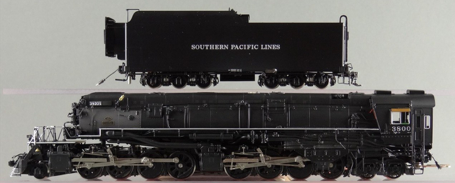
Key made the AC-9 from the Custom Series #110 set. It was limited to 150 locos. It had Excellent Back-Head Detail, Opening Tender Hatches with a Coasting Drive.
Lettering & Numbering
It is factory painted #3800 with 'Lines' on the tender.
4-6-2 P-12s
SP's utilized the heavy 4-6-2 P-12s. The first four were converted to oil at Bayshore in 1925 and transferred to the Coast Division. The remainder were converted in 1929-30. The 1924 EP&SW list of equipment states the P-12s on the Eastern Division, i.e. El Paso to Tucumcari. The P-12s were a critical source of power on the Golden State Limited. The MT-2s would have replaced them in 1924 to a great extent.
Terry Johnson