Southern Pacific Lines
Coast Line Division
“The Route of the Octopus”

Southern Pacific Lines
Coast Line Division
“The Route of the Octopus”
Steam Engines Types
0-6-0
Details
SP Heralds
Challenger has some very nice heralds on their 0-6-0's.
Plano sells an etched brass SP herald.
0-6-0s were pretty much gone in the Oakland area yards late 1955, or had they already been replaced by diesel switchers. As Tom Dill wrote in his article "Southern Pacific's Painted Ladies" in Classic Trains "Steam Glory 2" special issue, "as late as January 1956, no fewer than 53 0-6-0's were still earning their keep on the system, most assigned to the Western, Coast, and San Joaquin divisions."
Paint
Los Angeles General Shops Switcher #565
The shop switcher for Los Angeles General Shops was #565. For a color photo, see page 59 of Sweetland's "Southern Pacific in Color." #565 is pretty grungy in the photo. Presumably, the smokebox (door and sides) was painted aluminum. Note the silver bands (stainless steel?) bracketing the area painted white where the number is.
Window Paint Color
The window frames of the 0-6-0 switchers are red. Use Scalecoat Oxide Red for new or well maintained paint on freight engines and Daylight Red on passenger power. Discussions with Liz Allen on weathering reds which she did, suggested adding some orange to the brighter reds to simulate fading. Put glazing in the windows of your model.
Alan Houtz
For window sashes on all steam engines from 0-6-0 to AC, use Floquil Daylight RED, which has an orange cast to it.
Wouter J.K. De Weerdt
Polyscale SP Scarlet is the color for Daylight Red in Polyscale paints. It is slightly lighter than the Polyscale Daylight Red. The windows all had glazing. The inside of the doors matched the green of the cab walls and ceiling.
Gary Schrader
Polly Scale Scarlet is not a very accurate SP Scarlet. The true Scarlet is quite a different color from Daylight Red, the latter containing a distinct orange cast relative to scarlet. I don't want folks thinking Scarlet and Daylight Red are kinda the same color.
Tony Thompson
Switchers with fancy boiler and cylinder jackets (by Arnold S. Menke)
1182 (Eugene, Ore)
1209 (Sacramento)
1210 (Bay Area)
1217 (Bay Area)
1221 (San Jose) was really fancy, even had an airhorn!
1225 (Bay Area) in fancy paint in the early 1940's. This engine had an SP Sunset herald on the cab in 1946, but it was painted
black and the engine was black. #1225 in a blue boiler jacket into the 1950s (SPSP I).
1250 (Bay Area)
1266 (Bay Area)
1270 (Bay Area)
1272 (Sacramento) in a green jacket, was the Sacramento passenger depot switcher into the 1930s (SP Steam Pictorial Volume I).
1276 (Sacramento)
1277 (Bay Area)
1278 (Bay Area)
Grey-jacketed 0-6-0s lasted until the early 40s as San Francisco Third and Townsend switchers.
Oakland Pier had an 0-6-0 in a green jacket until 1955 at least
Reference
Use caboose red with some gray added to take the intensity down a notch.
There’s posted pictures of 217 in Oakland. The Winslow picture was taken when the engine was painted with the green (?) tanks shows a canvas curtain not a door. The other shot shows the loco with the curtain closed and also the very dirty windows.
Gene Deimling
52-C-1 Tender
52-C-1 cylindrical tender were used primarily with 0-6-0s from the '20s on.
Modeling 52-C-1 Tender
Sunset
Sunset made them and maybe PFM imported some when they did their 0-6-0's.
0-6-0 S-5 Shop Switchers
SP steam shop goats are a wonderful subject of individuality run rampant. No two are the same. #565 was almost identical to #567. Potentially, both locos are painted the same. Some details such as the headlight appear to be the same and maybe some elements of the top of the loco.
#565 was built from Baldwin 1109. It was classed as S-5 with 57" drivers. Color photos of #565, the LA General Shops switcher (located at Alhambra) on Richard Percy's site. That is black with white. Here it is shown in color: http://espee.railfan.net/picindex/lags-0565/index.html
Taylor Roundhouse switcher #567 is the second version of 567 that was rebuilt in 1940 from Baldwin #1108. It was classed as S-5 with 57" drivers. There was additional streamlining applied to 567. In Guy Dunscomb's Century of Southern Pacific Steam, on pg. 338, there is a 1940 picture of it very soon after it entered service. At that point, it had some extra sheet metal beneath the cab and just ahead of the cylinders, in an apparent attempt to "streamline" it. Black and white photos clearly show 2 colors. There’s a color photo of #567 on the bottom of pg. 123 of Dill's "Southern Pacific's Scenic Coast Line." Otto Perry found the 567 on Aug. 1, 1940 and the result is at: http://photoswest.org/cgi-bin/imager?00015336+OP-15336
PE 1508 was an S-5, not an S-8.
#1508 - ex-PE 3, ex-HBL 3, ex-SD&AE 3, ex-SP 1096, Baldwin 20900. Built 9-02 acq. 1-10-41 scrapped .4-22-47 LA
Joe Strapac
Reference
(*see MM 10/90)
Drawing
There’s a large drawing post of an S-5 class 0-6-0 with dimensions in the list's Files area of the Espee Yahoo Group from Joe Strapac.
Drawings also appear in Bob Church's SP steam loco books. The drawing are of the modified locomotive as altered for shop switcher service, not its original configuration.
Tony Thompson
Paint
On pg. 45 of the January 1948 Railroad Magazine, there is an H.L. Kelso photo of #567 that shows the engine looking mostly the same as it does in the 1954 photo on pg. 123 of "Southern Pacific's Scenic Coast Line" with one or two exceptions. In the magazine photo, there is a silver band (possibly of stainless steel) at the bottom of the wide white band that runs the full length of the white band. In the 1954 photo, this band appears to be missing forward of the cab.
Lettering & Numbering
Taylor Roundhouse switcher #567
The switcher was initially painted with a shamrock in the small `flying meatball' on its flanks, (see the 1940 photo on page 130 of Mullaly & Petty's "The Southern Pacific in Los Angeles." The shamrock, etc. was gone by the time the photo in Dill's book was taken in 1954, however.
In the January 1948 Railroad Magazine pg. 45 photo, the words "Taylor Round House" on the engine may not have the stencil gaps evident in 1954, apparently an interim scheme between the speed lettering of 1940 and the black letters on a narrow white band in place at the time that issue of Railroad Magazine was being prepared (i.e., late 1947).
Early photos show it with Italic lettering on the tank and the ball-and-wing (with a shamrock), while later images show it with an actual add-on plate with the words (sic) TAYLOR ROUND HOUSE in a 1946 photo as black-on-white and a 1947 photo as white-on-black. This latter image appears on pg. 80 of my Southern Pacific Review 1952-82.
Joe Strapac
References
Railroad Magazine, January 1948, pg. 45
Southern Pacific's Scenic Coast Line, pg. 123
The Southern Pacific in Los Angeles, page 130
Southern Pacific Review 1952-82
0-6-0 S-8
#1504 - ex-AE 35 SPdeM 6, CRYyP 6, Alco-Bks 45080 built 3-08. scrapped 6-7-49 LA.
#1505 - SP 1139, Baldwin 29138. Built 9-06 leased 12-1-38 to 9-22-46. scr 3.24-47.
#1506 - SP 1123, Baldwin 27517. Built 2-06 leased 12-27-38 to 6-13-49. scr. 11-14-49.
#1507 - SP 1146, Baldwin 29214. Built 10-06 leased 6-10-39 to 8-10-47 scr. 11-10-47 LA.
#1508 - ex-PE 3, ex-HBL 3, ex-SD&AE 3, ex-SP 1096, Baldwin 20900. Built 9-02 acq. 1-10-41 scrapped .4-22-47 LA
Details
Tender
There should be a tool box behind the bunker on the water tank.
There’s a photo in Tom Dill's SP San Joaquin Valley Division of one of the other 0-6-0, #1142, in the "bullring" with a PE "whaleback" tender. The engine is fitted with wartime headlight shields. #1142 is an SP engine borrowing one of the 4 leased PE engine's tenders during the war.
Jason Hill
Reference
Modeling S-8
Bachmann
Send me your address and I'll send you some photos of the 0-6-0.
Go to: tomedill@comcast.net
DCC decoder in a 0-6-0 Bachmann spectrum saddle tank switcher
They are not Plug and play like the rest of them. They are similar install with the N scale 2-8-0. They have solder points. DCC ready has no real meaning when manufactures use it for anything that has an engine. Try a RailComand decoder in a 0-6-0. Glue it to the cab roof. Use the smallest you can get. An "N" scale or a T-1 decoder would fit.
Challenger 0-6-0
There is no comparison to a Challenger 0-6-0, either in appearance or performance.
Tim O'Connor
There's a gray box mounted on the cab side of the tender, It must be for drinking water for the crew. There is no wood grain on the tender decking or foot boards. Also, the foot boards are way too thick.
MDC
0-6-0 (kit). For a detailed S-8, add what appears to be etched brass firebox sides. There was a company called Altoona Works that made some etched detail parts years ago, but they've been out of business for a while. The fellow that did the T-28/31/32 article in Prototype Modeler (March, 1980?) mentioned Altoona Works as he used their etched firebox sides. In the absence of the etched parts, one could probably cobble up firebox sides out of sheet styrene. These are not as reliable as a good running brass loco.
Roundhouse
0-6-0 builds into a reasonable S-8.
Sunset
Sunset did at least two runs of SP 0-6-0s. The first run was built by Samhongsa and the run included an S8 (with slope back tender) and an S10 (with 47C tender). They had a round sticker on the label that read "Sunset, Limited Edition". These Sunset locos run very well.
Wayne Cohen
The later run was part of their “Prestige Series” and was somewhat sparse on detail. The motor was a very small, open frame variety. This run included S8, 10, and 12. The S8 had a 47C tender and the S10 and 12 had 70C (70-C-9?) tenders. The first (Samhonsa) run is far more desirable.
Putting a motor in a Balboa is easier than a Sunset.
Wayne Cohen
Sunset Electrical
The motor is an "open can", skew-wound, silent and for its minuscule size not halfway bad. To improve performance you have to stop the gearbox' flopping around (install a little torque arm, or glue styrene blocks between the frame halves in front and behind the gear box), hard-wire the tender power pickup and ballast the engine.
Wouter J.K. De Weerdt
It's easy to stabilize the Sunset "Prestige" gearbox flop with 3M sticky foam tape.
0-6-0 S-10
Paint
S-10 1217 appears a light blue-gray color on the rear cover of Gene's book, while the SF/Third and Townsend switchers in Video Rails "SP 1941, Volume 1" appear with other hues of blue and gray. S-10 1217 is shown in color on the back cover of the Ainsworth's SP Pictorial Vol. 14 in a light blue-gray color.
#1221, the San Jose Cahill Street station switcher, wore a dark blue boiler jacket and red cab roof in 1953. A color photograph of 1221 at San Jose, taken by Charles Givens and subsequently color balanced at his direction to replicate his recollection of the colors, that shows it with a dark blue boiler jacket (close to Pantone 315C) and cylinder wrappers. The smokebox course and the boiler front were silver/white or aluminum bronze, with white or aluminum bronze running boards on the loco and tender. In the photo, the boiler checks and cab roof appear to be painted in a darker red (Pantone 202C) than the right front cab door (Pantone 199C).
References
The drawing mentioned above was done by Linn Wescott and appeared in Model Railroder Cyc in the 1940's.
Current knowledge comes from Dunscombs "Century...", some T&NO reference books and Richard Percy's wonderful Steam Index. There are some good photos but very little text info or specifications.
Mainline Modeler October 1990 had a 3 page article on an O scale S-10.
Prototype Modeler October 1978 has a 5 page article on SP 0-6-0's. (This magazine will be available soon on www.trainlife.com)
Tim O'Connor
Tender
47-C-1/2 Sausage Tenders
There were three classes: 47-C-1, 47-C-2. 47-C are so called "Sausage" tenders. It appears that Baldwin was the genesis by producing the original 47-C-1, the other by Espee. SP used a sausage tender used on a Baldwin S-10 0-6-0 switcher as used by T&NO #136. There are locos in the same class i.e. Baldwin S-10 #1217 with a sausage tender.
52-C-1 Sausage Tenders
This tender was produced by Espee. The 52-C-1 has a small rectangular section on top of the fuel tank.
70-C-10 Tender
The tender shown in the Sunset photo is a 70-C-10, the same as Glacier Models SP #1269 and #1294 had. These were rebuilt 70-C's with the oil bunker reshaped to provide clear vision for switching yet a larger water capacity than the much smaller 47-C and 52-C so called "Sausage" tenders.
Square Tender
There were 0-8-0's built in Sacramento & Houston with full view square tenders and some with a longer sausage tender. Drawing of this type of tender in 1940s MR Cyclopedia.
Vandy Tender
#1218 with a Vandy. The Vandy was mostly an upgrade.
References
Drawing of tender in 1940s MR Cyclopedia.
Gene Deimlings book, Southern Pacific Steam Switchers of the Pacific Lines, is a great source to see all the tender variations, also Guy Dunscombs, Century of Southern Pacific Steam. Joe Strapac sells diagram sheets of SP and T&NO locomotive and tenders also.
There is a brief write up on the cylindrical (sausage) tenders in "Southern Pacific Steam Pictorial, vol II" by Dunscomb, Dunscomb and Pecotich. Arnold Menke has written on early tenders in vol. I and late tenders in vol. II.
Dimensions of the tenders are given in "Diagrams of Tenders/Southern Pacific Company". This was published by the SPH&TS.
Modeling 0-6-0 S-10
Glacier Models
SP #1269 and #1294
KTM (Balboa)
Sunset
The later run was part of their “Prestige Series” and was somewhat sparse on detail. The motor was a very small, open frame variety. This run included a 70C (70-C-9?) tenders.
Putting a motor in a Balboa is easier than a Sunset.
Wayne Cohen
0-6-0 S-11
#1229 is a Lima Built S-11 class (Switcher-11 class), 0-6-0 Superheated, Steam Locomotive. Built in the Lima's shops, in Lima Ohio, during December of 1914 as Lima (builders #) 1496; for Southern Pacific (SP). SP numbered the locomotive as SP # 1229; and gave it an SP, S-11 classification.
The #1229 spent it's later years (late 1940's on), working mostly in the Oakland, CA area; but at least one earlier photo shows #1229 at Bayshore, (San Francisco), CA; and another shows it at Tracy, CA. The #1229 was used in the opening scenes of Buster Keaton's movie "The Goat". #1229 was donated to the city of Roseburg, Oregon, in 1958; and it has been on static display in Roseburg's Stewart Park.
Paint
#1276, the Sacramento station switcher and Shops "pet", had a red cab roof and "green" boiler and cylinder jacket as late as 1940 (see SP Steam Pictorial Volume I, Appendix 3, page 150 for a photograph). It carried the green jacket into the mid-1950s as an Oakland Pier switcher. #1217 also carried a lighter gray-green jacket at Oakland Pier into the 1940s, as did at least one switcher at San Francisco's Third and Townsend Station. The San Jose station switcher carried a blue boiler jacket in the early 1950s.
The blue green hue of the boiler jacket was apparently mixed at the paint shop foremen's whim as they attempted to approximate what to them was the hue that represented that of Russia Iron previously used for boiler jackets or other applications (e.g. air pump and cylinder jackets) that incorporated metal subject to rust induced by heat, water and oxygen in the air. Photographs in the Dunscomb collection seem to favor application of "colors" to passenger and passenger station switch locomotives.
Tender
70-C-9 Tender
The 1229's current Tender is # 7043; a 70-C-9 tender, assigned to the 1229, sometime in August, 1956. There were seven (7), tenders assigned to the 1229. They are (first to last) 5611, 5500, 5510, and again 5500, 6134, 6124, 6964 and her current tender 7043.
Modeling 0-6-0 S-11
0-6-0 S-12
#1259
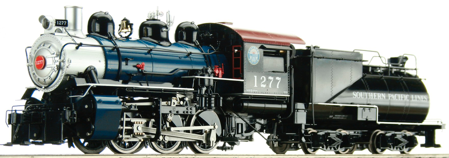
#1277
#1278
38 0-6-0’s were built by SP’s Sacramento and Los Angeles shop forces between 1919-1923.
Both the #1277 and #1278 were assigned to S.F. passenger service during the late 1940's, were maintained by the same shop.
#1259 was serviced on May 30, 1955 at Fresno, CA. It’s one of the 7 built in LA in 1921. The last stand for the S-12 switchers was the winter of 1956 working in San Francisco-area yard service. The #1259 was scrapped in 1959.
Paint
"Blue" 0-6-0 yard goat
There were 2 blue engines #1277 and #1278.
Passenger livery is generally defined as red cab roofs, full silver smokeboxes, colored boiler jacket and cylinder wrappers, white running board trim, herald on cab side (usually), chromed cylinder head covers and on a few engines, chromed/raised numbers and lettering. For S-12 and S-14 switchers, there is some question as to the actual paint color used on the jacket and wrappers.
There was no standard CS paint number color on the SP for boiler jackets.
Tony Thompson
Both the #1277 and #1278 were maintained by the same shop forces. Logic might suggest that the same blue-green was used on both engines, because of that.
Around the Oakland Pier in 1953, #1276 at Oakland Pier with a "close-to Pullman green" boiler jacket/cylinder wrappers. The jacket color seemed to be a little greener than the hue on the cover of Gene's "Steam Switchers Of The Pacific Lines". Guy Dunscomb said of the "Pullman Green" color that 1276 wore on her boiler and cylinder jackets during her stint as the Sacramento passenger station switcher ca. 1930-1940 (1930 photo on page 14 of SP Steam Pictorial Volume I). Also according to Guy, working in close proximity to the Shops, she was the pride of the Shop workers, who kept her specially painted and shined to within an inch of her life.
Color matching of chips and samples (still in Project 2472's possession when compared their colors to a Pantone chart) found by Mike Mangini and the Project 2472 restoration team when rebuilding that locomotive indicate that 2472's cab roof had at one time (probably circa 1920s-early 30s) been painted in Common Standard "Seat and Sash Red" (Pantone 174C) while the boiler checks were painted in Common Standard 22 "Cherry #214" (Pantone 187C).
The research for preparation of the "Boiler Jackets" Appendix in SP Steam Pictorial Volume I indicated that paint shop foremen of the various divisions painted the boilers of "pet" locomotives in what they interpreted to be their recollection of the hues of the Russia Iron boiler jackets used on locomotives just after the turn of the 20th century. Cab windows and roofs as well as boiler appliances for these locomotives were probably and logically trimmed in then-readily available (in the Paint Shop) Common Standard hues.
Different photos of these locomotives do show a range of colors from bluish-gray to greenish-gray and blue-greens in between. There’s a distinct greenish cast on pg. 10 of Dill's Coast book. I don't share your confidence that these are all different colors, though individual shops are known to have approached this scheme somewhat differently. I would bet on the blue-green, myself, but would agree with you that the bright blue is foolishness.
Tony Thompson
References
For published color resources, Morning Sun's SP in Color Vol. 1 shows #1277 (pg. 90) at SF with a BLUISH-GREEN boiler jacket (dirty). SP in Color Vol. 2 shows #1270 with a GRAY jacket/wrapper (pg. 54) and #1276 with a GREEN jacket/wrapper (pg. 55). Importantly, it also shows #1277 with the BLUISH-GREEN colored jacket/wrapper scheme. There are, apparently, no published color shots of the #1278.
Dill's SP Scenic Coast Line book confirms #1270 with a GRAY jacket/wrapper (pg. 10).
There is a color photo of 1278 on the cover of that book, in it's blue-green color. S-10 1217 is shown in color on the back cover of the above book in a light blue-gray color.
There is some color footage in Video Rails "SP 1941, Volume 1" that shows 1278 in fresh paint -- it appears to be a medium bluish color. Then 1277 is shown and it appears to be greener, but is quite dirty.
Gene's book, Steam Switchers of the SP Lines, clearly shows sister engines #1276, #1277 and #1278 in passenger livery, albeit in B&W photos. Ainsworth's SP Pictorial Vol. 14 confirms the #1276 and #1278 in passenger livery (B&W photos).
Tenders
SP Vandy type tenders would be most typical for the following 0-6-0 (S-12) locomotives:
47-C-252-C-1 70-C-x (-9 clear vision)
Modeling 0-6-0 S-12
Challenger
Paint
Who is usually meticulous in its research, produced the HO version of #1278 with a BRIGHT BLUE boiler jacket & wrapper. They did the #1277 in its verified BLUE-GREEN color. However, they produced the #1276 with a GRAY scheme when it clearly was in green in 1949. Likewise, they produced the #1270 in green, when it was clearly in gray in the late 1940's. All of which causes to question the bright blue color Challenger used on their #1278.
KTM (Balboa)
Sunset
The later run was part of their “Prestige Series” and was somewhat sparse on detail. The motor was a very small, open frame variety. This run included a 70C (70-C-9?) tenders.
Putting a motor in a Balboa is easier than a Sunset.
Wayne Cohen
This particular model was a 1970's import. Its tiny open-frame motor wasn't a good candidate for remotoring. The soldered-shut tender discourages one from installing a sound decoder.
Robert Bowdidge
0-6-0 S-14
Modeling 0-6-0 S-14
PFM
0-8-0 Switcher
#1300
#1314
#1409
#4508
Of the traditional types of switchers, 0-8-0s were limited mainly to large yards and passenger terminals.
#1300
It became an SP locomotive in November 1924 when the El Paso & Southwestern was leased to the SP. Very soon after that, it was renumbered to SP 1300 (exact date unknown). The former EP&SW lines used coal for fuel, even under SP administration. SP ran the 1300 as a coal burner until 1929, when it was finally converted to oil fuel.
Joe Strapac
#1314
On April 26, 1937, the SP’s Sacramento General Shops released for service the last of a series of eight modern 0-8-0 steam switchers, the 1314, later 1409 and still later, 4508. It held the dubious honor of being the last NEW steam locomotive (albeit using a reclaimed 4-4-2 boiler) to be built at Sacramento. From that date on, SP bought all its new locomotives from established manufacturers. Locomotive manufacturing in Sacramento was a dead issue.
Modeling 0-8-8 Switcher
MDC
Old-timer 2-8-0 (kit & RTR) can be transformed into 0-8-0 switcher. The MDC model has 63" drivers. These are not as reliable as a good running brass loco.