Southern Pacific Lines
Coast Line Division
“The Route of the Octopus”

Southern Pacific Lines
Coast Line Division
“The Route of the Octopus”

Steam Engine Types
4-4-0
SP 4-4-0 E-8 “Whiskey Two-Bits”
Old class E-8 4-4-0s. this refers to the sound they made due to their valve arrangement.
SP 4-4-0 E-23
The 4-4-0 had inside Walschaert valve gear. What made the engine different is there were only 2 eccentrics on the main axle. Also that structure that protects that gear is the crosshead guide support. It supported and straightened the outer ends of the main crosshead guides when there were 2.
Most E-23 were gone before the USA entered WWII. A couple of E-23s lasted until the early nineteen fifties in Texas. Nos #266 and #268. They were last used between Ennis, Texas (about sixty miles south of Dallas on the Sunbeam/Hustler route) and Ft Worth to make connections to points south.
Modeling 4-4-0 E-23
IHC
4-4-0 (RTR), probably close enough to E-23 (?);
Replace tender with Vanderbilt.
4-4-2 Atlantic
Paint
SP Painting & Lettering Guide, pg. 26, 27
Lettering & Numbering
SP Painting & Lettering Guide, pg. 26, 27
4-4-2 A-1
The original A-1 Atlantics #3000 and #3001 were scrapped in the 1920s.
4-4-2 A-3
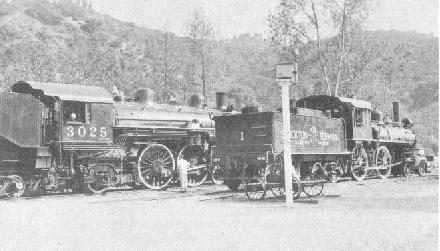
#3025
#3036
#3038 - 3065 built 1906-07
The SP engines were all oil burners. A few SPdeM engines were coal burners.
Jeff Cauthen
Spoked pilot wheels didn't last long!
Joe Strapac
The 4-4-2 Atlantic #3025 is preserved at Travel town.
Details
They had a booster valve on back of steam dome. Train indicators and blower valve assembly with elbow were present.
Delta Trailer Truck
The “cast trailer truck” typically called a Delta, was required for installation of a trailing truck booster engine, certainly a useful addition to these small class A-3 locomotives. In the mid-1920s, the following A-3 4-4-2 locomotives were rebuilt with Delta trailing trucks and boosters: #3025, 3036, 3038, 3050-3052, 3057 and 3060.
Joe Strapac
Rear cab exterior details
Go to: http://www.lacity.org/RAP/grifmet/tt/htmgallery/gallery_loco/south3025.htm
http://tardis.union.edu/community/project95/ALCO/images/sp3025-1.gif
Tender
Most of the original rectangular tenders were replaced in later years by higher water capacity Vanderbilt tenders.
Reference
The Compendium book by Strapac have a usable photo of the exterior rear part of cab of the A-3 by ALCO class loco.
Modeling 4-4-2 A-3
PFM / GOM
It has a cast trailer truck with booster, too. When comparing PFM class A3 engines to the online picture of SP #3048 and the only differences seen are solid wheels in the pilot truck, a shorter air tank under the right side of the cab and it's coal fired.
Pictures can be seen at http://picasaweb.google.com/beegmaq/SPATLANTIC?feat=email#
Leo Pesce
PFM / GOM Tender
It came with a small Vanderbilt tender instead of the original rectangular one.
Westside
It had the as built look from 1904-06 or so. #3042.
4-4-2 A-6
#3000-3001
The drivers were 81".
The A-6 Atlantics 3000 and 3001 (which were Daylight painted) were not vacated until 1950-51.
Piping
The small pipe beside the main stack is visible on the A-6s (ie: #3000-01).
Paint
The #3000-3001 cab and tender are in Daylight paint scheme.
SP Painting & Lettering Guide, pg. 26, 27
Lettering & Numbering
SP Painting & Lettering Guide, pg. 26, 27
Modeling 4-4-2 A-6
Westside
Westside made a nice model of this unit back in the 70's. Nice model, but the drivers weren't tall enough (77" instead of 81").
#3000 - can motor - runs smooth and quiet, constant intensity light (DC), Kadee coupler.
Paint
The factory painted cab and tender are in Daylight paint scheme. Those two A-6 Atlantics were painted in Daylight during 1947.
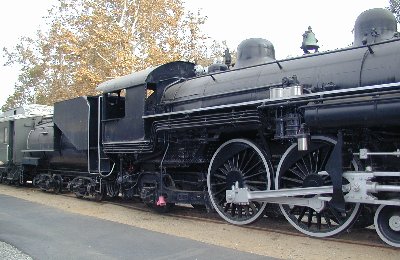
4-6-0 Ten Wheeler
4-6-0 T-6
SP #2192 is a T-6 class 4-6-0.
4-6-0 T-23
Details
The boilers, cabs, and tenders look the same on all of the T-23, T-28, and T-31. The T-23 is a smaller engine. The boiler is about 6" less in diameter and slightly shorter.
Paint
Regarding steam loco colors in 1940, the smokebox, including the front, stack, and firebox were painted graphite. Just about everything else, except the lettering, was black. The smokebox front is flat aluminum. Sometimes the cab window frames were painted red. The Scalecoat black with the slightly blue hue sounds good to me for the boiler jacket and cylinders.
Reference
A good reference for color photos from the period are the Morning Sun book Southern Pacific in Color (first volume) and the video by Video Rails, Southern Pacific - 1941.
Modeling 4-6-0 T-23
4-6-0 T-28
#2313
Details
The boilers, cabs, and tenders look the same on all of the T-23, T-28, and T-31. The T-28 and T-31 are virtually identical in dimension and weight specifications.
Valve Gear
T-28 & T-31 differed in valve gear. T-28's had the Stephenson valve gear.
Headlights
T-28s originally had headlights mounted on the top of the smokebox ahead of the stack.
T-28 Tender
EP&SW 4 wheel tender trucks
A 4 wheel tender trucks used on many ex EP&SW tenders. There's a pic of T-28 #2313 with an ex EP&SW tender on page 25 of Jeff Ainsworth's pictorial Volume 17 (SP T-23's and T-28's) which illustrates the type of truck. The type was quite common on the Reading and CNJ and some other Eastern lines but no so much in the West.
The same style truck was used on the Mallets acquired from the Verde Tunnel and Smelter RR. Arnold Menke identifies them as Paxton equalized pedestal trucks.
Ernie Fisch
Paint
Regarding steam loco colors in 1940, the smokebox, including the front, stack, and firebox were painted graphite. Just about everything else, except the lettering, was black. The smokebox front is flat aluminum. Sometimes the cab window frames were painted red. The Scalecoat black with the slightly blue hue sounds good to me for the boiler jacket and cylinders. A good reference for color photos from the period are the Morning Sun book Southern Pacific in Color (first volume) and the video by Video Rails, Southern Pacific - 1941.
Reference
In the July/August 1975 issue of Western Prototype Modeler, contains a nice article with photos titled "Espee's Universal Ten Wheeler" about the T-28, T-31 and T-32 class 4-6-0s.
Modeling 4-6-0 T-28
Bowser / Varner
Casey Jones" 4-6-0 builds into a reasonable T-28. It's certainly a lot closer to an SP T-28/-31/-32 class than either Casey Jones' IC 4-6-0 #382: http://www.watervalley.net/users/caseyjones/media/382.jpg
Arved Grass
MDC
There was an article about 25 years ago in "Prototype Modeler" about building T-28, T-31 and T-32 from MDC kits. Even though that's not brass, the article might be of some use to you. The MDC Harriman 4-6-0 was also similar, but is less desirable because with its plastic body, it's significantly lighter, and therefore pulls less.
Arved Grass
Westside ? KTM
Westside T-28 was a good runner.
4-6-0 T-31
#2353 - 2362
SP T-31 class 4-6-0 Engine #2353 was built by Baldwin in 1912. It worked the majority of its 45-year career in Northern California. Its last assignments were local and switching service in and around Bayshore yard in Brisbane, CA. An image shows #2353 working on a short local on August 1, 1955 passing through Burlingame, CA, some 8 miles south of Bayshore Yard. #2353 was retired in on January 18, 1957. It was donated to the Imperial County Fair in Imperial, CA where it was on static display until 1984, when it was donated to the San Diego Railroad Museum in Campo, CA. Over 12 years, SDRM volunteers restored the 2353 to operating condition. Unfortunately, a Fall 2000 FRA boiler inspection of the 2353 revealed serious problems that have sidelined the locomotive since then. At present the 2353 is on static display at the SDRM’s Campo, CA museum.
Engine #2358 was one of the passenger engines used for the Santa Cruz passenger run on the Vasona Branch.
Details
The boilers, cabs, and tenders look the same on all of the T-23, T-28, and T-31. The T-28 and T-31 are virtually identical in dimension and weight specifications.
Valve Gear
T-31's has the Walschaerts. http://donsdepot.donrossgroup.net/dr1002/sp2321.jpg
Headlights
You would expected the T-31 class to have had headlights mounted on the top of the smokebox ahead of the stack. But there’s not a photo to confirm this.
Paint
Regarding steam loco colors in 1940, the smokebox, including the front, stack, and firebox were painted graphite. Just about everything else, except the lettering, was black. The smokebox front is flat aluminum. Sometimes the cab window frames were painted red. The Scalecoat black with the slightly blue hue sounds good to me for the boiler jacket and cylinders.
Reference
A good reference for color photos from the period are the Morning Sun book Southern Pacific in Color (first volume) and the video by Video Rails, Southern Pacific - 1941.
Reference
In the July/August 1975 issue of Western Prototype Modeler, contains a nice article with photos titled "Espee's Universal Ten Wheeler" about the T-28, T-31 and T-32 class 4-6-0s.
http://www.flickr.com/photos/29427440@N00/8057513000/in/set-72157631690846278/
Modeling 4-6-0 T-31
MDC
There was an article about 25 years ago in "Prototype Modeler" about building a T-31 from MDC kits. Even though that's not brass, the article might be of some use to you. E-mail me offline for more info if interested.
Westside / KTM
Start with a Westside T-31 since the major difference between the T-31 and T-32 was the driver diameter. The T-31 is a very reliable, smooth running engine. Do install a can motor. Westside typically made very good mechanisms.
Westside Tender
Westside T-31's came with C-100 tenders.
Lettering & Number
The Ten Wheeler is numbered for #2355.
4-6-0 T-32
They had Walschaert valve gear. Also had drivers of 69".
In photos of the T-32 classes of ten wheelers, they originally had headlights mounted on the top of the smokebox ahead of the stack.
Paint
Regarding steam loco colors in 1940, the smokebox, including the front, stack, and firebox were painted graphite. Just about everything else, except the lettering, was black. The smokebox front is flat aluminum. Sometimes the cab window frames were painted red. The Scalecoat black with the slightly blue hue sounds good to me for the boiler jacket and cylinders. A good reference for color photos from the period are the Morning Sun book Southern Pacific in Color (first volume) and the video by Video Rails, Southern Pacific - 1941.
Reference
In the July/August 1975 issue of Western Prototype Modeler, contains a nice article with photos titled "Espee's Universal Ten Wheeler" about the T-28, T-31 and T-32 class 4-6-0s.
Modeling 4-6-0 T-32
MDC
There was an article about 25 years ago in "Prototype Modeler" about building a T-32 from MDC kits. Even though that's not brass, the article might be of some use to you. E-mail me offline for more info if interested.
If you want a T-32, start with a Westside T-31 since the major difference between the T-31 and T-32 was the driver diameter. Either that, or follow the article mentioned above.
PSC
PSC has a cylinder block that was designed as a piston valve replacement for the slide valve cylinder block on the MDC 0-6-0. Failing that, a Bowser cylinder block might work if modified (the one from the "Old Lady" 2-8-0). PSC also has valve gear parts, including hangers, but none of those, IIRC, even come close to the hanger on the T-32.
Westside
To convert a Westside T-28 to a T-32 you're going to need larger drivers (69"), a different cylinder block and Walschaert valve gear. You'd probably have to scratchbuild the valve gear hanger. Bowser has 69" drivers, but the axles are 1/8" diameter vs. 3mm on the Westside (although that's close). Greenway Products also have 69" drivers, but from the description, it looks like the counterweights are incorrect for a T-32.
4-6-0 T-40
Modeling 4-6-0 T-40
Bachmann SP 4-6-0
The new Bachmann 4-6-0s (both low- and high boilered versions) do not present enough similarities with any SP Ten Wheelers. One version is very low-drivered SP lettered version has 52” drivers which does not apply. Bachmann also offers a 63” driver model which several SP ten wheelers did have. The boiler is the biggest problem: it has the taper two courses forward of the cab, while most SP locos of this type had it one course forward. The boiler is close only to the small T-38 class on the T&NO which was built by Baldwin.
The cab is somewhat wrong, lacking the high arch typical of SP cabs and having non-SP "picture windows" on the side. The cab has a pair of large side windows unlike SP practice. The cab roof contour is shallow arch unlike the high arch Harriman and later cabs. There is a single small class which is not TOO different, the T-38 on the T&NO (ex-SAAP engines IIRC), but even it differs in several respects.
Tony Thompson
Bachmann 4-6-0 Tender
Bachmanns small rectangular tender is the wrong proportions but it can be modified to resemble SP tenders and a road pilot could be applied to replace the foot boards on the model. Overall, this model is not even a good stand in for an SP loco.
MDC
The 4-6-0 can be made into a reasonable model of 4 (including the T-40) separate classes of SP Ten wheeler with varying degrees of work. Actually, the Pacific Lines T-23 is not that far off. The drivers on an MDC Harriman 4-6-0 are oversize (at least for a T-28 or T-31) and scale out to about 66".
4-6-2 Pacifics
3 main groups: Harriman Common Standard Designs (1904-07, 1911-12, 1917-18)
Harriman Heavy Pacifics (1913, 1917, 1921-28)
Harriman Light Pacific
Light Pacifics
4-6-2 P-1 / 4
#2401, 2402, 2409, 2410
#2414, 2419,
#2420, 2422, 2424
#2436
Pre-1935 were all rebuilt as class P-4 with Delta trailing trucks and boosters, among other features, between March 1927 and December 1929. Here's why: ten older Pacifics were modernized, including the Delta trucks, in 1927-29; thereupon all became Class P-4. The unmodernized ones remained as Class P-1.
Paint
#2406 (Pacific type) sure looks like a shiny gray or green coat was placed on the jacketing. It would take some serious studying of the picture to determine if this jacketing is painted other than black.
Some passenger locomotives had jackets on boiler and cylinders which were other than black. Older examples were Russia or America Iron jackets, NOT painted. (In fact, that was the point: they didn't HAVE to be painted.) In later years, paint was used to capture the general appearance and approximate color of those early jackets. They usually look gray in B&W photos but of course could be many shades besides neutral gray. We now know, thanks to the restoration of 2472, that at least one of these paint colors was a distinct blue-green.
Tony Thompson
Reference
Harriman Heavy 4-6-2: Erecting card and data Mainline Modeler, by BOLAN, RICHARD J., March/April 1980 page 22
A Century of SP Steam Locomotives, Guy L. Dunscomb
4-6-2 P-1
#2400 - 2404 blt by Schenectady (1904)
#2405 - 2427 blt by Baldwin (1906-1907)
Some of the P-1's got a booster and the Worthington FW heater, but not the full P-4 upgrade. The P-1's never got the delta truck.
Classes Pi-P5 all had straight boilers of the same dimensions. P-1, #2404 had its booster removed in 1950.
Ernie Fisch
Reference
A Century of SP Steam Locomotives, Guy L. Dunscomb
Southern Pacific's P-1 4-6-2 Prototype Modeler, by HARRIS, STANLEY August 1979 page 27
Modeling 4-6-2 P-1
Balboa
PSC
Westside
Modernizing The Westside SP P-1 4-6-2 Prototype Modeler, by HARRIS, STANLEY, August 1979 page 30
4-6-2 P-3
#2428 - 2437 blt by Baldwin (1911)
#2459 - 2460 blt by Sacramento (1918)
Classes Pi-P5 all had straight boilers of the same dimensions.
Ernie Fisch
Reference
A Century of SP Steam Locomotives, Guy L. Dunscomb
Modeling 4-6-2 P-3
4-6-2 P-4
#2401, 2402, 2409, 2410
#2414, 2419,
#2420, 2422, 2424
#2436
1947- rebuilt used on Peninsular commute
1947 - used on local and branch line service on LA Division
1953 - 4 leased to Pacific Lines used for Pax work hauling Lark on occasion
#2401, 2402, 2409, 2410, 2414, 2419, 2420, 2422, 2424 and 2436 were all rebuilt as class P-4 (with Delta trailing trucks and boosters, among other features, between March 1927 and December 1929. Here's why: ten older Pacifics were modernized, including the Delta trucks, in 1927-29; thereupon all became Class P-4.
The P4s had a "sport cab”. Classes Pi-P5 all had straight boilers of the same dimensions.
Ernie Fisch
Most have a booster exhaust pipe coming up the smokebox and ending either in front of the chimney or into it.
Reference
A Century of SP Steam Locomotives, Guy L. Dunscomb
Modeling 4-6-2 P-4
Westside
It is a good model of an SP P-4. If I remember correctly it is based on the later version. #2414 and 2422 seem to match the model the best.
Bill Daniels
Included in the box is a plaque stating that it was manufactured in 1975.
Westside Tender
The tender is class 100-C-3 to 100-C-6. The actual dimensions are 8'-1/4" x 31'-4-3/8". The listed water capacity is 10,060 gallons. The tender is cylindrical and for an oil burner. The water tank scales out at 31 feet long with a diameter of 8 feet. The top of the oil tank is 10 foot square.
Ernie Fisch
Reference
Espee 4-6-2 Class P-4 Pacific, Westside NMRA Bulletin, by HIGGINS, ROBERT, October 1976 page 27
4-6-2 P-5
#2438 - 2452 blt by Baldwin (1912)
# 600 - 609 blt by Baldwin (1912)
The P5s had Walschaerts gear. Classes Pi-P5 all had straight boilers of the same dimensions.
Ernie Fisch
There are no photos of Pacific Lines P-5's with a Delta trailing truck or booster. There are photos of T&NO engines with the truck, and they all have boosters. #600 - 609 all went to Texas. These P-5's had a straight top rather than tapered boiler.
John Bruning
Ex-T&NO P-5 Pacific class engines #600, 602, 605 and 606 came west in 1953 and could be seen working in the East Bay area on Western Division trains 73/74 (Oakland Lark) and 250/255 (Daylight connection). There is a nice photo of #606 at the Oakland Mole in just this use, by Harre Demoro on pg. 98 of his "SP Bay Area Steam" book.
Other engines were used as far south as Bakersfield, but under normal circumstances NEVER on freight trains, only on Oakland-San Jose and Oakland-Sacramento trains. But the light 2400's (P-1, -3, -4 and maybe P-5) were used on strawberry trains from Watsonville to Roseville. All express reefers and a rider coach in the train.
Reference
Espee's 4-6-2 P-5 Pacifics Model Railroader, by GEBHARDT, ED, June 1955 page 34
A Century of SP Steam Locomotives, Guy L. Dunscomb
Modeling 4-6-2 P-5
Key
In 1987 Key imported a small number of very attractive unpainted HO brass P-5 Pacifics with a non-booster Delta trailing truck,100-C tender with freight trucks, Worthington FWH and a small, below center Pyle headlight. The information sheet inside the box provides a short history of early SP 4-6-2's and also identifies the model as a "Pacific Lines" P-5. This model has a straight boiler and looks a lot like a fully updated P-4, but it is a P-5.
John Bruning
Heavy Pacifics
4-6-2 P-6
#2453 - 2458 blt by Brooks (1913)
# 610 - 621 blt by Brooks (1913)
used on Coast Line in the 1920’s, after 1942, 3 remaining P-6’s assigned to Coast.
used on Coast Line on Del Monte and LA-SB local
Steam Right Side Injector
In Dunscomb's "A Century Of Southern Pacific Steam Locomotives", the 1946 Doug Richter pic of P-6 #2454 on page 171 showed that she had no right side injector, which indicates that there was a feedwater heater on the left side since it was common practice for SP to have an injector and feedwater heater on the fireman's side.
In Beebe's "The Central Pacific and Southern Pacific Railroads", there's a 1954 picture of #2454 on the point of #77 (page 337) that clearly shows a right side injector.
Reference
A Century of SP Steam Locomotives, Guy L. Dunscomb
Modeling 4-6-2 P-6
4-6-2 kitbashing photos available fromtomedill@comcast.net
Mantua
The P-6 has a wagon top boiler, not conical. There is a way to adapt his method to a wagon top.
The Mantua and K-4 mechanisms can be used to make a lot of Pacifics with drivers in the 75-80" range.
4-6-2 P-7
#2476 - 2477 blt by Lima (1917)
Reference
A Century of SP Steam Locomotives, Guy L. Dunscomb
4-6-2 P-8
#2461 - 2475 blt by Baldwin (1921)
Baldwin Locomotive Works, built April 1921, was experimentally factory-equipped with a booster and Worthington BL feedwater heater. #2475 was the first S.P. locomotive so equipped. The booster is supplied by a large pipe [outside the boiler jacket] running diagonally down the fireman's side from steam dome to booster.
Doug Debs
Paint
Working with the Project 2472 restoration crew, were able to do a color match. The 2472 crew found that 2472's boiler check valves and injectors were painted with 1914 Common Standard 22 "Cherry #214" (Pantone 187C), also described as "Red" and "Electric Red". From comparison with color photographs made in the early 1950s of other locomotives similarly decorated. Cab roofs, on the other hand, were painted "Seat And Sash Red" (Pantone 174C) as found by the 2472 crew on portions of her roof. There have been red cab roofs on 4-6-2s and passenger Mikados in photographs as early as July 1914 (see SP Steam Pictorial Volume II, locomotive 3248) and as late as the 1930s. Some passenger station switchers lasted longer with their red cab roofs.
It’s unknown how many layers of paint the #2472 crew went thru to get to the red cab roof layer, but to be mostly prototypically correct with a red roof if you model the 1920-1932 time period with your Pacific. During the teens and twenties, and the treatment wasn't limited to Pacifics.
Lettering & Numbering
The "SF" stands for Superheater, Feedwater heater below the cab #'s, where it say's P-8 P-73 25/30 181-SF.
Reference
A Century of SP Steam Locomotives, Guy L. Dunscomb
See Johnsen's #2472 Pacific class family book.
Photos of SP 2475 on its last run Jan 1, 1958. www.Trainorders.com
Modeling Southern Pacific P-8 Pacific #2470 Model Railroading, by CLARK, HEATHER, January 1996 page 30
Modeling 4-6-2 P-8
4-6-2 P-9
# 622 - 630 blt by Baldwin (1923)
Reference
A Century of SP Steam Locomotives, Guy L. Dunscomb
4-6-2 P-10
#2478 - 2491 blt by Baldwin (1923-24)
SP's three P-10s in Daylight colors had skirts and skyline casing. The three P-10's lost their skirts but remained in service with the Skyline casings right to the end of steam. They had 120Cx tenders.
Glenn Joesten
#2484
Details
Cab
P-10 4- 6-2, with straight sides (not "sport" cab).
Reversing gear
A reversing gear was used on SP P-10 #2491 locomotives.
The 1941 San Joaquin Daylight was pulled by a P-10 in daylight colors for short time after introduction until wartime required heavier power. The T&NO Sunbean also in daylight colors was also pulled by a streamlined Pacific.
John Vasconcelos
The SP's three P-10s in Daylight colors with skirts and skyline casing were assigned to the Oakland-Bakersfield portion of the San Joaquin Daylight's run but page 95 of the 2002 edition of "Daylight Reflections" has a photo of one of the engines (with skirts, Daylight colors, etc.) on the front of # 51 at Glendale teamed with a GS.
John Sweetser
Paint
Three SP's P-10s came in Daylight colors.
Reference
A Century of SP Steam Locomotives, Guy L. Dunscomb
A picture of #2484 leading train 52 as it departs Martinez, on its way from Oakland to Los Angeles (via California's Central Valley) in August 1941 here: http://www.railpictures.net/viewphoto.php?id=284875&nocomments=true
Enzo Fortuna
Drawing
SP 4-6-2 Class P-10 article Mainline Modeler, by CHURCH, ROBERT, July 1997 page 62
Modeling 4-6-2 P-10
Balboa
Glacier Park SP P-10
Electrical
Pacific #2487 random short issues
There’s a problem of intermittent shorts when the wire is plugged in between the tender and engine (for the back up light). The engine will stop and the throttle was shorted. Once the wire was unplugged, no problems. The backup light did work fine with the wire plugged in, going in reverse, and did not work with the wire unplugged.
See: http://www.glacierparkmodels.com/SP-Pacifics-1.html
http://espee.railfan.net/nonindex/steam-01/2487_sp-steam-p10-gene_deimling.jpg
PSC
PSC imported P-10's in the early 90's including a skyline casing version with skirts but with inaccuracies. Wrong width walkway, wrong ladders instead of steps in front (or other way around, some missing and wrong details, etc. On these models the running boards are about 1' to wide and this model is wide at the running boards. It shorted out with the front truck hitting the frame on even the slightest curve or incline. PSC's advice to the dealer was to put a piece of tape on the lead truck to prevent a short.
An excellent P-10, it’s recommended the Westside 1979 (or 1978?) P-10. A price of $600-$800 would not be out of line.
Westside / KTM
Westside P-10 4- 6-2, with straight sides (not "sport" cab). It was a good runner.
Paint
Painting up an Balboa P-10. Airbrush the stripped / cleaned boiler, etc with a Floquil engine black /weathered black mix. Next paint the boiler smokebox course with a mix of Old Silver and Lark light grey.
Masking
Be careful to mask off the rest of the boiler, between the first and second courses, so that overspray doesn't get back under the masking and ruin the black. There is a pipe that runs over the top of the boiler at the joint that makes masking all but impossible. Walther's and Microscale both make a brush-on, later peel off type of liquid masking. Get the special narrow masking tape for such things, but get a good seal. Paint the smokebox first. Now you'll have to mask almost the entire engine.
Used a combination of drafting tape and liquid mask (Super Mask) to mask the boiler and the details on the smoke box that remain black. The liquid mask is removed after painting with a toothbrush and water. This will work great. Before applying the liquid mask, use a very fine paint brush to pint the graphite color around the base of details such as handrail standoffs and number boards. That way, you won’t have to rely on applying the liquid mask to define the color separation. Allow the mask to slop over on the smoke box. The liquid mask needs to go on as a very heavy coat.
Spraying
In general, after you mask, spray that color (black in this case) over any edges or seams in the tape. This prevents any seepage under the tape when you spray the smokebox color.
Brushing
Or brush paint the graphite. It helps to give it the necessary inconsistency. On painting a 4-10-2, 4-6-2, and 4-8-2, try painting the black first, then the oil/graphite.
4-6-2 P-11
#3100-3109 blt by Baldwin (1927)
The P-11s were small drivered (68") Pacifics that were inherited from the El Paso and Southwestern; they were numbered from 3100-3109. Dunscomb's "A Century of SP Steam" doesn't have much information on them, just driver and cylinder diameters. So far, the best source of info has been a web page from someone kitbashing one in 1/32 scale.
References
A Century of SP Steam Locomotives, Guy L. Dunscomb
See Johnsen's #2472 Pacific class family book and the Ainsworth volumes on Pacific class engines for more photos. MHP Publishing's Diagrams of Locomotives and Tenders has a diagram on page 173.
The 1951 locomotive diagram book does not show P-11s. Another listing (up-to-date in 1952 or 1953) does not show P-12s either.
Modeling 4-6-2 P-11
Bowser
Try to scratchbuild a P-11 boiler on top of a Bowser K-11 mechanism.
4-6-2 P-12
#3120-3129 blt by Brooks (1917)
SP acquired 10 P-12’s from EP&SW in 1924. They converted them from coal to oil. They were assigned at different times from Oregon to Arizona and featured a variety of tenders.
SP #3126 had a boiler tube pilot, an unusual 120-C-7 tender and post-1946 Southern Pacific lettering.
Scott Inman
SP's utilized the heavy 4-6-2 P-12s. The first four were converted to oil at Bayshore in 1925 and transferred to the Coast Division. The remainder were converted in 1929-30. The 1924 EP&SW list of equipment states the P-12s on the Eastern Division, i.e. El Paso to Tucumcari. The P-12s were a critical source of power on the Golden State Limited. The MT-2s would have replaced them in 1924 to a great extent.
Terry Johnson
Reference
A Century of SP Steam Locomotives, Guy L. Dunscomb
The 1952 locomotive diagram book does not show P-12s. Another listing (up-to-date in 1953) does not show P-12s either.
Modeling 4-6-2 P-12
4-6-2 P-13
# 631 - 633 blt by Baldwin (1928)
Reference
Southern Pacific 4-6-2 Class P-13 Trains, April 1943, page 5
Modeling 4-6-2 P-13
Varney
4-6-2 builds into a reasonable P-13
4-6-2 P-14
# 650 - 652 rebuilt (1937)
Reference
A Century of SP Steam Locomotives, Guy L. Dunscomb
Paint
SP Painting & Lettering Guide, pg. 22, 23
Lettering & Numbering
SP Painting & Lettering Guide, pg. 22, 23