Southern Pacific Lines

Coast Line Division 

“The Route of the Octopus”

 
 
General Info
Designation of SP Tenders
   A 9000 gallon tender would be a 90-X-X in Espee designation. 

A 10,000 gallon Vanderbilt tender would be a 100-C-X in Espee nomenclature. In checking tender diagram books you cannot find a 100- C tender with a 3800 gallon fuel tank. The listed fuel capacities are as follows:

    100-C-1 & 2 3,    120 gallons
    100-C-3 thru 6  2,940 gallons
    100-C-7             3,060 gallons

Assigning Numbers to Tenders
The SP did assign numbers to there tenders. A list of said numbers was part of the SP Tender Diagram book. Also located on a small "builders style" plate mid way along the frame or side of the tender.

Values for Tenders
Values are the numbers that come from Espee's tender diagram sheets. If you look at the weights painted on the tenders there may be a difference. It is likely that Espee used actual weights rather than nominal. 
Ernie Fisch

Assigning Tenders to a Locomotive
Tenders behind SP steam locomotives were often swapped, both at shopping times and upon changes of division assignment. All the SP tender assignment cards are at CSRM, so if you really want to know the history of that particular tender, you can do so, including how long it was with a loco. 
Tony Thompson

References
There is a large amount of info in the back of the large format book "Southern Pacific Steam Pictorial, Vol I & II" by Dunscomb, Dunscomb, and Pecotich. There is an extensive chapter in each volume by  Arnold Mencke on the various classes of tenders and changes over the years. Another good book is "Southern Pacific Company Diagrams of Locomotives and Tenders (Pacific Lines)." It was edited by Richard K. Wright, published by Wright Enterprises in 1973. This book has been out of print for many years. It shows diagrams and lists important data for all of the Pacific Lines locomotives and tenders. It is a very good resource for SP steam.

Beware of  the notes added by the editor in the back. Some of them are garbled or must have resulted from misunderstandings or inadequate research. Just use the diagrams themselves! If in doubt, trust the  Diebert & Strapac on locomotives, and Menke on corrections/additions to D&S.
Tony Thompson


Tender Details
Brake Chains
Some SP 12,000 gallon tenders had hand brakes that used a length of chain to connect to the brake cylinder. 
Modeling Brake Chains
To model this chain:  52-link-per-inch from Traincat2. The next finest chain doesn’t look quite right on an HO model.

52-link chain (Traincat2 Item 1001408), 
Harry Meislahn

“Keeley Cans”
On many tenders of locomotives used on mountain districts there is a small tank with a hose on the firemans side of the tender above the rear truck ahead of the tool box. This tank held water to be used to cool over heated car journals. They were called “Keeley Cans”. The liquid that they contained was soapy water, the soap-content providing some lubricating function, as all preceding was told to me by Fred Hartwell, a SP1936-1947 employee.
Bob Pecotich

They also hung on the side of some SP Cabooses. (See* SP Frt Cars. Vol 2 pg. 158)
Steve Panzik

Lighting
Oliver Back-up Light
These were installed starting in 1928 and replaced starting in 1936 but lasted as late as 1945.

Steam Loco Headlights & Back-up Light
The manufacturer of the common headlight (and backup light) found on nearly every Pacific lines steam loco until the wholesale replacement of the headlights in the mid '40s with the "modern" Pyle-National were Type GF Golden Glow headlights manufactured by Electric Service Supplies Company. 
    Jason Hill
References
The Locomotive Cyclopedia of American Practice Sixth Edition - 1922 shows this headlight on page 622, Figure 1407. 
Modeling Headlights
There isn’t a good representation of this headlight from any of the brass detail parts manufacturers. 

    The “Sunbeam with Visor” type by Bowser (Cal Scale #201) is fine. PSC also makes suitable ones.
    Jason Hill
Electrical
light packages #5321, thus “barrel” headlights
                                                                        http://www.railpub.com/

Tender Trucks
Andrews tender trucks

Roller Bearing Tender Trucks
Roller bearings tender trucks only existed on the two GS-5 engines, #4458 and #4459. 
Modeling Tender Trucks
Greenway Products 
Precision Scale
PSC for many years had Andrews trucks.
                                                                        http://www.precisionscaleco.com/ see HO/HOn3 Steam, Trucks, page 3
PSC # #31651
PSC # #31909 page 5?

Kenneth R. Clark
Railworks
Railworks sells several versions of 3 axle tender trucks in brass.

Electrical
To pick up power, get the plastic ones, and install wipers on both sides. Then hard-wire the tender, rather than relying on metal-to-metal contacts. Your engine will run much better than with the antiquated half/half pick-up system still used on brass steamers. 
Wouter J. K. De Weerdt

Water Hole
The 120-C-2 tender has a single water manhole. The latest date for adding water manholes is 1943 on 120-C-2s.

Wheels
33” Wheels
All of the 100-C tenders are shown with 33" diameter wheels.
Ernie Fisch

A quick look at "Southern Pacific Company Diagrams of Locomotives and Tenders" 1973 by Richard K. Wright, pages 261-269, shows all cylindrical classes (47-C thru 120-C, but not 160-C) rode on 33" wheels. 
36” Wheels
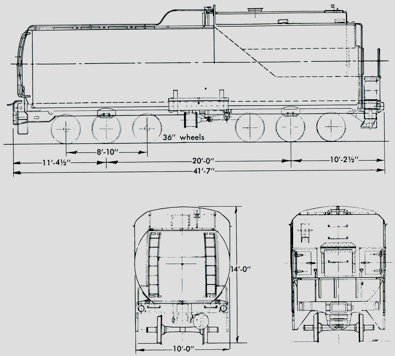
The 160-C classes rode on 36" wheels.
Storey Lindsay

The larger tenders, 16000 gallons and up rode on 36" wheels. 
Ernie Fisch


Paint
For those painting models use Engine Black?


Steam Loco Lettering & Numbering
SOUTHERN PACIFIC LINES changed to SOUTHERN PACIFIC  1947

LINES was officially dropped from tender lettering with the issuance of the locomotive painting blueprint issued June 2, 1946. 

Specifically non-skyline MT class for 1927-era, have it lettered SOUTHERN PACIFIC LINES on the tender.
Early Steam - Color
Prior to June, 1946, lettering was "aluminum bronze," a silver color metallic paint which did not tarnish as would silver. At that time, IIRC, freight power became white lettering. In 1947, passenger power ceased to be aluminum bronze and changed to "lettering gray," a light gray color intended to look essentially like aluminum bronze without the metallic quality. And before long, the only engines painted as "passenger power" were the GS classes so assigned.
Tony Thompson 

So in October 1947, all SP steam lettering, freight and passenger engines, was changed to "Synthetic Gray" (or lettering gray). Prior to that time, passenger power was lettered in aluminum bronze, freight power in white.
Tony Thompson
The Pacific lines changed all steam loco letters and numbers to synthetic gray enamel when the "Lines" was dropped. It was 1947. 
References
A while back SPH&TS had a reproduction of Espee's lettering drawing available. The material in the 4-8-2 book reproduces parts of that drawing.

There were several separate lettering drawings, one of which is in the Mt book, and then a kind of "global" drawing showing everything. The entire set is at CSRM, IIRC.
Tony Thompson 
                                                                       SP Painting & Lettering Guide, pg. 17


Decals 
Early Vintage Large Steam
Champ

Foothill Model Works
If you plan to decal Espee steam locos in HO or O scale, I strongly urge you NOT to use the Microscale decal sets and instead use the SP steam loco decal sets produced by San Juan Decals.
Their SP steam set FMW-600 was once available in the Aluminum, Aluminum-Bronze, and Lettering Gray styles, and came complete with quite comprehensive instructions and lettering info, along with several pages of very helpful placement and lettering drawings for many classes of Espee steam.

A few details regarding Espee steam loco lettering are found at their Web site 								 http://home.inreach.com/jkitts/DecalSP.html#FMW600. 
San Juan Decals
Charlie Givens designed the most accurate SP Steam decals that have been produced for the HO modeler. They were originally printed by Foothill Model Works and are currently produced by San Juan Decals.
They can be acquired here:                 http://www.sanjuandecals.com/sp-decal-sets.html
Scott Inman

Contact SJD at:
	361 S. Camino del Rio, #276, 
	Durango, Co 81303.
	Ph (970) 259-2832
	Fax (970) 259-2832 		                    wspheres@frontier.net

Thin Film
ThinFilm makes nice HO scale decal sets for S.P. steam, including for Daylight-painted locos which Foothill sets do not cover.
                                                                          http://www.thinfilmdecals.com/
If you intend to decal Espee Daylight painted steam locos, I recommend the various sets offered by ThinFilm for your specific era.
Rob Sarberenyi 

	S.P. Steam Locomotive  HO Decals
	    #158  SP                                                        2-Tone Gray cars, lettering gray with black outline
	    #159  SP 			         Post-1958 	all-Gray cars, lettering gray no outline
	    #160  SP Heavyweight cars			         Dulux Gold lettering
	    #162  SP Small Steam 		pre 1947 	White lettering
	    #163  SP Small Steam 		post 1937 	Aluminum Bronze lettering
	    #164  SP Small Steam 		post 1947 	Silver Gray lettering
	    #165  SP Medium Steam 		pre 1947 	White lettering
	    #166  SP Medium Steam 		post 1937 	Aluminum Bronze lettering
	    #167  SP Medium Steam 		post 1947 	Silver Gray lettering
	    #168  SP Large Steam 		pre 1947 	White lettering
	    #169  SP Large Steam 		post 1937 	Aluminum Bronze letter
	    #170  SP Large Steam 		post 1947 	Silver Gray lettering
	    #171  SP Articulated Steam 	pre 1947 	White lettering
	    #172  SP Articulated Steam 	post 1937 	Aluminum Bronze lettering
	    #173  SP Articulated Steam 	post 1947 	Silver Gray lettering
	    #174  SP Daylight Steam 		post 1937 	Aluminum Bronze w/Black outline
	    #175  SP Daylight Steam 		post 1954 	Synthetic Gray w/Black outline

A listing of ThinFilm Espee decals appears in:  http://groups.yahoo.com/group/Espee/message/26475

ThinFilm can be obtained from 
    The Original Whistle Stop in Pasadena CA   http://www.thewhistlestop.com/Index.html
    Caboose Hobbies in Denver CO   	            http://www.caboosehobbies.com/	


Microscale
The only alternative to Champ is a Microscale's set.

	S.P. Steam Locomotive  HO Decals
            #48-190  large SP steam                     contrary to its name, it is only suitable for 4100 class and up ACs.

Operations
Rules for Tenders (Steam engines)
Engine and tender size were based on COST and the JOB they were assigned to do. A long haul tender had to carry enough fuel and water to make it between water spouts and coal towers.
A yard tender carried just enough fuel and water so that the crew could get their work done with minimum interruption. Along the right of way, water towers were usually more frequent then coal towers.

An 0-4-0 should have a small tender, relatively low or with a sloped back so the crew has good visibility. The Pacifics, depending on the prototype might have small Vanderbilt tenders, but not large or long haul tenders. Large Vanderbilt and long haul tenders were found on road engines with 8 or more drivers.
Air signals on SP tenders, locos
The small device located on the engineer's side or front of the tender is not an air signal whistle, but an air brake "retainer valve". Most passenger and freight cars, along with cabooses and tenders were equipped with a retainer valve, located near the hand
brake wheel.

The retainer valve is a manually operated valve that provides a constant minimum brake application even though the air brake has been released from the engineer's brake valve in the cab. Normally, when brakes are released, all of the air in the brake cylinders is discharged into the atmosphere. By setting retainer valves, when the brakes are released, some of the air pressure is "retained", thus the name. Typically, a certain number of cars on the rear of the train would have their "retainers set" at the direction of the conductor by the brakemen before descending a grade.

The retainer valve has nothing to do with the air signal system, per se. However, the air signal (or hand signal) may have been used by the conductor to communicate to the engine crew to stop the train to set the retainers, and to start the train after the retainers had been set.

The air signal whistle was mounted inside the cab, not on the outside of the tender.

The retainer valve was painted black, along with the rest of the tender. It was mounted on a "tee" in the air line, which was sometimes located right at the retainer valve (with two air lines running up to the tee), and in other installations located under the tender or car (with one air line running from the tee up the side or end of the tender or car to the retainer valve).

The air signal line is mounted "inside" the air brake line at the ends of cars, tenders, and locomotives so equipped. It is of smaller 1" diameter rather than the larger 1 1/4" diameter air brake line. The glad hands were proportionately smaller, to avoid miscopying the lines. The glad hands were sometimes natural bronze, or painted aluminum. The air signal whistle was unpainted brass. The glad hands were usually either unpainted bronze or painted aluminum.

The air signal line is only on passenger trains. Never any on a freight train. Air signaling was done by increases in brake pipe pressure as read on the air gauges of the helpers.

On photos of SP steam power, air signal whistle were mounted in the cab on larger locomotives, especially those with enclosed cabs such as the GS's, ACs, etc. This is the air signal whistle that the conductor would "blow" according to the communication signal rules outlined in the Rules and Regulations. Examining the photos, sometimes there are two air lines to the whistle, and sometimes only one. You can see a second smaller line or wire running parallel to the air line. 

This is not an air signal whistle, which was always installed in the cab so that it could be heard by the engine crew. The device that you see on the tender is a "conductor's valve" for making an emergency application of the brakes from the gangway. It had a rather high-pitched note.


Oil Tender Classes
52-C Tender
52-C-1 Tender


70-C  Tenders
    7000 gallon 
    short Vandy tender?

70-C-1  Tenders
The 70-C-1 tender was behind M-6 #1761 and #1830.

70-C-9  Tenders
   SP #1768 (2-6-0) had a  70-C-9 tender.  #1768 got a 100-C-6 tender just before retirement.


90-C  Tenders
    9000 gallon
Tender diagrams show the 90-Cs with one hatch.

90-C-1  Tenders
    Used on SP #794 (MK-5).

57600 LBS LT
155400 LBS LD

Frame Length:            32'-6"
Tank Length:              28'-3"
Tank Diameter:            8'-0"
Oil Tank:                   10'-4"
Front to Fill Pipe:        6'-0"
Truck Bolsters C-C:   18'-0"

If you measure the length of the oil tank from the front of the tender that dimension is 10'-5-3/4". If you use this measurement the distance from the front to the fill pipe is 5'-10-3/4". These dimensions are taken from the SP tender diagram.
Ernie Fisch
Reference
SP 90-C-1 tender line drawings
                                                                            www.sp794.org

90-C-2  Tenders
   SP #1731 (2-6-0) had a  90-C-2 tender.
   SP #1744 (2-6-0) had a  90-C-2 tender.  


100-C  Tenders
Tender diagrams show the 100-Cs with three hatches
All of the 100-C tenders are shown with 33" diameter wheels.
Ernie Fisch

100-C-5  Tenders
Modeling 100-C-5  as done by Robert Bowdidge
Kemtron
Look through the Walther's model railroad catalog (or Precision Scale (PSC)'s own catalog of lost-wax brass castings): "Vanderbilt tender top", "running boards", and sketches of a Vanderbilt tender. These parts are the remnants of a tender kit that used to be offered by Kemtron, a now-gone model railroad manufacturer. With these parts and a bit of soldering, you could have an SP-style Vanderbilt tender. 

Find a Kemtron kit with instructions at a swap meet. In case you're been interested in this tender, here's some details about the kit and hints on how to build your own. 

The Tender
The Kemtron kit resembles a 100-C-5 Southern Pacific tender, but it isn't an exact model. It has slightly different dimensions, appears to ride a bit high, and has trucks that only appear under larger tenders. The tender diagram in the SP Historical and Technical Society's tender diagram book shows:

       Type                         Prototype                                    Kemtron
100-C-5 tank                   31' 4" long                                  32' long
oil bunker                          6' high  and 10'6" long                5' 6" tall  and 10' 8" long
overall height                   12'                                                12'8

Adjust the dimensions of your model to match the 100-C-5 tender where you can. Generally, overall length and height could be adjusted easily by changing the length of the water tank and adjusting the position of the oil tank. 

The Parts
The first step is to collect the parts. In 1997, the brass castings for the kit were still available individually from Precision Scale, but all the etched and sheet pieces weren't. Some of the parts appear to have since gone out of production, but many might be hiding in the parts bin of your favorite model railroad store. The entire list of castings is: 

3050 toolboxes (2) 
3115 Rerail frogs 
31084 running boards 
31257 front and rear sills 
31325 Vanderbilt tender rear ladders and front steps 
31399 steam and air piping 
31509 tank top 
31510 tank front (top section), Vanderbilt oil tender 
31511 tank front (bottom section), Vanderbilt oil tender 
51512 tank rear, Vanderbilt oil tender 
31513 oil filler cap 
31514 tank platform with manhole covers 
31541 Commonwealth tender trucks 
31644 Vanderbilt tender tank steps 
brake wheel 

Several other parts were listed in PSC's catalog -- etched parts for the tank cylinder, the oil tank sides, and the front apron. The catalog also lists a built-up underframe (though the instructions I saw insist you'd have to fabricate your own frame from brass bar stock.) To build the kit, you'll need to fabricate these yourself. 
Kemtron instructions 
Pick up the castings from Walther's via mail-order and hobby shops. You may find the etched front apron part at the Hobby Gallery in Wolcott, CT. They used to buy old stock from other hobby shops, and so had a nice selection of old parts. 
Building the Kit
Most of the assembly work matches what you'd do when building a loco or tender out of brass. The Model Railroader magazine series on building brass locomotives in 1982 and 1998 give details. However, there were a couple of trouble spots to keep in mind. 

You may have to make some parts yourself: the water tank body, oil tank sides, and frame. The tank body isn't as difficult as it looks. The tank body is brass sheet; Use 0.015 inch brass, though the castings were designed for 0.025 brass. The tank end and oil tank castings stick out a bit too far if you use thinner metal. Insert 0.010 brass strip under the wrapper so that the tank end and tank side castings don't stick up past the fabricated parts. Emboss rivets in the sheet with a Northwest Short Line Riveter tool or use Archer Decal Rivets later. Roll the tank's cylinder by bending it over a dowel in a vise. When the tender is in the right shape, file the two ends to meet perfectly, bent the tank so it would stay in shape, wrapped some florist's wire around it to hold it in a cylinder shape, then soldered the bottom seam to make my cylinder. Used the riveter to emboss the side and back sheet for the oil tank or again use Archer Rivets.
Final result before painting -- front and back 
The rest of the assembly involved soldering parts on. One difficult part was attaching the running boards and single steps on the tank. Both have brackets to attach them to the boiler, but the brackets all need to be bent at an angle to fit against the tank. If you bend the running board brackets you may break them. For the running boards,  use 0.032 inch brass rod as pins to attach the running boards. 

You’ll have problems getting the running boards and rear ladders to fit appropriately. The ladders are too far apart, and the running boards will not touched the tank. The rear ladders may slope forward too much and hit the tank end. Making the tank shorter would have been better. 

Finally, the instructions point out you'll need to grind off parts of the steam and air pipes for wheel clearance. It's easier to cut these off with a jewelers's saw before soldering them in place.

It’s hard to set the heights of everything, so make a simple surface plate and surface gauge so you could scribe level lines on the boiler. The surface plate is merely steel sheet attached to a particle board base, and the surface gauge is made from brass tubing and sheet. 
Designing in Access for a Decoder and Sound
To make it easier to install the speaker, decoder, and wires, make the oil bunker removable. It'll be a great improvement over trying to wedge all the sound decoder parts through the top of the oil bunker. 
Robert Bowdidge
Westside 100-C-5 tender

100-C-5  Tenders
   SP #1744  (2-6-0) got a 100-C-6 tender just before retirement.
   SP #1768  (2-6-0) got a 100-C-6 tender just before retirement.
   SP #1785  (2-6-0) had a 100-C-6 tender.


120-C
According to Church, the 120-C was the most frequently re-assigned tender SP owned. One loco changed tenders 11 times in 1 year.

The 3-axle trucks used on the Athearn 120-C tender appears to be closest to the CSC Pattern 16722, used on 5 120-C-6 and all 120-C-8 tenders. The only Mt-4's delivered with this truck were 4346-4350 (delivered under the 120-C-6 tenders).
Tim O'Connor

There's a 1949 photo of 4349 w/ skyline casing and 120-C in Church's book. It was retired in 1955 and it’s unknow if it ever received a 160-C.

The 120-C tender does limit the prototype options for Mt-4's after 1940.
John Bruning

MANY SP Mikes had 120-C tenders by the late 40's and into the 50's
Paul Lyons

Mikes also wore 120-SC- tenders in later years.
Gene Deimling

The 120-C tender just wasn't used very often on modernized Mt-4's. 

120 C-1  Tenders
Modeling 120 C-1 Tenders
Sunset 120-C-1 Tender
The tender 4-wheel trucks - unpainted.
Good for 2-8-2's and 2-10-2's.

120 C-2  Tenders
Tender diagrams show the 120-C-2’s with four hatches. In the revised addition of  The 4300's, Arnold Menke's tender section shows that the 120-C-2 have 4 square hatches & 4 wheel trucks. 

The values for a 120-C-2 tender are as follows:
    Oil Capacity         4,000 gals
    Water Capacity   12,000 gals
    Empty Weight    93,300 lbs
    Loaded Weight 224,900 lbs

Lighting
Back-up Lamp
The 120-C-2 has an Oliver backup lamp.
Water Hole
The 120-C-2 tender has a single water manhole. The latest date for adding water manholes is 1943 on 120-C-2s.    There is no water deflector above the rear truck. These were added between 1938 and 1942.
Ernie Fisch

120 C-3 Tenders
Tender diagrams show the 120-C-3’s with four square hatches and six wheel trucks. Most of the 120-C-3 wore tie sprinklers. The 120-C-3 was used extensively behind Mt-class locos. The P-10 got them as well. Engine #2467 was retired with one. #2472 had a 120-C-3.
Modeling 120 C-3 Tenders
Athearn 120-C-3 Tender
These are ESTIMATED at 60$, about half the price of brass. But you get SP prototype, good detail, good rolling trucks, and the interior is already set up for speaker installation. 

Fred Hill Told me that he has ordered 200 separate 120-C-3 tenders from Athearn. The tender was good for some Pacific classes and for Santa Fe class as well for brass engines that you could not put sound in.
Bob Liberman

There will be the usual Athearn News announcement and they will have a stock number and be sold through the normal dealer network through Horizon just like the rest of Athearn products."
Rick Watson

SP 120-C-4 Tenders
Tender diagrams show the 120-C-4’s with four square hatches and six wheel trucks.

SP 120-C-5 Tenders
Tender diagrams show the 120-C-5’s with four square hatches and six wheel trucks.

SP 120-C-6 Tenders
Tender diagrams show the 120-C-6’s with four square hatches and six wheel trucks. SP traded tenders. The -6 were delivered behind Mt-class but ended up on other locos. The top handrail is different in shape and length from the 120-C-3; the trucks were different as was the rivet pattern on the oil tank.

SP 120-C-8 Tenders
Tender diagrams show the 120-C-8’s with four square hatches and six wheel trucks.
Modeling 120 C-8 Tenders
PSC 120-C-3 Tender


SP 123-R Tenders
SP 123-R-1 Tenders
SP 160-R-1 tender. is the tender that was built up from the 123-R-1 and was used behind the Mt-2's and later in MoW service. 
Jim Elliot

References
See photos in Church's 4300 4-8-2's book


160-C Tenders
The 1949 photo does not depict the same 120-C tender that #4349 had on delivery,

I have a photo of 4349 in the Roseville deadline in 1955 with a 160-C tender. so the 160-C tender would be correct to model the engine being scrapped. I have several other photos of 4349 on the Shasta with 120-C tenders.
Kenneth R. Clark
Modeling 160-C Tender
Broadway Limited
Broadway Limited makes a very nice 160-C tender. It would need to have the pressure cap replaced to go behind an Mt. The BLI tender from the AC-4/5 have never formally sold it as a stand-alone item.
Ernie Fisch
Bachmann 160-C “Hickman” tender
Re-work the HO scale Bachman 160-C "Hicken" tenders to contain dual speakers and Tsunami heavy steam decoders. Also add a few extra brass details. Put one behind each of the following brass SP locos: MT-4, SP-3, F-5, AC-4. 

Discard the tenders' supplied wiring, and install Miniatronics connections to the Locos. It works well. The Athearn tender can probably be reworked using the same process.

The SP tender Bachmann sells with their non-spectrum 2-8-0 with an added trailing truck (now its a 2-8-2) is dead on for an AC-5 cab forward. 
Westside


Rectangular Tenders
#2829 used a rectangular tender

#3727 used a square tender at SLO
tender had a swamp cooler on top and was connect to engine. It was run by a 2nd generator behind 1st generator on top of engine.

There were 0-8-0's built in Sacramento & Houston with full view square tenders. 
References 
Drawing
Drawing of this type of tender in 1940s MR Cyclopedia.

45-R Tenders
45-R-1 Tenders
Length        18' 6.5"
Height        12' 7"
Wheelbase    4' 4"

Used on 2-6-0 M-4’s, 4-4-0s and 4-8-0s.

Photos from the Arnold Menke Collection of M-4s, mostly taken around 1907, identifies the tenders as 45-R-1.
When the 45-R-1 tenders were converted to oil, the upper edges of the coal bunkers were removed before the addition of the oil tanks. The 45-R-1 did not retain the sides of the coal bunker.
Modeling 45-R-1 Tender
Fujiyama M4 Tender
The Fujiyama tender would be an example of one. One major discrepancy on the Fujiyama tender is that the truck's wheelbase is 5'6" whereas both the 45-R-1 and 50-R-1 trucks had a 4'4" wheelbase. On the Fujiyama tender there is a 13' long line of fine rivets running to the back end of the body about 11" above the bottom of the water tanks. No pictures  of M-4s and rectangular tenders of that size have any such rivet line. 


50-R Tenders
50-R-1 Tenders
Length        18 '7"
Height        12' 7"
Wheelbase    4' 4"

Photos from the Arnold Menke Collection of M-4s, mostly taken around 1907, identifies the tenders as 50-R-1.

When the 50-R-1 tenders were converted to oil, the oil tanks were dropped in between the sides of the coal bunker. The 50-R-1 retained the sides of the coal bunker.

50-R-2 Tenders
Some of the 50-R-2s had the coal bunker side boards removed before installing the oil tank.


90-R Tenders
These tenders were built between 1900-1930.
Tender diagrams show the 90-Rs with one hatch.   
They were used with C, A, MK, P, MC, MT, and F class engines.
Spen Kellogg

90-R-1 Tenders
Modeling 90-R-1 Tenders
The 90-R-1 tenders are quite plentiful in brass and can be found behind Westside A-3s and P-1s, among others.
Spen Kellogg

90-R-7 Tenders
Assigned on SP #4501-4508

These tenders were built around 1930.
Main body length of 24'11"

The LT Wt is 66,500 lbs. The LD Wt is 163,400 lbs. The water capacity is 8,828 gals. The oil capacity (not shown on tender) is 3,018 gals. to the marker bar is 2,792 gals.
Ernie Fisch
Lettering & Numbering
San Juan Decals
Charlie Givens designed the most accurate SP Steam decals that have been produced for the HO modeler. They were originally printed by Foothill Model Works and are currently produced by San Juan Decals.
They can be acquired here:                 http://www.sanjuandecals.com/sp-decal-sets.html
Scott Inman

San Juan Decals has all the lettering in HO and O Scale--pre- and post-1946 as well as the diagrams.
Glenn Joesten


Whaleback Tender 
Nearly all were delivered for and used behind cab-forwards, which usually didn't do much switching. In later years, as the oldest cab-forwards went to scrap, more and more of these tenders became surplus and showed behind much other power, including 2-8-0 and other small engines. What was NOT built for cab-forwards.
Tony Thompson     

The tender behind #1644 is a strange bird. It is a 7300 gallon Whaleback (73-SC-classes). The SP diagram book doesn't show handrails for this class. Generally a full length walkway on top with high handrails dipping low for the the oil and water hatches. 
Normally on an SC the oil and water tanks are completely separate with a cover plate over the space between. Early SC tenders did not have this. No diagrams show handrails like that. Handrail shape can be a useful identifier.

A shot of #3227 at Santa Cruz has a large whaleback tank fitted with a pressure cap, obviously from a scrapped 4000.

References
A  source of information that could serve as a "spotters guide" for SP whaleback tenders is an SPH&TS publication called "Diagrams of Tenders"

The Bible on SP tenders, written by the Espee List's own Arnold Menke, appears in Volumes One and Two of the Southern Pacific Steam Pictorial, by Dunscomb and Pecotich.

Gordon Y. Mills wrote an article titled "Southern Pacific Whaleback Tenders" in the October 1981 issue of Prototype Modeler. Twelve pages with 13 photos, but no drawings. with informative text, and included photos illustrating the various classes of SP whaleback tenders, actually classed "SC" for semi-circular. Back issues of PM can often be obtained from Paul Gibson at 
Railpub  

73-SC-1 Whaleback Tender
The 73-SC-1 came with the A-2 Atlantics and C-5 2-8-0's in 1902 and '03. Check Arnold Menkes article in Trainline.

The whaleback sometimes came with the 2-8-0 locos. It looked a little small to be an ex-AC tender. Photos show these tenders in use in the early 40's and replaced with larger tenders in the 50's.  
Modeling 73-SC-1 Whaleback Tender
Balboa
The whaleback sometimes came with the Balboa 2-8-0.
Westside
Westside imported a whaleback tender of the 73-SC-1 class.

98-SC Tenders
One small class of 98-SC cars was bought new for NON-cab-forward use with high front decks.
Tony Thompson  


Specific Assigned Tenders
0-6-0 Tender
52-C-1 Tender
52-C-1 cylindrical tender were used primarily with 0-6-0s from the '20s on.

0-6-0  S-10 Tender
47-C-1/2 Sausage Tenders
There were three classes: 47-C-1, 47-C-2. 47-C are so called "Sausage" tenders. It appears that Baldwin was the genesis by producing the original 47-C-1, the other by Espee. SP used a sausage tender used on a Baldwin S-10 0-6-0 switcher as used by T&NO #136. There are locos in the same class i.e. Baldwin S-10 #1217 with a sausage tender. 
52-C-1 Sausage Tenders
This tender was produced by Espee. The 52-C-1 has a small rectangular section on top of the fuel tank. 
70-C-10 Tender
The tender shown in the Sunset photo is a 70-C-10, the same as Glacier Models SP #1269 and #1294 had. These were rebuilt 70-C's with the oil bunker reshaped to provide clear vision for switching yet a larger water capacity than the much smaller 47-C and 52-C so called "Sausage" tenders.
Square Tender
There were 0-8-0's built in Sacramento & Houston with full view square tenders and some with a longer sausage tender. Drawing of this type of tender in 1940s MR Cyclopedia.
Vandy Tender
#1218 with a Vandy. The Vandy was mostly an upgrade.

0-6-0   S-11 Tender
70-C-9 Tender
The 1229's current Tender is # 7043; a 70-C-9 tender, assigned to the 1229, sometime in August, 1956. There were seven (7), tenders assigned to the 1229. They are (first to last) 5611, 5500, 5510, and again 5500, 6134, 6124, 6964 and her current tender 7043.

0-6-0-  S-12 Tenders
    SP Vandy type tenders would be most typical for the following 0-6-0 (S-12) locomotives:
    	47-C-2	52-C-1 	70-C-x (-9 clear vision)

2-6-0 Mogul
Tenders
Most of the M class had 90's or 100's not the 120's.
Paul C. Koehler

2-6-0  M-4
Tender
It had several types: 70C-1 tender, 73-SC-classes, 120-SC-X, 45-R-1 and 50-R-1.

The tender behind #1644 is a strange bird. It is a 7300 gallon Whaleback (73-SC-classes). The SP diagram book doesn't show handrails for this class. Generally a full length walkway on top with high handrails dipping low for the the oil and water hatches. 
Normally on an SC the oil and water tanks are completely separate with a cover plate over the space between. Early SC tenders did not have this. No diagrams show handrails like that. Handrail shape can be a useful identifier. 

The tender behind #1685 is a 120-SC-X. If you could read the weight you could classify as it as a 120-SC-1 to 3 or 120-SC-4 to 6. These came from the old AC-1 to 3 engines. The tip off is the screw down cover over the oil filler. This shows they came from cab forwards. 

Photos from the Arnold Menke Collection of M-4s, mostly taken around 1907, identifies the tenders as 45-R-1 and 50-R-1.
Modeling 2-6-0 M-4 Tender
Bachmann
Balboa 73-SC-classes Tender
Balboa imported a similar tender without the running boards 3/4s of the way up the side, but it seems a little too tall, perhaps it is a 98-SC class without running boards.
Ken Clark 
IHC
IHC tender is too long and should be shorted or replaced. M-4s had a variety of tenders in their later days, so a replacement would make the loco a little more distinctive. Replace tender with Bachmann or MDC Vanderbilt. 
MDC

Mehano / AHM
Many modelers replace the tender on the Mehano M-4 mogul with a short Vanderbilt. Usually the old MDC one. Mehano only offers the locomotive today with a coal tender (same tender, but with a coal load insert replacing the oil tank) and painted in Southern (sans-Pacific):                                      http://www.mehano.si/EN/article.php?id=43&mo=3

Early AHM imports had a tender drive.
Westside 73-SC-classes Tender
This is basically the tender WestSide Models used on their Fire Train model and separately as a 7300 gallon Whaleback tender.
References
Mainline Modeler from May 1986 that has an article on SP 2-6-0 engines.

2-6-0  M-6 Tenders
    SP Vandy type tenders would be most typical for the following 2-6-0 (M-6) locomotives:
		90-C-x	90-R-1 	70-C-x

SP #1761 had a 70-C-1 tender (when lettered for P.E.).
   SP #1744 had a 90-C-2 tender.
   SP #1785 had a 100-C-6 tender.
SP #1830 had a 70-C-1 tender (when lettered for P.E.).

Modeling 2-6-0  M-6 Tender
Sunset
   These Moguls have backhead detail with 100-C-4 tenders.
   The old SP M-6 2-6-0 came with a 120-C-6 TENDER.

2-6-0  M-9
Modeling 2-6-0  M-9
Sunset
   These Moguls have backhead detail with 100-C-4 tenders.
   The old SP M-9 2-6-0 came with a 120-C-6 TENDER

2-8-0  Tender
100-C-3, 4, 5, 6  were used on 2-8-0   (10,000 gal.)

7,000 gal Vanderbuilt tender
9,000 gal Vanderbuilt tender had 1 run added between water and oil tanks making the tender longer, but holding more capacity.

2-8-0  C-5
The 73-SC-1 came with the C-5 2-8-0's in 1902 and '03.

2-8-0  C-9
Tender
Came with a 170-C-2 tender

Modeling 2-8-0  C-11 Tender
Bachmann SP Vanderbilt Tender Conversion
Convert the rectangular tender to oil or use one of Bachmans Vanderbuilt. The Bachman tender isn't quite right with respect to dimensions, but will do. It needs an oil bunker (with rounded end plate for some) and railings on top. These engines all had rectangular tenders. Don't forget that some of the Bachman engines had problems with the DCC plug wiring.

2-8-2  Mk-2
Tender
    90-R-1 Tender
    120-C-2(?) Tender

2-8-2  Mk-5
Tenders
    SP Vandy type tenders would be most typical for the following 2-8-2 (MK-5) locomotives:
 	100-C-x	90-R-1

   The SP #794 (MK-5) had an SP 90-C-1 locomotive tender.

2-8-4  B-1 Tender
Tenders
They got tenders from the 4000 class cab forwards. Cab forwards, including the "wamps" had to have a pressure cap (a large screw-like device atop the oil filler cap -- looks like a wine press) for the pressurized oil tank. Shots of #3507 at Oakland Mole and on the Tracy turntable in 1950 show no no pressure cap.

A shot of #3227 at Santa Cruz has a large whaleback tank fitted with a pressure cap, obviously from a scrapped 4000.
Of course there's always the possibility that the mechanical department might have taken a surplus 4000 whaleback tank, retrofitted it with a non-pressurized cap and attached it to a 3500, but it seems unlikely.

2-10-2
Tender
120-C-1 
The tender is a 120-C-1 (four wheel trucks, two rows of rivets on the fuel bunker). According to the tender section in Bob Church's 4-8-2 book, the 120-C-1s were rebuilt with new frames and six wheel trucks into the 120-C-6 class.
120-C-2
Tender 4-wheel trucks 120-C-2,
120-C-3
Tender 6-wheel Commonwealth trucks 120-C-3 / -8
120-C-6
At some point it carried a 120-C-6 tender before the larger tender was passed along from a retired steam loco. Two photos of #3765 show a 12,000 gal tender. The first in 1946 was taken in Dunsmuir, the second taken in 1952 was in Fresno. #3765 was still assigned tot he Shasta Division as late as the July 1948 roster. So the tender is close (with new trucks) and after a big enough quake Fresno could be on the Coast line.

2-10-2  F-5
These engines used 160-C “Hickman” Tenders.
Modeling 160-C Tenders
Bachmann 160-C “Hickman” tender
Re-work the HO scale Bachman 160-C "Hicken" tenders to contain dual speakers and Tsunami heavy steam decoders. Also add a few extra brass details. Put one behind each of the following brass SP locos: MT-4, SP-3, F-5, AC-4. 

Discard the tenders' supplied wiring, and install Miniatronics connections to the Locos. It works well.


4-4-0  E-23
4-4-0  E-23
Modeling 4-4-0  E-23
IHC 
Replace tender with Vanderbilt.

4-4-2
The 73-SC-1 came with the Atlantic's in 1902 and '03.

4-4-2  A-3
Modeling 4-4-2  A-3  Tender
Westside 4-4-2  A-3 Tender
The 90-R-1 tenders are quite plentiful in brass and can be found behind Westside A-3s among others.

4-4-2  A-6
   The A-6 Atlantics 3000 and 3001 (were Daylight painted).
Paint
    The #3000-3001 cab and tender are in Daylight paint scheme.
Modeling 4-4-2  A-6  Tender
Bachmann 4-6-0 T-40 Tender
Bachmanns small rectangular tender is the wrong proportions but it can be modified to resemble SP tenders and a road pilot could be applied to replace the foot boards on the model.


4- 6- 0  Twelve Wheelers
Modeling 4-6-0  TW-8
Mantua
Kitbashing an SP TW-8 using the Mantua 4-6-0 chassis, and the Harriman style boiler, cab and Vanderbilt tender from MDC.

Modeling 4-6-0  TW-31
On the NWP 4-6-0's T-31, tenders rode on 36 inch wheels.
Bachmann shorty Vanderbilt tenders trucks are unacceptable. Use 3 trucks from PSC. They have 33 inch wheels.
Richard Todd


4-6-2  Pacific
4-6-2  P-1
Modeling 4-6-2  P-1  Tender
Westside 4-6-2  P-1 Tender
The 90-R-1 tenders are quite plentiful in brass and can be found behind Westside P-1s, among others.

4-6-2  P-10
The 120-C-3 was used extensively behind P-10’s.


4-8-2 Light Mt. 
120-C-3 was used extensively behind Mt-class locos.
4-8-2  Mt-2
Tender
120-C-1 Tender
According to the tender section in Bob Church's 4-8-2 book, the 120-C-1s were rebuilt with new frames and six wheel trucks into the 120-C-6 class. So the tender is close (with new trucks) and after a big enough quake Fresno could be on the Coast line.
Tender Mt-2 #4388 
Mt-2 #4388's tender was wrecked in 1934, it was replaced with a 120-C-series Vanderbilt tender. 
According to tender record cards of Arnold Menke, the tender was a 120-C-8, #8759, from 6-1934 to 12-1946, and 3-1947 to 5-1951. That tender came with 5029 when new. #4388 had a 160-C from 12-46 to 3-47. The engine was retired in 1951.
Reference
There are wonderful photos, drawings and descriptions of various types of tenders in Robert J. Church's book, THE 4300 4-8-2's.

4-8-2 Heavy Mt. 
4-8-2  Mt-4
As to tenders, 160-C tenders started showing up on the older Mts by 1938. The choice of 120-C or 160-C seems to be more one of what was available than of engine assignment. (MT-5’s came with 160-C tenders.)
Charles Givens

Tender 120-C
According to Church, the 120-C was the most frequently re-assigned tender SP owned. One loco changed tenders 11 times in one year.

These are the original tenders for the Mt-4 locomotives.
The 120-C tender was common although not as common as the larger 160-C in later days. 
Bill Daniels

   There is a 1956 photo of #4358 w/ a 120-C, presumably when it was in San Francisco commute service.
   SP 4360 had a 120-C when photographed in San Francisco in 1953.

3-axle trucks used on the Athearn 120-C tender. It appears to me to be closest to the CSC Pattern 16722, used on 5 120-C-6 and all 120-C-8 tenders. The only Mt-4's delivered with this truck were 4346-4350 (delivered under the 120-C-6 tenders).
Tim O'Connor

Tender 160-C
These engines used 160-C “Hickman” Tenders.

The 160-C is correct for the non-updated version and much better for the updated ones. 
Ernie Fisch

   SP 4358 had a skyline casing and 160-C in 1941 w/ Lines lettering.  
Reference
The best source of SP steam tender information is a small amount of info in the 4-8-2 Mountain book.

Modeling 4-8-2  Mt-4 Tenders
Athearn Tender
Those are the 120-C-6 tenders the first run came with. These are the original tenders for the Mt-4 locomotives.
The 120-C tender was common although not as common as the larger 160-C in later days. 
Bill Daniels

Replace the pressurized oil hatch (needed on the AC use) with a non-pressurized one for use behind the Mt. There are also handrail arrangement differences between AC and non-AC tenders of 160-C classes.
Tony Thompson
Bachmann 160-C “Hickman” tender
The Bachmann SP heavy mountain, it may indeed be a reasonable model of the 160-C. Another Espee tender looks like a possible 90-C or 100-C. The handrails look suspicious but the rest of the tender is good. Beware the tender "coal hole extensions" fouling the underside of the cab roof when the engine and tender are close coupled. Especially when backing through switches. You may also want to check that the front of the tender isn't fouling the cab grab irons when loco and tender are close coupled. The "U" bend at the bottom of the cab grab irons seems to be a broader radius than on the light mountain.

Re-work the HO scale Bachman 160-C "Hicken" tenders to contain dual speakers and Tsunami heavy steam decoders. Also add a few extra brass details. Put one behind each of the following brass SP locos: MT-4, SP-3, F-5, AC-4. 

Discard the tenders' supplied wiring, and install Miniatronics connections to the Locos. It works well.

4-8-2  Mt-5
Tender
According to Richard Wright's book on the Mt-5 s, the tender that was assigned to MT-5 #4370 was a 160-C-2 number 8850. This was the tender from January 1947 until July 1952.
Maynard Stowe


4-8-4  GS	
4-8-4  GS-1	
Tender 
220-R-1 class
Some of the GS-1 class got these after construction, the ladder is left of center. The GS-1's were originally built with 16,000 gallon semi-Vandy tenders and some retained those tenders for their entire careers.
Tender Lettering
SP painted the weights on the tender sides. The data painted on the sides of the cab below the loco number should read:
	 GS-1 GS 73 27/30 266 SF
"Correct" tender weight data is variable of course, since it was stenciled on after actual weighing of the tender. For a 220-R-1, the weights below are typical:
	 145,000 LBS LT SP
	 373,000 LBS LD

4-8-4  GS-2	
Tenders 
220-R-1 Tender
GS-2 220-R-1 tenders had, according to Arnold Menke's excellent tender section, the Oliver backup lights removed between 1941-1944 and replaced with headlights. This would have been when some if not all were still in Daylight Livery.
GS-2 Tender Ladder
The ladder is left of center. It had ladder extensions.
Tender Paint
With ladder extensions            painted black
Without ladder extensions       painted Daylight
Tender Lettering
This tender sometimes would have appeared before the lettering change (Orange front number board, small lettering high on the tender with "Lines") without the ladder.

The GS-2 never had the large lettering on the tender. 
Modeling 220-R-1 Tenders
Balboa

4-8-4  GS-3	
Tender
235R-1Tender
Photos of GS-3 tenders show the lower location in a couple of books, including page 126 of  Coast Line Pictorial (they had their backup light atop the tender, not mounted into the back face of the tender body.
Modeling 235R-1 Tenders
Bachmann 235R-1Tender 
The major work appears to be the tender. Removing the rear ladders from the 235R-1 tender, shaving the top and applying a flat top to the tank plus building up a deck to create a 220R-1 would be a major part of the work.

GS-4 Tender 
Photographs of high-located end numbers on GS-4 tenders include pg. 121, Signor's Tehachapi book and pg. 153 of Thompson/Signor, Coast  Line Pictorial. (they had their backup light mounted into the back face of the tender body).But in 1950, 4433 definitely had the lower location.
Tony Thompson

In Signor's Tehachapi book there is an excellent photo of the rear of 4448's tender. There are brackets for marker lights and the wiring conduit runs to each of the brackets. If the fixture is connected to the conduits, it is a junction box. Conduit runs to each bracket and to the rear light. The marker lights are not in place. They were probably stashed in one of the storage boxes on the tender for use in the rare case they were needed. It would appear that they are not carried normally. In several other photos, the markers are not in place.
GS-4 Tender Paint
The side ladders on the tender were painted to match the stripes without the flat aluminum dividing stripes. 
GS-4 Tender Lettering 
Number Location
Back of the tenders. There are differences in how each type (black vs daylight) of GS was decorated and where the number goes on the rear of the tender on this black paint scheme. 

On the Daylight, it goes above the light between the silver stripes. 

The rear of a GS-4 painted in the black "war baby" scheme, essentially it's just the standard black paint scheme a normal steam engine gets. The standard black paint schemes all have the number centered on the rear of the tender. A 1956 photo that shows the rear of the tender of black-painted #4431 is on page 68 of Dill's "Southern Pacific's San Joaquin Valley Line." Page 33 of "Daylight 4449's Family Album" has a photo of  #4431 taken in 1956 when the engine was painted all  black. A quick review of photos in books showed black-painted GS-4s having their numbers above the rear light (including #4431. 

As clearly shown on page 369 of Bob Church's new book about the GS engines, it was centered, and located below the horizontal handrail below the rear light. Nearly every photo in the new book shows the number below that handrail. Whether this depends on era, hasn’t been determined.
Tony Thompson 

Regarding #4433, while the 1950 photo taken at the Alhambra roundhouse found in "Those Daylight 4-8-4's" shows its number below the rear light, a 1956 photo taken at Roseville on page 44 of Dill's "Southern Pacific's Historic Overland Route" shows the number for this engine above the rear light. In "Daylight 4449's Family Album"  has #4433, with its number painted below the light (photos of #4433 can be seen on pg. 45 of "Southern Pacific Lines Common Standard Plans".

It is unknown if the location of engine numbers on the rear of tenders of black GS-4s depended on the era or if it was something done at the whim of shop forces. 

#4447 also for awhile had a red and orange-painted tender and cab with the skirts removed. See the photo on pg. 126 of Dill's "Southern Pacific's San Joaquin Valley Line." So, that makes the known number of GS-4s that carried this scheme stand at 10.

GS-6 Tenders
No SP 6-wheel commonwealth trucks on Vanderbilt tenders had roller bearings. Roller bearings tender trucks only existed on the two GS-5 engines, #4458 and #4459. 

Photos of GS-6 tenders show the lower location in a couple of books, including page 126 of  Coast Line Pictorial (they had their backup light atop the tender, not mounted into the back face of the tender body.

4-8-4  GS-3	
Roller Bearing Tender Trucks
Roller bearings tender trucks only existed on the two GS-5 engines, #4458 and #4459.

4-10-2  SP
4-10-2  SP-1
Tender
16,000 gal. Vanderbilt tender,                                 (*see T-28/13),

4-10-2  SP-2
Tender
16,000 gal. Vanderbilt tender.

4-10-2  SP-3
Tender 
16,000 gal. Vanderbilt tender
These engines used 160-C “Hickman” Tenders.
Modeling 160-C Tenders
Bachmann 160-C “Hickman” tender
Re-work the HO scale Bachman 160-C "Hicken" tenders to contain dual speakers and Tsunami heavy steam decoders. Also add a few extra brass details. Put one behind each of the following brass SP locos: MT-4, SP-3, F-5, AC-4. 

Discard the tenders' supplied wiring, and install Miniatronics connections to the Locos. It works well. 
 

4-8-8-2  AC-
Reference
The best source of SP steam tender information is a small amount of info in the Cab Forward book.


Electrical
Powered Tender
If you want to power a late AC - 7/8/10/11/12 or GS - 2/3/4/5/6 HO tender with Buckeye trucks, consider using a Kato RSC-2 chassis. The wheelbase is very close, any minor differences will be hidden by sideframes. And it is a Kato so the mechanism is top rate. You have to shorten the frame a couple of feet and other mods to fit, but it's cheaper and more powerful than the expensive power trucks. The tender becomes a booster to the engine. My KTM engines have 37:1 gearboxes and 7-9,000 rpm motors and tend to run well with Kato diesels. With DCC you should be able to dial in the dual mechanism operation precisely. This as an alternative to some of the powered truck options. The drawbar between engine and tender may have to be improved on some models.
Kenneth R. Clark

http://www.railpub.comhttp://www.precisionscaleco.comhttp://home.inreach.com/jkitts/DecalSP.html#FMW600http://www.sanjuandecals.com/sp-decal-sets.htmlmailto:wspheres@frontier.nethttp://www.thinfilmdecals.com/http://groups.yahoo.com/group/Espee/message/26475http://www.thewhistlestop.com/Index.htmlhttp://www.caboosehobbies.comhttp://www.sp794.orghttp://www.sanjuandecals.com/sp-decal-sets.htmlhttp://www.mehano.si/EN/article.php?id=43&mo=3shapeimage_2_link_0shapeimage_2_link_1shapeimage_2_link_2shapeimage_2_link_3shapeimage_2_link_4shapeimage_2_link_5shapeimage_2_link_6shapeimage_2_link_7shapeimage_2_link_8shapeimage_2_link_9shapeimage_2_link_10shapeimage_2_link_11
Southern Pacific Lines
S.P. Steam Tenders
General Information
- Designation of SP Tenders
Assigning Numbers to Tenders
Values for Tenders
Assigning Tenders to a Loco

Tender Details
- Brake Chains
Lighting
Paint
Lettering & Numbering
Decals

Oil Tenders
Rectangular Tenders
Whaleback Tenders
Specific Assigned Tenders

Electrical
- Powered Tender
Home../Modeling_the_SP_Coast_Line/Title_Page.html