Southern Pacific Lines
Coast Line Division
“The Route of the Octopus”

Southern Pacific Lines
Coast Line Division
“The Route of the Octopus”
S.P. Track Support
S.P. Track Support Structures
(*see also: Steam Age Equipment Company of Dunsmuir CA. published 5 Volumes of Southern Pacific Common Standard Plans). These are an invaluable addition to your library.
SP Common Standard drawings
There's a pretty comprehensive listing compiled by Carl Rodolf posted on Richard Percy's website
http://espee.railfan.net/common_standards_drawings_table.html
Rob Sarberenyi
Crossing Gate Control Towers
Those towers were built to protect automobile and pedestrian traffic from approaching trains via manual operation of the crossing mechanisms. From 1938 to 1947 and thru the late 50's, most of the SP crossings were protected by flagmen until automatic gates or overpasses were built.
Frank Ferrita
Some of the towers were elevated to about 14' and the structure was 6' x 8'.
Some had electrical control panels with approach lights and bells to help alert the operators to the presence of trains moving in their direction. The crossing gates from those days seemed to have a constant bell or buzzer opposed to the clapper activated bells. At Newhall St, there was a bell in the flagman's shanty that went off shortly before a train got there on the main. He would shut it off and go out and stand in the crossing with a red flag and stop sign.
Drew Jacksich
With advances in signal automation the necessity of posting watchmen (and women) at those locations went away.
Frank Ferrita
Locations
Located in San Jose, Hedding, Stockton, Emory, and Newhall,
A photo taken in the 1950s shows one at Burlingame, but the wood structure was already torn down by the early 1960s.
One was in San Mateo located south of the station on the west side of the tracks.
Jim Evans
Brokaw Rd. in Santa Clara had a small tower with levers to control the gates by hand. This went away in 1959 when Highway 17 (now I-880) was opened and Newhall and Brokaw were closed off. Hedding got an over pass, Emory was closed and gates were installed on Stockton St. (College Park).
Drew Jacksich
The 6th St. tower in Gilroy controlled the main crossing just north of the Gilroy Depot. There was plenty of commercial traffic using this crossing with the F&P cannery and other industries on the east side of the mainline and US 101. During the busy farm production season, the crossing gates needed to be down a little as possible, as the road crossed the very active Coast mainline tracks.
Modeling Gate Crossing Tower
The February 1980 issue of the NMRA Bulletin has an O Scale drawing of the Gateman's House in Gilroy. It was elevated about 14' and the structure was 6' x 8'. Copies of the drawing can be obtained from the NMRA library.
Chuck Catania
Handcar Shed
Handcar Shed- Santa Susana, Ca. Western Prototype Modeler Sep/Oct. 1976
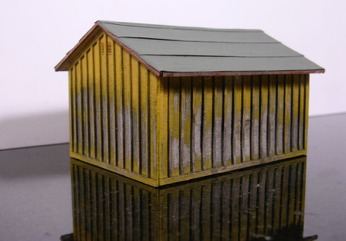
Modeling SP Handcar Shed House
AL & W Lines
Available as HO scale laser kits alwlines.com
Paint
Floquil Paint
Walls - SP Armour Yellow #133
Trim - 2 parts Roof Brown #70 + 1 part SP Armour Yellow #133
Roof - Depot Olive #44
References
(*see Western Prototype Modeler Sept/Oct 1976)
Operators Dwelling
A photo in the January 2008 issue of The Ferroequinologist has an article titled "Gaviota and its Railroad 1955-56." On page 5 it shows an operator's dwelling composed of two converted boxcars.
John Sweetser
Signal House
Valuation records indicate such a structure (actually a train order office) measured 10'x12'.
A 10’ x 12’ signal house" was located at Cameron for train order operations and served as a train order office at Sivert.
John Sweetser
Reference
The building can be found on pg. 131 of Signor's "Tehachapi".
Drawing
There is an SP plan M.W.D. 1948, "Southern Pacific Signal House” dated August 1922. See pg. 3 of Petty's "Southern Pacific Lines Common Standard Plans, Vol. 5" for the plan.
Modeling Signal House
Micro-Trains Line
Micro-Trains Line released a "Line Shack Kit" in HO scale that has a very Espee-esque feel about it.
See the photo and description here: http://www.walthers.com/exec/productinfo/489-89990901
Harry Wong
The model appears to follow SP plan M.W.D. 1948, "Southern Pacific Signal House” dated August 1922. See pg. 3 of Petty's "Southern Pacific Lines Common Standard Plans, Vol. 5" for the plan. The model structure measures 10'x12'.
Speeder Shed
Reference
See: August 1977 Railroad Modeler, which had an article on two speeder sheds at Saugus on pages 20-25.
John Sweetser
Go to: Trainorders.com for a bunch of great photos.
Drawings
See page 60 (8' x 10' "Tool House for Signal Maintainer") and page 61 (12' x 16' "Section Tool House") of Bruce Petty's/Steam Age Equipment Co's. "Southern Pacific Lines Common Standard Plans, Vol. II. If the above publication is not readily available, photocopies can be obtained from the Calif. State RR Museum Library.
Modeling Speeder Shed
AL & W Lines
Available as HO scale laser kits alwlines.com
The kits very easy to construct and fast to complete. To match some photos of sheds, modify these kits slightly by replacing the stock shingles on the larger toolsheds with simulated tar paper from Builders in Scale. Replace the standard hinges supplied with the kit with hinges from Grandt Line. Lastly, make your own hasp and lock assemblies for the doors using leftover hinges from the AL&W kit. Here are a few photos: http://www.pbase.com/tracktime/alw&page=all
Harry Wong
Clyde King Scratchbuild Speeder Shed
His water tank is based on the SP Common Standard CS 1550 found in Bruce Petty's CS plan book, Volume 1. Clyde's two HO scale structures incorporate plenty of Evergreen styrene and other parts.
Rob Sarberenyi
Images of Clyde King's HO scale scratchbuilt 65,000 gallon SP water tank and speeder sheds can be seen at:
http://www.pbase.com/espeef5/water_tank
Reference
http://espeef5.rrpicturearchives.net/archivethumbs.aspx?id=67882
Tie Storage
Reference
SP Tie Storage Mainline Modeler Jul. 1989
Tool House / Shed
Some tool houses had side windows, but many did not (possibly for security reasons).
Standard Tool House Mainline Modeler Aug 1986
Section Tool Sheds Railroad Model Craftsman Oct 1998
Go to: Trainorders.com for a bunch of great photos.
Drawings
See page 60 (8' x 10' "Tool House for Signal Maintainer") and page 61 (12' x 16' "Section Tool House") of "Southern Pacific Lines Common Standard Plans, Vol. II. Photocopies can be obtained from the Calif. State RR Museum Library.
Modeling SP Tool / Shed House
AL & W Lines Kit #SP3 Large Tool House
The structure's size is about 1" by 1.5"
Available as HO scale laser kits alwlines.com
The parts are fine-quality and everything fit to a "T". Unlike the instructions, hand paint all the parts while still attached to part sheets and sprues and to complete the walls before forming the structures. The only alteration made of the sheds was the addition of door clasps (used small bits of painted plastic "stripwood") which are quite prominent in the prototype picture provided.
Mark Pierce
The kits very easy to construct and fast to complete. To match some photos of sheds, modify these kits slightly by replacing the stock shingles on the larger tool sheds with simulated tar paper from Builders in Scale. Replace the standard hinges supplied with the kit with hinges from Grandt Line. Lastly, make your own hasp and lock assemblies for the doors using leftover hinges from the AL&W kit. Here are a few of the kits I built a while back: http://www.pbase.com/tracktime/alw&page=all
Harry Wong
It is easiest to paint all the walls and trim before assembling the little building. When dry assemble the AL&W kit using the kit’s very nice peel-and-stick trim. The walls glue neatly to the floor and hold everything square and in alignment.
Funaro & Carmelengo
They produce a structure for SP #16 Tool House.
Paint
Airbrushed the walls Colonial Yellow before doing any assembly. Use Tru-Color’s version of this standard SP color (Tru-Color no. TCP-153). Trim is airbrushed with Tru-Color no. TCP-163, (Depot Trim Brown). The doors should not be brown.
Water Tank - Wood (22,500 gallons)
Reference
Drawings
Locomotive Terminals & Railroad Structures, pg. 28
Water Tank - Wood (50,000 gallons)
The standard wooden 50,000-gallon water tank was not the straight-sided wooden tank found in "Southern Pacific Lines Common Standard Plans, Volume 1", but rather the kind with tapered sides, which were far more common on the SP than the straight-sided wooden tanks.
John Sweetser
Reference
Drawings
Southern Pacific Lines Common Standard Plans, Vol. 1, pg. 44-47
Locomotive Terminals & Railroad Structures, pg. 22
The Shasta Division Archives has plans for a 50,000-gallon tank that are probably for the taper-sided type, based on the date of the plans.
John Sweetser
Southern Pacific. MWD 765 Jul. 12, 1900 / Dec. 30, 1909. Two story iron frame with wooden floor, carrying 50,000 gallon wooden tank. 24 x 36 White line on blue paper TORN. ID 51621
Southern Pacific. MWD 771 May 10, 1897 / Nov. 1915. 50,000 gallon water tank, on cast iron columns. 23 x 31 in. Blue line on white paper. Filing location: + D ID 978
Water Tank - Steel (65,000 gallons)
Legs, Metal
SP tanks had both steel lattice girder legs and cast iron legs (if it had cast iron legs, they would look like pipes). There are both high and low leg versions.
Red Rock, Cantil and San Luis Obispo were on steel legs. Santa Barbara had one next to one with wooden legs.
Legs, Wood
There are both high and low leg versions.
Santa Barbara and Gaviota had a 65,000-gallon steel water tank on wooden legs.
Go to: http://www.trainorders.com/discussion/read.php?11,1035588
John Sweetser
Roof
Some water tanks have a flat roof, others are peaked.
The 65,000 gallon steel tank at San Luis Obispo has a peaked roof.
Arved Grass
Tank
All 65,000 gallon water tanks were made of steel.
Reference
See photo: Southern Pacific's Coast Line, pg. 135
Drawings
Southern Pacific Lines Common Standard Plans, Volume 1, pages 48-51
Drawings at the Calif. State RR Museum Library
American Bridge Company. Not numbered Not dated Mild climate 65000 gallon common standard steel tank and tower. Used on: SP bridge. 24 x 34 in. White line on blue paper (Fragile). ID 29877 (used at Morley)
Southern Pacific. CE 15759 / 2 Aug. 15, 1939 / Jul. 16, 1941. Timber tower for 65000 gallon water tank. 24 x 34 in. White line on blue paper. Filing location: Box 31 (X) ID 4290
Southern Pacific. CE 15759 / 2 Aug. 15, 1939 / Jul. 16, 1941. Timber tower for 65000 gallon water tank. 24 x 34 in. White line on blue paper. Filing location: Box 31 (X) ID 4291 (used at Santa Barbara)
Southern Pacific. CS 32 / 1 Nov. 1904 / Nov. 4, 1925. Common standard: 65000 gallon steel water tank, detail of tank, floor and foundation. Black line on white paper. Filing location: Box 126 ID 24566
Southern Pacific. CS 32 A / 2 Nov. 1904 / Aug. 1, 1921. Common standard: 65000 gallon steel water tank, details of valves. Black line on white paper. Filing location: Box 126 ID 24567
Southern Pacific. CS 32 B / 3 Nov. 1904 / Nov. 4, 1925. Common standard: 65000 gallon steel water tank, details of spout and operating mechanism. Blue line on white paper. Filing location: Box 126 ID 24568
Southern Pacific. CS 32 C / 4 Nov. 1904 / Nov. 4, 1925. Common standard: 65000 gallon steel water tank, details of columns and bracing. Blue line on white paper. Filing location: Box 126 ID 24569
Southern Pacific. CS 32 G / 1 May 1905 / Aug. 1, 1921. Common standard: 65000 gallon steel water tank, details of tub and foundation. Blue line on white paper. Filing location: Box 126 ID 24570
Southern Pacific. CS 1550 [Former number: CS 32] Nov. 1904 / Aug. 9, 1945. Common standard: 65000 gallon steel water tank, details of tank, floor and foundation. Blue line on white paper. Filing location: Box 128 ID 25399
Southern Pacific. CS 1551 [Former number: CS 32] Nov. 1904 / Aug. 9, 1945. Common standard: 65000 gallon steel water tank, details of roof, eaves, and walkway. Blue line on white paper. Filing location: Box 128 ID 27007
Southern Pacific. CS 1555 [Former number: CS 32 G] May 1905 / Aug. 9, 1945. Common standard: 65000 gallon steel water tank, details of tank, floor and foundation. Blue line on white paper. Filing location: Box 128 ID 25400
John Sweetser
Chatsworth Water Tank
Based on a on photo on p. 31 of the ' 87 version of Daylight Reflections, the Chatsworth water tank was a standard 65,000-gal.steel tank, sat on round iron posts and had a spout.
John Sweetser
The water tank has 12 cast iron legs.
Lettering & Numbering
Interestingly, both sides of the water tank had the wording "FOR EMERGENCY USE ONLY" on them.
John Sweetser
Reference
Page 6 of March 2001 issue of The Ferroequinologist, published by the Central Coast Chapter of the National Railway Historical Society, has two freight train action photos that show the Chatsworth water tank much more closely than the photo in "Daylight Reflections". The top photo on the page shows the north side of the tank while the bottom photo shows the south side.
John Sweetser
Gaviota Water Tank
Pages 4-6 of the January 2008 issue of The Ferroequinologist has an article titled "Gaviota and its Railroad 1955-56." Photos useful for modeling include the photo on page 4 of the Lark going by the water tanks at Gaviota.
John Sweetser
There is a posting today on Trainorders.com of a photo of the Coast Starlight led by an SP engine going by the water tank at Gaviota in 1972 (the thread is titled "Two Amtrak shots, one with SP power.")
John Sweetser
Laws Water Tank
For a first-hand inspection of a water tank with cast iron legs, the narrow-gauge tank at Laws has them. However, it is smaller than the Chatsworth tank, having only 8 legs compared to Chatsworth's 12.
San Jose Water Tank
The large steel water tank west of the San Jose Market Street station was a prominent feature of photographs and the Sanborn maps. The tank resembles the one currently near Diridon station.
The 65,000 gallon steel tank at San Jose has a flat roof.
Reference
SLO Water Tank
In 1940, a 65,000 gallon steel water tank was erected across from the depot and used to refill the steam engines boilers.
The 65,000 gallon steel tank at San Luis Obispo has a peaked roof and steel legs and a steel floor for the tank. There was an inspection hatch on the roof.
Reference
I have a whole series of the SLO plans including the water tank, the 1943 station, a compilation of the roundhouse drawings and some additional drawings I have prepared for my SLO model including the turntable which was a standard 100 foot with extensions to make it possible to turn a 4-8-4. It will take some effort to reproduce the bigger buildings.
http://img.groundspeak.com/waymarking/83166993-7576-4cd4-8772-7be9d8e7949b.jpg
http://images1.findery.com/476742442407/6965141/900xN?1342473968
Santa Barbara Water Tank
Santa Barbara had two 65,000-gallon steel water tanks on wooden legs. One was on the main line west of the passenger depot, right next to a 65,000-gallon steel tank that had steel legs.
The other 65,000-gallon steel water tank on wooden legs at Santa Barbara was at the engine servicing area. A late-1940s photo on pg. 36 of the July/Aug./Sept. 2007 issue of The Railroad Press of three-cylinder-type No. 5021 being serviced at Santa Barbara shows the tank. In addition, two photos with the tank in the background can be found on pg. 21 of that issue.
John Sweetser
Reference
See photo: Southern Pacific's Coast Line, pg. 135
See photo: The Railroad Press, pg. 21 & 36
Drawings
Southern Pacific. CE 15759 / 1 Aug. 15, 1939 / Jul. 16, 1941. Timber tower for 65000 gallon water tank. 24 x 34 in. White line on blue paper. Filing location: Box 31 (X) ID 4291 (used at Santa Barbara)
Modeling SP Steel Water Tanks
Central Valley
They makes latticed bridge girders as a separately packaged product. The modeling effect should be right. The October 2000 issue of Mainline Modeler had an article about modeling a standard SP 65,000-gallon steel water tank (pgs. 64-70).
The January 2001 issue of Mainline Modeler had an article about modeling a Union Pacific 65,000-gallon steel water tank. Even though the UP tank featured in the article appears much taller than any SP steel water tank, its basic design probably had the same Harriman-era origin as SP 65,000-gallon water tanks.
Overland Models
Modeling the Chatsworh tank would be easier if one of Overland Models' 65,000-gallon tanks in brass could be found.
Precision Scale
PSC came out with a series of SP water tanks in brass. The SP water tanks were imported in late November /early December 1993. (Train Shop in Santa Clara, CA December, 1993.)
Precision Scale #16564 -- 65,000 gallon water tank tall, no spout
Precision Scale #16562 -- 65,000 gallon water tank short, with spout. The short version was not 100% accurate. The water level indicator for the tank was located in the channel above the water spout. On the model the channel appears to hold the counterweight for the spout.
Robert Deis
Cost $110-120 in 1993.
There are no other kits made.
Rix Products
A SP-style water tank can be built to match the water tank at San Jose's Market Street station. Use a Rix Products 24 foot diameter tank (with only three of the four courses used); the girders are Central Valley bridge girders. The tank floor and supports is styrene sheet, strip, and I-beams. http://rixproducts.com/6280501.htm
Scratchbuild Water Tank
Use the common standard steel 65,000 gallon tank shown on page 49 of Common Standard Plans Vol 1.. Put it on the high wooden support system shown on page 46. Note if you are going to be completely accurate, the tank support floor is made of steel and not wood as shown in the plan. I had to construct a special jig given the complex but efficient interlacing of the 4x8 timbers (see sections A-A and B-b).
Andrew Merriam
To avoid dealing with the issue of modeling the tongue and groove roofing or not, one could always make a shingled roof. Many 65,000-gallon steel water tanks on the SP had shingled roofs and many such roofs were comprised of green shingles (several years ago, I saw an internet photo taken at San Jose and it showed a 65,000-gallon steel water tank with a green shingled roof.
John Sweetser
Clyde King Scratchbuild Water Tank
His water tank is based on the SP Common Standard CS 1550 found in Bruce Petty's CS plan book, Volume 1. Clyde's HO scale water tank and two structures incorporate plenty of Evergreen styrene and other parts. The girder uprights come from the Central Valley truss kit. The tank features PVC pipe cut down to 3 5/16" OD (outside diameter), providing a nice solid base over which to wrap .005" Evergreen styrene. The first, third, and fifth bands feature an additional .005" sheet laid over the first. Rivets are from Archer Transfers.
Rob Sarberenyi
Images of Clyde King's HO scale scratchbuilt 65,000 gallon SP water tank and speeder sheds can be seen at:
http://www.pbase.com/espeef5/water_tank
Reference
SP Water tank Railroad Model Craftsman Oct 1949
Mainline Modeler, Oct. 2000, Pg. 64-70
Pages 64-70 of the October 2000 Mainline Modeler had an article about modeling a standard SP 65,000-gallon steel water tank. The legs are steel.
The January 2001 Mainline Modeler had an article about modeling a Union Pacific 65,000-gallon steel water tank (UP's 65,000-gallon tanks were probably based on SP/UP common standards for water tanks apparently adopted in November 1904). The UP 65,000 gallon water tank, was a much taller tower, and larger frost enclosure, with the same basic tank and leg design (in steel).
Photocopies of the above can be obtained from the Calif. State RR Museum Library. If they are missing any issues of Mainline Modeler, check with NMRA's Kalmbach Memorial Library or get actual issues from Railpub.com.
John Sweetser
Bruce Barney already did a fine article for the S*P Trainline, modeling the 65,000 gallon water tank at Oakridge, OR.
SP Railroad Supporting Structures
Culverts
Culvert - Laws Ca. NG - Railroad Model Craftsman Jan 1993
Culvert - Concrete Mainline Modeler Mar 1990
Culvert - Concrete Model Railroader Nov 1963
Grade Crossing
Grade Crossing Details Model Railroading Feb 1993, Part No. 1.
Snowshed
Drawings
Snowshed - SP Type Bridges & Buildings for Model Railroads' Book - Kalmbach #12006
Snowplow, Clearing Mountain Rails, by Gerald Best, 1966.
SP Trainline Issue 110, Winter 2012
Telltales
Telltales were absent in the Tehachapis from the 1930s to the late 1940s.
Tunnel Numbers Signs on Telltales
After the use on telltales on Tehachapi was reinstated around the late 1940s, tunnel numbers and tunnel lengths were painted on the telltale frames. For example, see the middle photo on pg. 184 of "Tehachapi." I don't think I've seen any photos taken in the Tehachapis after telltales were reinstated that showed both a number on a telltale frame and a number sign on a portal. Also, I can't recall seeing any photos taken on other parts of the SP system of wooden telltale frames that had tunnel numbers painted on them (has anyone seen such photos?).
John Sweetser
Paint
The Tehachapi line also appears to have been unique in having the wooden telltale frames painted flat black.
Elsewhere, such as on the Coast and Western divisions, color photos show that telltale frames were painted mineral red, like the color used for sign posts.
John Sweetser
Lettering & Numbering
On Tehachapi's telltale frames, numbers were painted in glossy black on a silver background. The top and bottom borders of the silver area were comprised of a 7/8"-wide black band (in glossy paint), followed by a 7/8"-wide silver band, followed by another 7/8"-wide black band (glossy).
John Sweetser




Harry Wong model & photo