Southern Pacific Lines
Coast Line Division
“The Route of the Octopus”

Southern Pacific Lines
Coast Line Division
“The Route of the Octopus”
S.P. Revenue Support Structures
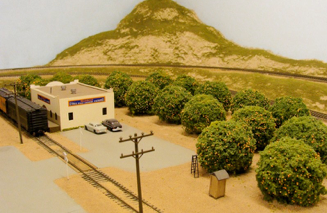
Southern Pacific Automobile Station in Los Angeles
In the photo archives at USC are two interesting photos of a "Southern Pacific Automobile Station", October, 1935. Said Automobile Station was captioned as being located at 8th & Alameda.
http://digarc.usc.edu/search/controller/view/chs-m30448.html?x=1237570792229
http://digarc.usc.edu/search/controller/view/chs-m1524.html?x=1237570792229
Eric Berman
It is a station for receiving autos and trucks that were shipped in box cars. Carloads of new autos were unloaded for the dealers or delivery companies to pick up and deliver to new car dealers. The dock could handle both side door and end door unloading. Considering the population of Los Angeles even in those days, the volume of new autos and trucks must have generated many daily shipments from the midwest assembly plants. As you can see from one of the pictures a new fire truck was being unloaded for one of the local fire departments. This structure was torn down in the 1970's.
Beet / Chip Loader
Sugar Beet Loaders
Not all beet loaders were alike; however, most shared many of the same features. All were owned by the companies or grower cooperatives who loaded sugar beets, not by the railroad. The structures made for an interesting operation, though only seasonal in nature given the sugar beet harvest etc.
Rob Sarberenyi
An A-frame hoist was used for tipping the wooden body of the beet trailer into the loader.
Locations
The sugar beet loaders varied somewhat based on their location. The "modern" 1940's-1960's era beet loaders, was found at either San Ardo or Sargent, Ca.
San Ardo Beet Loader
The San Ardo beet loader still exists. http://goo.gl/maps/FP47t
Lettering & Numbering
A Union Sugar sign was on that loader.
Reference
An article on modeling Californi'a's Surgar Beet Industry by John R. Signor, along with plans of the San Ardo beet loader, appears in the November 2008 issue of Railroad Model Craftsman. Also check the January 2009 issue of RMC, which had a reader's letter pointing out that a couple of key components of the San Ardo loader were absent in the plans (apparently, they weren't still around for Signor to see).
John Sweetser
There’s a complete article on the SP beet loader at San Ardo and on SP beet operations in general for Kalmbach Publishing.
Here's a picture of the one at San Ardo http://www.railpictures.net/viewphoto.php?id=92051&showexif=1
Here's a satellite image of the loader http://tinyurl.com/qysfydm
Drawings
There is a scale drawing of the San Ardo beet loader scaled from photographs in MR, 2009.
John R. Signor
Sargent Beet Loader
The beet loader at Sargent siding, was a few miles south of Gilroy. Most of that loader is still in place, though it does appear to have been vandalized for the wiring and some other metals. There was a cable pull fairly near the loader at Sargent to pull the gons past the loader.
Pat LaTorres http://byteboy.wordpress.com/2004/11/30/sugar-beet-loader-gilroy-ca/
There is an overhead shot of Sargent in action on page 200 or so of the Coastline Pictorial
Seely Beet Loader
There is a complete and intact beet loader in the Imperial Valley at the station of Seely. It is of essentially the same design only reversed. The tracks are still in at Seely.
\
Sucro Beet Loader
There is also a complete loader at Sucro west of Davis on the old CalP line. It is of a different design with a swing loader suspended by cables. The tracks are still in at Sucro.
John Signor
Reference
There is a big series of shots by an SP company photographer, negatives in the N-1672 series, all showing the 1948 beet rush. Several additional ones to this one are in my SP Freight Cars, Vol. 1, in John Signor's book, Coast Line, and in Pat Bray's article on the beet trains in Trainline issue 69.
Tony Thompson
Tony Thompson also has a blog about moving sugar beets from an earlier era
http://modelingthesp.blogspot.com/2011/04/racks-for-sugar-beets.html
More info and photos on moving sugar beets is posted on this site, along with links.
See a scan in the Miscellaneous folder in the Photos section for a beet loading prototype. The photo shows G-50-20 #57269 loading beets at Cooper, near Salinas. The Gon dates the picture to 1948 era.
http://finance.ph.groups.yahoo.com/group/Espee/photos/browse/5f6c
I currently have an article awaiting publication which details this process (as well as illustrating how to model a complete sugar beet complex from beet dump to outbound sugar loads, Beet pulp, and molasses). This is a follow-up article to the Oct. 2010 RMC article focusing on the actual American Crystal Sugar beet plant in Mason City, Iowa. Please feel free to contact me if you would like further info/pictures.
Richard Wehr
Modeling Sugar Beet Loaders
Clyde King scratchbuilt a sugar beet loader using Evergreen styrene. The model represents Union Sugar's San Ardo sugar beet loader as it appeared from approximately the 1960s to the mid-1990s. A nifty structure if you model the Coast or Central Valley routes in California. You’ll need is a siding or spur to handle some GS gondolas used in sugar beet service, either with or without side extensions depending on your era.
The structure's footprint is 16 1/2" long by 5 1/4" wide. The corrugated roof and siding material are from a Coca Cola can. He cut the material to size, heated the can and annealed the aluminum before pressing it onto Evergreen's corrugated plastic material to get the desired pattern.
Reference
Clyde's HO scale model is based on the article by John R. Signor titled "Modeling California's sugar beet industry", appearing in the November 2008 issue of Railroad Model Craftsman. The article includes drawings of the sugar beet loader at San Ardo, CA.
Mr. Signor's model does not include a scale house and a small sampling chute, both visible in the photos in the article and both readily added if one wished to do so.
Tony Thompson
Sugar Beet
The beets varied quite a bit from the ideal "elongated top" shape, bring very irregular & lumpy.Most were between about two & four lbs., about 10" to 16" long.
Sugar beets grown near our orchard in the Brentwood area, were covered with dark, almost black dirt. Beets that were much drier, were lighter in color.
Ken Clark
References
Sugar beet photos from the web:
Rob Simpson
Modeling Sugar Beets
Anise
Try Anise seeds glued in place with white glue. The smell goes away after a while. In natural color they look the best, but don't get them in plastic bags in the Mexican Food section of your local grocery store. These ones seem to have too long a "tail." Get 'em in jars. They are expensive but worth it.
John R. Signor
We have two large sugar beet processing plants on separate HO layouts. We've looked at several different seeds and settled on Anise seeds for 2 reasons: 1. they are the closest scale wise to actual sugar beets, and 2. many seeds have a small "tail" which resembles the root on the beet. They are easy to paint, using several different colors which serves three purposes:1. gives them the (slightly random) correct color, 2. masks the slight licorice smell of the beets, and 3. reduces the "food appeal" for small critters which may be around.
Richard Wehr
Bulgar Wheat
A different approach is to use bulgar wheat colored to a sugar beet color by mixing it with Bragdon Enterprises weathering powder. (The uncolored bulgar wheat is a much lighter color than sugar beets.)
Simply put the wheat and powder in a container and shake it. It doesn't take much powder to get a color similar to the anise seeds that John used.
Anise & Bulgar Wheat Combination
I use a mixture of about 30% anise seeds and 70% bulgur wheat. Put the anise seeds, bulgar wheat and a little dark brown weathering powder from Bragdon reddish-brown dry pigment into a jar with a lid and shake it to mix it all up. The color approximates the color of real beets. No need to add any liquid to "paint" the dry pigment to the seeds as the pigment adheres to the seeds and the wheat. The anise seeds and bulgar wheat provide a little variety in shape and the weathering powder makes the color a little darker. To me the darker color looks more like what I see in photos and what I recall from seeing loaded beet gons years ago. There's a photo of my sugar beets here: http://coastdaylight.com/mrr/1-11/sugar_beets.jpg
Jim Lancaster
I'm looking at a mix is that most seeds are too long or not triangular in shape, but a mix breaks up the uniform appearance. I plan to mix these with some steel cut rolled oats. The mix to knock a little more of the homogeneity of a single type of seed.
John Gillette
I have found the mix of seeds worked well for me.
Andrew Merriam
Fenugreek Seeds
I have made sugar beet loads with fenugreek seeds. These are used in the cuisines of the Middle East and India. They are naturally irregular in shape, just as are real beets, and are a good size. The ones I have used are a medium brown, probably a little dark for sugar beets.
Tony Thompson
Sorgham
The very best model beets was sorghum for HO scale. There are many varieties, but the right one really looks like miniature beets, and even has that grayish-tan color. A visit to a pet shop might be very interesting: just have a look at all kinds of birdseed and make your choice.
Loading Dock
Rail measurements
SP built a loading dock from the rails (center of track) about 6' from the track center line or more.
The California Public Utilities Commission standards for track clearances, for MANY years, required the track side face of a loading dock to be at least 7' - 6" from track centerline IF the deck was no more than 4' above top of rail. Above 4' the clearance requirement jumped to 8' - 6".
The whole thing changed if the track and deck were on a curve!
Stock Pen
A stock pen should have some size relation to expected shipments. Ordinarily about 25 cattle (typically weighing around 1000 pounds each) were loaded in a car, or 75 hogs in a single-deck car, or 240 sheep in a double-deck car. Needed pen capacity for these sizes of car loads is about 850 square feet per car.
Stock yards were located throughout the Coast Line. They included: Watsonville Jct., Salinas, Soledad, King City, San Ardo,
Paso Robles, Santa Margarita and San Luis Obispo to name a few.
There were a number of corrals turning up along the tracks - 10th Street in San Jose, 5th and Kirkham in Oakland, Harrison Street in Berkeley.
http://www.flickr.com/photos/47871268@N02/7319235520/in/set-72157630008483840/
Reference
For typical stock pen sizes and designs, with detail drawings of loading chutes and other details, may wish to look at Chapter 13 in John A. Droege’s book (Freight Terminals and Trains, McGraw-Hill, 1925; NMRA reprint, 1998). The chapter also contains detailed comments about stock handling by railroads.
Tony Thompson
Modeling Stock Pens
A.H.M Stock Pen Kit
Double the size of the pens in the old A.H.M stock pen kit to provide pens of this size. It’s easy to modify or scratchbuild pens with stripwood or styrene.
SP Cattle Ramp
There was a cattle loading ramp along the abandoned right of way parallel to the highway off location is Henry Mayo Drive (Highway 126) about 150 yards east of Potrero Canyon Road.
The SP served a stock yard at Newhall Ranch (about MP 444)that was listed as having a capacity of 4 carloads. In 1931 the station was called Castaic.
Cliff Prather
Below are links to view this site. Click on the "Birds Eye View" tab and enlarge the image by hitting the "+" button so see the ramp.
There’s an SP Cattle Ramp On the Fillmore (CA) Branch.
Page 5 of the March 2001 issue of The Ferroequinologist has two photos of the Coast Mail going through Gaviota in 1955, with the top photo showing a portion of the corrals there.
TOFC Ramps
These were used by Pacific Motor Transportation.
Stationary Ramp
It was just a concrete ramp where flats were spotted, then loaded circus style. These were "minor ramp locations," which were a simple but permanent ramp. They were located at Chico, El Centro, Santa Barbara, San Luis Obispo, San Jose, etc.
SLO Ramp
The SLO ramp was adjacent to the team track just east of the old freight station (north of the north end of the freight house platform).
Tony Thompson
Santa Barbara Ramp
The Santa Barbara ramp is just east of Santa Barbara Street mountain side of the tracks. It is hard to see as this is now a storage yard. This was the site of the freight station in Santa Barbara and the ramp was just behind it. Neither are functional as TOFC ramps any more.
Bruce Morden
Modeling TOFC Ramp (Stationary)
Reference
Trailer Ramp LA Ca. - Plans & Scratchbuilding Railroad Model Craftsman Apr. 1988
Trailer Ramp Model Railroader Feb 1990
Ramp - Freight House Railroad Model CraftsmanJun 1952
Portable TOFC Ramp
Portable TOFC ramps were used for TOFC service at several locations including: San Luis Obispo, San Diego, Santa Barbara, etc.
Reference
Trainline #108, pg. 24
Modeling TOFC Ramp (Portable)



Photo and Model by Ryan Dora