Southern Pacific Lines
Coast Line Division
“The Route of the Octopus”
Southern Pacific Lines
Coast Line Division
“The Route of the Octopus”
S.P. Locomotive Support
Engine House
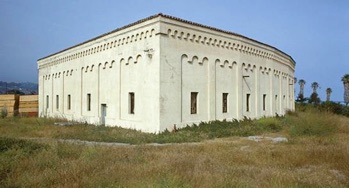
Indio Engine House
The Mojave and Indio engine houses basically had the same design but there were differences. The west wall of the Indio engine house had only wood louvers. The lower portion of the east wall of the Indio engine house was open.
Reference
Photos that show the Indio engine house in steam days can be found on pgs.50-51 of Dill's "Southern Pacific's Sunset Route" and pg. 115 of Signor's "Beaumont Hill." By the way, the bottom photo on pg. 115 of the latter book was actually taken at Mojave, not Indio.
John Sweetser
Drawings
There is a plan supposedly in the Shasta Division Archives labeled "MWD 1411 Not dated Engine and boiler house at Indio."
Mojave Engine House
The Mojave and Indio engine houses basically had the same design but there were differences. The east wall of the Mojave engine house had both glass windows and wood louvers. Also, the lower portion of the east wall of the Mojave engine house was brick for about 5 1/2 feet high.
Be aware that Mojave wasn't built exactly as the plans in "Southern Pacific Lines Common Standard Plans, Vol. 2" indicate. Mojave never had a row of glass windows starting about 19 feet above the ground; wood louvers were used instead for that row.
A 1960s photo showing the corresponding west wall of Mojave can be found on pg. 98 of Dill's "Southern Pacific's San Joaquin Valley Line" (the machine shop wall originally had glass windows for its full length, not partly filled in with wood like later).
John Sweetser
Reference
The bottom photo in Dill's "Southern Pacific's Sunset Route" pg. 115, was actually taken at Mojave, not Indio.
Roundhouse
There were several different types of roundhouses. Dunsmuir, San Jose. There were three or four boilermakers. They mostly did light repairs on locomotives.
An important point to make is that by 1919, according to the roundhouse data tables on pg. 30-31 of "Southern Pacific Lines Common Standard Plans, Vol. 5," there were only three wooden roundhouses on the Pacific lines that had stall lengths close to or at 72 feet - those at Port Costa, Hornbrook and Colton. In other words, no similar roundhouses existed in Oregon, at least not in 1919 and after.
John Sweetser
Though shorter than the Port Costa, Hornbrook and Colton roundhouses, the majority of the wooden roundhouses the SP erected in the 1870s had similar architectural features to them - mainly, the four tall, narrow windows each three panes wide on the end walls and one similar window at the back of each stall. Siding was either board and batten or rustic (horizontal boards that interlocked).
John Sweetser
Details
Smokestacks
Several pictures of the Taylor house and the old Colton house show a pyramid shaped triangular cross-section structure where smoke jacks would normally be mounted. These were on a number of roundhouses across the system, instead of individual smoke jacks on each stall.
The smoke outlets did vary from place to place (possibly era to era), so that might be left to the modeler, and the presence or absence of doors also varied, doubtless with climate.
Tony Thompson
Oil Delivery to the Roundhouse
SP got C oil to the large oil storage tanks at the roundhouse from tank cars, or a pipe line from an oil refinery. There were cases with pipeline delivery (Taylor) and with tank car delivery (Dunsmuir, San Luis Obispo). No doubt there are lots of other examples of each.
Tony Thompson
Look at Trainline #85: http://www.sphtsstore.org/servlet/the-65/Trainline-Issue-085--dsh-/Detail
The article titled "The Great Transformation: Coal to Oil on the Southern Pacific" includes information on how SP distributed oil through the system.
Arved
In an old "Railroad Magazines" from the early 1940's there is an article about Espee oil burners and how they are supplied. Of interest was a photo showing cars on the "sump track" having heating coils lowered into the domes to help liquify the oil. It was emptied out the bottom into a trough between the rails and then pumped into storage tanks.
Dave Yingst
That was also covered in the SP Bulletin during WW II. Such photos are in my book about SP tank cars, Vol. 5 of SP Freight Cars. Usually the bottom outlet of the car was connected to an unloading hose, but the sump method was used in a few places.
Tony Thompson
The Calif. State RR Museum Library has plans for fuel oil plants at Gerber plus many locations on the Coast Division. The plans are mostly just one sheet each so they would not be detailed construction plans. In addition, there are plans identified as:
1913 Trough for fuel oil unloading
1919 Auxiliary oil heating and fuel oil plant
1908 Fuel oil unloader
John Sweetser
Roof Vents
Some roundhouses had triangular-shaped vents that were used on numerous SP roundhouses. Photos show that the triangular-shaped vents on the Gerber engine house were just like the ones on the Bakersfield, Brooklyn, Colton, Sacramento, Taylor and Tucson roundhouses (and probably numerous other ones on the SP). It's highly unlikely any of these vents were made from old engine house doors.
It's evident in numerous photos that the front panels of the vents were comprised of a light-colored corrugated material. The sides of the vents appear to be of the same light-colored material. Because of the angles most photos were shot at, it's been difficult to determine if the sides were also corrugated but I was able to find two photographs showing corrugated side panels:
- Bottom photo on pg. 113 of "Chasing the SP in California, 1953-1956" showing such a vent on the metal-clad extension on
the back of the Alhambra Ave. roundhouse in Los Angeles.
- 1949 photo of the Gerber engine house on pg. 72 of the 1981 History West book, "Shasta Route" (a magnifying glass helps a
lot for this photo).
- Trainline #21
John Sweetser
Paint
Roundhouses and shop buildings
Woodwork is "mineral," not Light Brown.
Photos indicate that buildings that were painted mineral red with black trim usually had white window sashes, not black.
There are a lot more color photos in publications that show shop buildings painted mineral red with black trim than of shop buildings painted black with mineral red trim. In contrast, shop buildings with a body color of mineral red were widely found on the SP, including the locations of Colton, Mojave, Bakersfield, Fresno, Tracy, West Oakland, San Jose, Port Costa, Roseburg and Eugene (Roseburg had a roundhouse with corrugated steel walls painted mineral red). The preceding discussion pertains to roundhouses and shop buildings that had walls of wood or corrugated steel.
John Sweetser
Roof
Typical green roof of SP Buildings.
Alhambra Ave. Roundhouse
The Alhambra Ave. roundhouse had the same basic design as the roundhouses at San Jose, Tracy and Bakersfield. There were some differences such as the top fronts of the some of the stalls and the tops of the end walls (for photo showing the latter, see pg.126 of Dill's "Southern Pacific's San Joaquin Valley Line."
A photo on pg. 80 of "The Southern Pacific in L.A." shows the back of the roundhouse. The back wall is higher than the back walls on the similar San Jose, Tracy and Bakersfield roundhouses. Also, the tops of the two end walls not only are different from the other roundhouses mentioned, but are higher also (a high end wall can be seen in the photo on the bottom of pg. 11 of Dill's "Southern Pacific's Sunset Route").
Note the panels on the roof of the roundhouse above the back of each stall in the photo on pg. 80. The panels can also be seen in the aerial photo on pg. 69 of "The Southern Pacific in L.A.."
The stalls in the Alhambra Ave. roundhouse were 78 feet long.
John Sweetser
A portion of the blacksmith shop can be seen on the right side of the top photo on pg. 77 of "The Southern Pacific in Los Angeles." A photo showing the machine shop before the erecting shop was added to it in 1923 is on the bottom of that page.
References
Useful photos of the roundhouse are on pg. 126 of The Coast Line book.
Photographs of San Jose, Tracy and Bakersfield roundhouses (for example, two Tracy photos on p. 131 of Signor's Western Division book) would be helpful in modeling Alhambra Ave.
.
The following B&W movies from the early 1930's, each contain a number of live-action exterior and interior scenes at/around the Alhambra Shops (both are available in VHS and DVD formats).
(1) "The Phantom Express"
(2) "The Steel Highway"
Eric Berman
Bakersfield Roundhouse
Its east end was open. It was actually opened sometime between 1937 and 1944 when a second lead was added through what had been stall 8, joining an existing lead through stall 9. This left the roundhouse in two non-connected sections. The second lead was added due to wartime demands (for a 1937 aerial view of the Bakersfield roundhouse showing its original fully-enclosed configuration with just one lead running through the back wall, see pg. 24 of SP Trainline No. 20 or pg. 16 of SP Trainline No. 102).
The seven stalls that were cut off with construction of the second lead weren't later "victims of the 1952 Tehachapi earthquake" as was claimed in the article about Bakersfield in Trainline 102 since photos taken up to at least 1954 show the stalls intact. The roundhouse structure for those stalls was eventually removed, however, leaving just their tracks in place (this probably happened between 1954 and 1956). The seven stall tracks lasted until late 1956 or early 1957, replaced by leads going to a new diesel servicing facility.
John Sweetser
Bayshore Roundhouse
Bayshore Roundhouse was brick. The 2 easternmost bays of the roundhouse were an enclosed shop- for painting. The door of bay 2 slides over the front of bay 1. Bay 1 had the original doors attached, with a window cut into each one. In the mid '90s, only the sliding door was intact. There might have been a man-door cut into the right hand door with a small window.
J.R. Boye
http://en.wikipedia.org/wiki/File:Southern_Pacific_Railroad_Bayshore_Roundhouse.jpg
http://www.railroadforums.com/photos/data/505/Close-up_of_SP_Bayshore_Roundhouse_Sized.jpg
Brooklyn Roundhouse (Portland, OR)
http://www.davehonan.com/2006/05/brooklyn-roundhouse-portland-or-05-21-06-l.jpg
Colton Roundhouse
This was a 5-stall version of the Colton roundhouse. The stall length was 72 feet. At Colton, the windows on the north and south end walls were originally like those of Port Costa and Hornbrook. Photos indicate that these roundhouses had the basic design featuring four tall, narrow windows each three panes wide on the roundhouse end walls and one similar window at the back of each of the stalls. At some point, the Colton roundhouse was reduced in size from six to five stalls, the windows on the north wall were shortened as seen in photos in the article about the Colton roundhouse in the Summer 2003 SP Trainline.
John Sweetser
The roundhouse had triangular-shaped vents that were used on numerous SP roundhouses. Good views of similar vents on the can be found in the article about that roundhouse in the Summer 2003 SP Trainline (issue No. 76). A photo of the Colton roundhouse in Southern Pacific's Sunset Route, pg. 34 gives an idea of the length of these vents compared to their height.
John Sweetser
References
SP Trainline, Summer 2003 (issue No. 76)
Southern Pacific's Sunset Route
Drawings
One or more of the following Colton station plans in the collection of the Calif. State RR Museum Library will show the footprint dimensions of the Colton roundhouse. Copies can be ordered (it is often advisable to get as many different station plans for a location as possible. Sometimes one station plan might inexplicably leave out information that another station plan includes):
Southern Pacific. 60005 Valuation Section: V 3 / S 14 c. Mar. 2, 1955 Station map, Colton : lands, tracks and structures, from station 4159 to station 4214. Scale 1:100. Blue line on white paper. Filing location:Box 50 + D ID 21001
Southern Pacific. Not numbered May 1932 / Feb. 1943. Station plan of Colton. Scale 1:100. Ink on linen; black line on white paper. Filing location:Box 669 (XX) + D ID 20784
Southern Pacific. Not numbered (sheet 1) Apr. 1966 / May 22, 1972. Station plan of Colton. Scale 1:100. Blue line on white paper. Filing location:Box 50 + D ID 57324
Southern Pacific. Not numbered (sheet 2) Mar. 1966 / May 22, 1972. Station plan of Colton. Scale 1:100. Blue line on white paper. Filing location:Box 50 + D ID 20984
Reference
See the three-page article about the Colton roundhouse in the Summer 2003 SP Trainline. A photo showing the original configuration of the north windows can be found on the bottom of pg. 30 of "Beaumont Hill".
John Sweetser
Hornbrook Roundhouse
The Hornbrook roundhouse was completed in late 1887 or early 1888 (the Nov. 25, 1887 Ashland Tidings reported that erection of a roundhouse at Hornbrook was to commence shortly). The stall length of the Hornbrook roundhouse was 72'. Photos indicate that these roundhouses had the basic design featuring four tall, narrow windows each three panes wide on the roundhouse end walls and one similar window at the back of each of the stalls.
John Sweetser
Reference
A photo that shows the Hornbrook roundhouse can be found on pg. 21 of Signor's "Rails in the Shadow of Mt. Shasta;" a partial view can be found on pg. 76 of "Southern Pacific's Shasta Division".
Indio Roundhouse
Two short ladders that went from the machine shop roof to the main roof. Similar ladders that were on the roof of the Mojave engine house.
Roof Vents
The roof vents of the Indio roundhouse appear to be similar to one seen in the right side of the photo on pg. 80 of Signor's Donner Pass book showing the roof of roundhouse #1 at Roseville. If so, each vent at Indio would have had two straight sides and two half-round ends. The main difference between the Indio vents and the Roseville vent is that the latter is taller.
The Indio vents also appear to be similar to ones that were on the Bakersfield roundhouse. Page 14 of the Winter 2010 SP Trainline has a photo that shows how the Bakersfield vents were fastened to the roundhouse roof. Each vent base appears to have had small, triangular-shaped metal braces sloping about 45 degrees, three braces on each of the flat sides and one brace at each of the half-round ends.
The next photo over from that one shows how the caps over the vents were attached. Indio appears a bit different though with the supports for the caps apparently flaring out.
The roof vents on the Mojave engine house were 42 inches long, 26 inches wide and 4 feet high. The ones on the Indio engine house were probably similar. There were no small triangular braces at the base of the vents like Bakersfield had but rather collars at the bases. The collars were but no more than 6 inches high.
John Sweetser
Reference
Photos in John R. Signor's book "Beaumont Hill: Southern Pacific's Southern California Gateway"
Modeling SP Roundhouse (Indio)
Clyde King Scratchbuild
Port Costa Roundhouse
There was a roundhouse at Port Costa as least as early as 1887 (mentioned in the Aug. 6, 1887 Stockton Daily Independent). The roundhouse data in the Common Standard Plans book indicates that the Port Costa and Colton roundhouses were built in 1901 and 1904 respectively. The stall length of the Port Costa roundhouse was 71' 7". Photos indicate that these roundhouses had the basic design featuring four tall, narrow windows each three panes wide on the roundhouse end walls and one similar window at the back of each of the stalls. The Port Costa roundhouse had a clerestory while the others didn't, a later addition. A photo on pg. 23 of "Southern Pacific's Colorful Shasta Route" plus a number of other photos clearly show that there were four windows.
John Sweetser
Modeling SP Roundhouse (Port Costa)
Banta Modelworks
Banta Port Costa Roundhouse Kit is a standard SP design (i.e. similar structures built at other locations). The Banta Modelworks' model of the Port Costa roundhouse on its website has just three windows on the right end wall.
John Sweetser
Roseville Roundhouse
Roseville had TWO roundhouses and they didn't have similar designs.
Roseville Roundhouse #1
It was built in 1906 or 1907.
Roseville Roundhouse #2
The one was built in 1914 had a stall length of 121 feet, nine stalls and accommodated cab-aheads. It had an extension on the back. The extension can be seen above the cab-ahead's tender in the middle photo on pg. 36 of Dill's "Southern Pacific's Colorful Shasta Route" and on the far left of the top photo on pg. 45 of his "Southern Pacific's Historic Overland Route" book. Both photos show the end wall in the southwest quadrant of the roundhouse. Note in the photo on pg. 45 of the Overland Route book that the front of the extension is higher than the roof line at the back of the regular part of the roundhouse. If one looks carefully at the aerial photo of the two Roseville roundhouses on pg. 143 of Church's "Cab-Foward," this ridge can be seen on the roof of roundhouse No. 2.
John Sweetser
In the aerial photo on pg. 143 of "Cab-Foward," the back of nine stalls of roundhouse No. 2 at Roseville apparently had the triangular-shaped vents that were used on numerous SP roundhouses, including Bakersfield and Taylor Yard. A photo showing such a vent on the Bakersfield roundhouse can be found about three-quarters way through Don Ball, Jr's. book, "Rails". The photo with the vent is a closer view than usually seen).
John Sweetser
Regarding the clerestory on the roundhouse roof, the arrangement of such in the northeast quadrant of the roundhouse was rather unusual. See bottom photo on pg. 44 of "Southern Pacific's Historic Overland Route" and the aerial photo in "Cab-Foward."
(when I mention the "southwest quadrant" and the "northeast quadrant" of the roundhouse, for orientation, refer to the map of Roseville yard on pgs. 74-75 of Signor's Donner Pass book).
John Sweetser
Reference
Roundhouse data table: Southern Pacific Lines Common Standard Plans, Vol. 5, pgs. 30-31
Drawings
Here are pertinent plans at the Calif. State RR Museum Library:
Southern Pacific. MWD 31 / 1 Jun. 1906 / Jul. 22, 1907. Roseville: 85 foot standard roundhouse, ground and roof plan and details. 24 x 36 White line on blue paper; blue line on white paper (4 copies) Fragile / torn. Filing location:+ D ID 10016
Southern Pacific. MWD 31 / 2 Jul. 1906 Roseville: 85 foot standard roundhouse, part elevation and part framing of end wall, section and details of windows. 24 x 36 White line on blue paper (2 copies) Fragile / Torn. Filing location:+ D ID 10017
Southern Pacific. MWD 31 / 3 Jul. 1906 / Jul. 22, 1907. Roseville: 85-foot standard roundhouse, plan, elevation and framing of rear wall of one stall and elevation and section of firewall; elevation and section through front door. 24 x 36 White line on blue paper; blue line on white paper. Filing
location:+ D ID 10018
Southern Pacific. MWD 31 / 4 Not dated / Jul. 22, 1907. Roseville: 85-foot standard roundhouse, ground plan and foundation details. 24 x 36 White line on blue paper (4 copies) Fragile / Torn. Filing location:+ D ID 10019
Southern Pacific. Not numbered Sep. 18, 1906 Roseville: brick roundhouse, partial foundation plan. 20 x 33 White line on blue paper Fragile / torn. ID 10014
Southern Pacific. Not numbered Jan. 13, 1914 Roseville: second roundhouse, sketch showing method of framing at backwall of existing 85-foot roundhouse; [2 copies plus one of unidentified beam structure]. 13 x 17 White line on blue paper. Filing location:Filed with SP MWD 31 ID 10012
Southern Pacific. Sac Z 140 U Aug. 1914 Roseville: proposed wall, second roundhouse. 22 x 30 White line on blue paper Fragile / torn. Filing location:Filed with SP MWD 31 + D ID 10015
Southern Pacific. Sacramento Division [not numbered] / 10001 A Dec. 1935 Roseville: replace wood floor with concrete in roundhouse No. 2. 9 x 13 White line on blue paper. Filing location:Box 73 ID 28804
San Jose Roundhouse (Lenzen)
The interior framing of the San Jose roundhouse was wood.
There are numerous photographs on the 'net of the similar San Jose roundhouse. One of the better photos that shows an end wall is at: http://www.railpictures.net/viewphoto.php?id=181957&nseq=7
http://www.calcoastrails.com/cgi/photo_show.php?id=1152
http://www.rrpicturearchives.net/pictures%5C66438%5CSan%20Jose%20June1988-0003.jpg
Paint
Interior Paint
Some think SP’s San Jose roundhouse was painted green on the inside. There is no discernible green paint on the walls in the 1982 photo of the interior of the San Jose roundhouse found on pg. 50 of the August 1982 Railroad Model Craftsman. The walls look more like the bricks have been left unpainted. If the walls were in fact green, they would have been heavily weathered in the RMC photo. The portion of the walls under the windows in the RMC photo has been painted white and there is a black stripe at the top of the white band. This was a common painting practice for brick SP roundhouses. The white band on the interior of roundhouses was maybe 4' 8" to maybe 5' 6" wide - it all depends on where the bottom of the windows were. For some roundhouses, such as Bakersfield, both the inside and the outside of the buildings were painted this way. Several interior photos differ from each other. You will need specific info for a particular roundhouse.
Reference
A photo showing the back wall of the San Jose roundhouse can be found on pg. 70 of the Feb./March 1997 issue of Finescale Railroader. For a photocopy of the page, check with the Calif. State RR Museum Library of the NMRA's Kalmbach Memorial Library.
Drawings
Plans of the San Jose roundhouse have been made by the Calif. Trolley & Railroad Corporation, the group that dismantled that roundhouse in hopes of rebuilding it someday for a railroad display. They have a website.
Modeling SP Roundhouse (Bayshore, San Jose, ...)
Korber
SP roundhouses do not look anything like the O scale Korber.
SLO Roundhouse
Roundhouse, turntable and other facilities completed in 1894. The roundhouse was included on air navigation maps in the early years of aviation.
The brick for the roundhouse came from San Jose. A wooden end wall was on the left. The San Luis Obispo roundhouse had three windows on the other brick end wall and one window at the back of each stall. These arched window tops were on the back wall. However, it appears that the front of the stalls of the SLO roundhouse had taller openings than Fresno. SLO had a clerestory. It had a metal SP medallion on top center of wall. SLO did not have doors. To accommodate larger power such as GSs, the brickwork at the front of five stalls at SLO was knocked open.
The stalls were numbered 1 through 10. The light smaller power engines were positioned on the right, larger on the left. (In this instance, a 2-10-2 is in stall 10.) Stall 11 & 12 was used for the machine shop. Often a stall or two had machine-shop equipment if there was no local shop (true at SLO). The roundhouse was to get more stalls. At SLO, about half the tracks had the long pits, and a few short pits.
The roundhouse also had garden tracks. 2-10-2 were positioned on the garden tracks. The locker room building by roundhouse was in the back left.
The roundhouse, turntable and coal arrangements were 4 to 5 feet lower than the rest of the yard. Cars would pitch down quite a steep grade to reach the turntable and coaling outfit.
The roundhouse was dismantled by Bert Metal Company in 1959.
SLO Roundhouse Foreman’s Office
The Roundhouse foreman’s office and crew caller’s office was a squarish building right north of the turntable. It was in no records, no AFE, no blueprints. It was like a lot of things on the railroad, you go out and liberate some materials, do a little work, first thing you know you have a building. Kermit Morgan was the roundhouse foreman in the 50’s.
Mac Gaddis
SLO Locker Room
There was a locker room there, just north of the roundhouse, where the roundhouse foreman’s office was.
Santa Barbara Roundhouse
1927
The Santa Barbara roundhouse was built as a replacement for an earlier one destroyed by the June 29, 1925 earthquake. Completed in 1927, it serviced SP past the end of steam in 1956 to about 1960 or so.
Bruce Morden
1948
During the 1948 date, most of the businesses on 1930 Sanborn maps were all getting rail traffic. The engine facility including the roundhouse was in active service and the yard's 8 or 9 tracks were in use. The Santa Barbara Roundhouse turntable in the latter years turned TOFC flats on it.
Jim Baker
1960
The turntable was removed in 1960 or 1961.
Bruce Morden
1972
The 1972 aerial photo image shows the roundhouse lead was still there (with the turntable gone Scroll L and R through adjacent images traces can be seen of former shippers. http://www.californiacoastline.org/cgibin/image.cgi?image=7232040&mode=big&lastmode=sequential&flags=0&year=1972
They had filled in the pit and ran a single track into the building for a while). Interestingly the structure seems to have had more facade detail then.
1979
The roundhouse was at Cabrillo and Calle Puerto Vallarta. The roundhouse was replaced by Fess Parker's hotel (Red Lion or Double Tree, depending on date). The round portico is on the roundhouse site. See the 1979 aerial photo showing the roundhouse and an SP diesel on a track behind and parallel to the main.
The roundhouse building was demolished in September 1982.
Bruce Morden
2010
Compare that to this September 2010 photo of the same location <http://www.californiacoastline.org/cgibin/timecompare.cgi?image=201000731&latdeg=34.410358&longdeg=119.675218&flags=0&year=current&hidden=0&oneimage=1979/7945025-current/201000731-
The turntable was used as a lumber yard for at least 10 years. You can see some piles of lumber in the 1979 photo above but clearly no turntable.
Bruce Morden
Taylor Yard Roundhouse
There was a 7-stall version of the Taylor Yard Roundhouse, based on plans and B&W photos. It appears to be of poured concrete construction.
Bob Poole
Taylor Yard apparently had the triangular-shaped vents that were used on numerous SP roundhouses Two photos showing such vents on the Taylor Yard roundhouse can be found on pg. 124 of Dill's "Southern Pacific's San Joaquin Valley Line."
John Sweetser
Reference
Drawing
See: Common Standard Plans Volume 5.
Paint
The exterior of the walls were unpainted, just the natural concrete color.
See photos on pg. 124 of Dill's "Southern Pacific's San Joaquin Line."
Notice in the photos how much dirtier the wall on the right was in steam days.
John Sweetser
Interior Paint
Interior walls were probably unpainted also but no doubt heavily coated with soot during the steam era.
Interior posts were painted white to 5 or 6 feet above the ground, at least in some photos.
John Sweetser
Roundhouse Boiler House
The boiler house was to supply steam all over the roundhouse area. There almost certainly was a boiler house, needed to heat the oil. Even helper stations had boiler houses, such as seen at Saugus in the following photo (the boiler house may have also served as a pump house for the water facilities at Saugus):
John Sweetser
Paint
The normal color for corrugated iron or wooden buildings used in conjunction with engine servicing was mineral red (not the same shade as used on SP freight cars as some peoples here would have you believe). Corrugated iron or wood shingle roofs on such buildings would have been painted green.
John Sweetser
Reference
The Shasta Division Archives supposedly has the following plan according to the Calif. State RR Museum Library (on the SP, a boiler house and a power house are the same thing):
Southern Pacific. MWD 165 Not dated Power house, Roseville. Filing location:Information about this drawing is from a SP drawing index (Architectural Department, Southern Pacific Company, MWD) in the collection of SP Shasta Division Archives, Dunsmuir). CSRM does not have a copy of this drawing. ID 22363. Contact people for the Shasta Div. Archives would be John Signor or Bruce Petty (Petty can be contacted thru his Los Angeles River Railroads website).
John Sweetser
The SP Common Standards Plan book, vol. 2, has MWD 8407 drawings and picture. Along with a 15 HP oil engine and supplying steam to the roundhouse, it had a large Fuel Oil steam pump.
Bruce Petty
Modeling Roundhouse Boiler House
AL&W Lines
AL&W Lines has an excellent HO scale kit based on these plans. This is a laser cut kit with both wood and styrene components. The walls are corrugated with scribe lines marking the individual panels.
Scroll to the very bottom of the pictures at: alwlines.com
Larry Castle
SLO Boiler House
The SLO facility had a round house power station. The boiler was a on the side of the roundhouse.
Drawings
The Calif. State RR Museum Library has a 1918 San Luis Obispo plan titled "Enlarge boiler house" and the Shasta Division Archives in Dunsmuir has two San Luis Obispo plans, MWD 1532 and MWD 1779, that are titled "Boiler house"
(View via the Calif. State RR Museum Library's website).
John Sweetser
Contact person for the Shasta Division Archives is Bruce Petty, who can be reached via his Los Angeles River Railroads website.
Surf Boiler House
The map of Surf on pg. 129 of the Coast Line book shows an "oil pump house" separate from the power house/boiler house.
Paint
The boiler house at Surf was apparently painted Colonial Yellow but in yards, the normal color for corrugated iron or wooden buildings used in conjunction with engine servicing was mineral red.
John Sweetser
Turntables
Locations of Turntables
Location Year Length Notes
Roseburg 100’
Ashland 100’
Siskiyou 100’
Tracy 1942 110’ 3-point
Dunsmuir 1939 126’ replacement, 3-point
Yuma 100’
El Paso 1939 126’ 3-point
Tucson 1946 126’ 3-point
Roseville Roundhouse #1 1943 100’
Roseville Roundhouse #21928 120’ 3-point, deck plate girder table
Mission Bay 100’
Bayshore 110’ had garden tracks to accommodate Cab-Forwards (*see MR 10/95, pg. 26)
Oakland 1926 70’ 1 stall track went right through roundhouse and out back wall used for long locos
Santa Barbara removed in 1960 or 1961
San Luis Obispo1923 105’ replaced with steel turntable bridge, removed 1988, (*see MM 3/93, pg. 31)
Taylor Yard, L.A. (*see MR 10/95, pg. 26)
Alhambra, L.A. 126’ replacement, 3-point
Hearne Junction still at work as of September 1996
Colton 1905 80‘ steel deck
Pony Truss Type Turntables
They were a Southern Pacific Common Standard. The SP turntables were at San Luis Obispo, Klamath Falls, Siskiyou summit, Ashland OR and one of the two at Bay shore was a pony truss.
Reference for Pony Truss Turntables
100 foot Pony Truss turntable Mainline Modeler March 1993, page 31 History + Plans
Southern Pacific Lines Common Standard Plans Volume 1 -
100 foot Pony Truss turntable - page 38 truss detail,
100 foot Pony Truss turntable - page 39 floor beams, stringer and wheel detail
100 foot Pony Truss turntable - page 40 center casting detail,
100 foot Pony Truss turntable - page 41 turntable pit detail.
Lamps on Turntables
In a number of steam ear shots of both the San Luis Obispo and Bay Shore turntables show what looks like switch stand lamps or even caboose markers on the ends of the turntable truss work.
(See Signor and Thompson's Coast Line Pictorial pgs: 28, 162, 163 & 164).
Power Cables to Turntables
Power was supplied to a turntable directly via overhead wires to the “power arch”. Power wires to the power arch appear to have a similar arrangement for most turntables. Maybe 10 feet beyond the center of the arch, the three wires (which presumably are the power wires), are either bundled or connected into one wire or cable. There are photos that indicate the existence of stabilizing cables to the top of the arch on the other side of the power arch that are opposite the above mentioned three wires.
Richard Brennan
Alhambra Ave. Turntable
The roundhouse had a 126-foot turntable of the same design as the existing turntable at Dunsmuir.
Bayshore Turntable
The turntable pit show a wooden walkway around the perimeter only where tracks were located. A circular emblem was on the side of the turntable shed, one of SP's safety slogans.
Paint
The turntable was painted silver and it became dark from decades of dirt and grime. The turntable control booth was painted white, but later on it was painted either a SP orange, or a red color.
Reference
Color photos of the entire Bayshore Roundhouse area in 1976 exist, You can find Pete Hall’s collection of about 40 photos on Richard Percy's website.
Colton Turntable
The CSRM library has the following detail plans for the 80-foot turntable:
Southern Pacific. MW 34002 / 2 Apr. 1905 Common standard 80 foot steel deck turntable: details of transverse girder and wheel strut: turntable 509, Colton. Blue line on white paper. ID 53997
Southern Pacific. MW 34003 / 3 Apr. 1905 Common standard 80 foot steel deck turntable: detail of center bearing, turntable 509, Colton. Blue line on white paper. ID 54000
Reference
See the three-page article about the Colton roundhouse & turntable in the Summer 2003 SP Trainline.
John Sweetser
Houston Turntable
Reference
Photos were taken in the early to mid-90's.
http://www.flickr.com//photos/mop3115/sets/72157631837576684/show/
http://www.flickr.com/photos/mop3115/sets/72157631837576684/detail/
Randy Keller
Roseville Turntable
At Roseville, power cables come to the turntable from a power pole at the edge. A photo on the bottom of pg. 44 of Dill's "Southern Pacific's Historic Overland Route," shows three wires to the power arch of the Roseville turntable that most likely came from the wooden utility pole seen on the right.
At Roseville, note the turnbuckle-like device on this wire. This turnbuckle-like device is in addition to the two seen in the photo on pg. 109 of "Shasta Route").
John Sweetser
The best photo of this is the Fred Stindt photo of an SD45 on the turntable on pg. 109 of the History West book "Shasta Route."
Taylor Turntable
Another helpful photo is the one of the Taylor roundhouse turntable on pg. 92 of "Those Daylight 4-8-4's." The Taylor turntable was 120 feet in length, just like at Roseville, and the
Unlike Roseville, the Taylor roundhouse photo shows the entire pole that the three wires run from.
Reference
Turntable SLO & Sander Trainline (T-22/10)
Turntable - 100ft NMRA Bulletin Aug 1970
Turntable - Gallows Railroad Model Craftsman Nov 1958